Jump to a question in this guide
- How does a pressure washer add to an ordinary water supply?
- What must reach the pump before it can deliver water?
- How do motor movement and pump valves create a discharge?
- Why do pressure and flow need different numbers?
- What changes when the trigger is released?
- How does the nozzle change the outgoing stream?
- Why must the target be understood as an assembly?
- Where do cleaning agents enter, and where does the water go afterwards?
- How do water and electricity create separate safety boundaries?
- What can an ordinary weak or pulsing result mean?
- Why do cold weather and storage history matter?
- What should a repair or replacement assessment return?
- Why does the exact model matter for a recall enquiry?
- How would a fictional owner compare a pump quote with a supply finding?
- The supply delivers water, the motor drives the pump and the nozzle shapes the outgoing stream.
- Quiet standby, stored hose pressure and a protective stop are different states.
- Maximum and rated pressure/flow values can describe different conditions.
- A working jet does not establish a suitable target, protected supply or permitted receiving-water route.
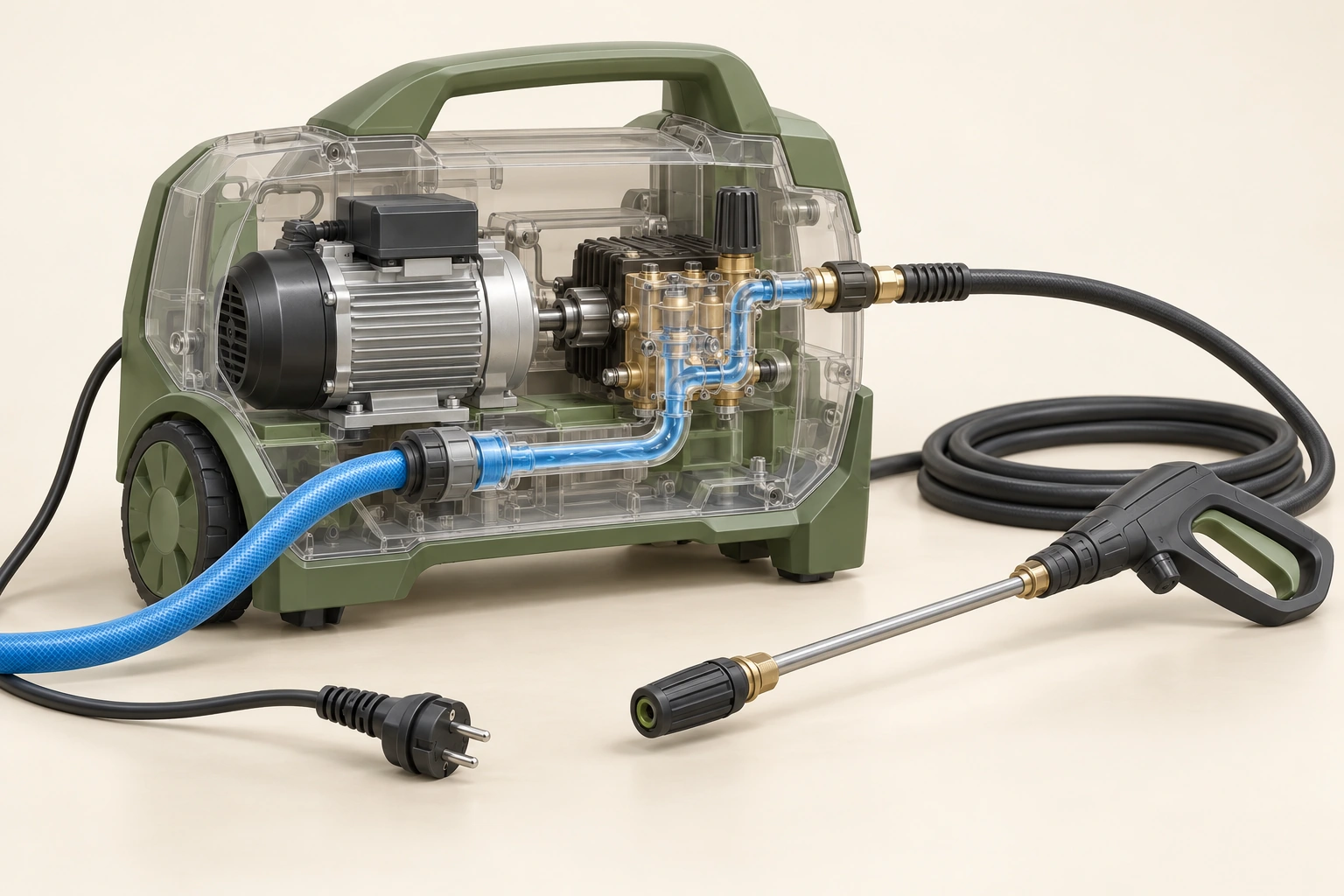
The garden supply reaches the conceptual pump beside its driving motor, while a separate pressure hose and gun show the outward equipment. The complete functional route is traced in the native diagram.
About this illustration
The pressure hose leaves the frame and its gun connection is not fully visible. The pictured plug is conceptual and is not Canadian electrical approval or a safe installed arrangement. This is a conceptual teaching model, not an assessment of your home.
8 picture lessons appear beside the questions in this guide. Use them to understand the explanation, then consider what it means for your home.
How does a pressure washer add to an ordinary water supply?
A household pressure washer takes supplied water, adds mechanical energy through a driven pump and sends it through an identified high-pressure hose, trigger gun, lance and nozzle. The garden supply hose and the discharge hose do different jobs. The motor drives the pump; the nozzle shapes the outgoing stream. A strong-looking jet is the result of several parts working together, not a direct reading of household tap pressure.
The guide follows electric cold-water equipment, with named manufacturer examples used to make the mechanism concrete. A gasoline engine introduces combustion and fuel questions that an electric model does not have. CCOHS warns against gasoline-powered equipment in buildings or enclosed spaces because of carbon monoxide. Changing the drive source does not remove the high-pressure injection, hose and receiving-surface hazards.
A high-pressure jet can penetrate skin and cause severe injury. Never point it at yourself, other people, animals or electrical equipment, and never use a hand to look for a leak. Seek urgent medical help for a suspected injection injury and state that high-pressure equipment was involved. Smoke, electric shock, uncontrolled leakage or equipment damage changes the response from an ordinary cleaning question to a safety issue.
Here the new owner question is the complete powered cleaning route and its controls. The drinking-water backflow guide owns supply protection; the wall, roof and deck guides own their assemblies and condition. Those links matter because a washer can be working while the connection, target material or receiving-water arrangement is unsuitable. This lesson does not authorize use on a particular surface or supply.
Supply, motor and discharge are separate parts
The garden supply reaches the conceptual pump beside its driving motor, while a separate pressure hose and gun show the outward equipment. The complete functional route is traced in the native diagram.
Numbers identify the parts explained below.
- Supply inlet
Receives the intended water source.
- Motor
Drives the pump’s mechanical movement.
- Discharge assembly
The separate hose and gun have pressure-boundary roles.
- Off-frame continuation
The native diagram supplies the intended full route, not proof of this concealed connection.
What does this illustration leave out?
The pressure hose leaves the frame and its gun connection is not fully visible. The pictured plug is conceptual and is not Canadian electrical approval or a safe installed arrangement. This illustration explains an idea. It is not an installation guide.
Can the provider identify the complete actual route and matching electrical equipment?
Explore this with HomeAI ↗Opens an editable question. Nothing is sent until you choose to send it.What must reach the pump before it can deliver water?
A pump needs a suitable water supply. The named Sun Joe manual distinguishes an adequate stable supply from the pump’s outgoing delivery and warns against operating dry. Its inlet, garden-hose connection and filter protect a different boundary from the high-pressure outlet. A full-looking hose outside the cabinet does not establish what reaches the actual pumping chamber during use.
Supply restrictions, a kink, trapped air or an inlet problem can therefore affect the observed output without proving that the motor has failed. The manufacturer’s troubleshooting table also includes internal valve and seal possibilities. These are alternative assessment paths, not an instruction for the owner to dismantle a filter, force water through a nozzle or run the machine repeatedly until the symptom changes.
Use an existing ordinary account: which equipment and supply were involved, when the change began and whether the event affected other household uses. The provider can decide what measurements or controlled checks are appropriate. A tap elsewhere producing water does not, by itself, prove that the washer’s exact supply route met the product’s requirements throughout the task.
A potable supply also needs appropriate protection and permission for the actual connection. The named manual contains a warning about connection to drinking-water mains; this guide does not override it by drawing a hose. Ask the manufacturer and relevant local water provider or qualified installer how the proposed product and supply must be arranged. Do not improvise a crossover or treat a garden fitting as a backflow assessment.
Follow the complete water route
The supply feeds the pump; the pump delivers through the pressure hose, trigger gun, lance and nozzle. The electrical input drives movement but is not a water connection.
Numbers identify the parts explained below.
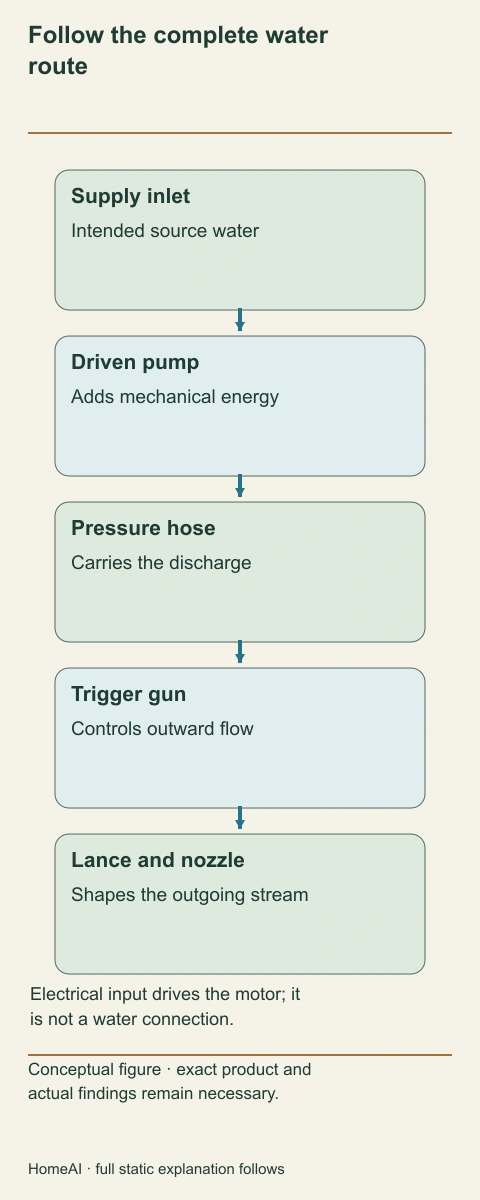
- Supply
Water reaches the intended machine inlet.
- Pump
Driven movement adds energy to the water.
- Pressure hose
Carries the intended discharge to the gun.
- Gun and nozzle
Control and shape the outward water route.
What does this illustration leave out?
Conceptual functional route; additional controls and protection are omitted. No potable connection approval or installed layout. This illustration explains an idea. It is not an installation guide.
Which exact supply, product and accessory define the proposed route?
Explore this with HomeAI ↗Opens an editable question. Nothing is sent until you choose to send it.Follow the complete water route
The supply feeds the pump; the pump delivers through the pressure hose, trigger gun, lance and nozzle. The electrical input drives movement but is not a water connection.
- Supply
- Water reaches the intended machine inlet.
- Pump
- Driven movement adds energy to the water.
- Pressure hose
- Carries the intended discharge to the gun.
- Gun and nozzle
- Control and shape the outward water route.
Figure scope: Conceptual functional route; additional controls and protection are omitted. No potable connection approval or installed layout.
A useful question: Which exact supply, product and accessory define the proposed route?
Full wording shown in this figure
- Follow the complete water
- route
- Supply inlet
- Intended source water
- Driven pump
- Adds mechanical energy
- Pressure hose
- Carries the discharge
- Trigger gun
- Controls outward flow
- Lance and nozzle
- Shapes the outgoing stream
- Electrical input drives the motor; it
- is not a water connection.
- Conceptual figure · exact product and
- actual findings remain necessary.
- HomeAI · full static explanation follows
- The supply feeds the pump; the pump delivers through the pressure hose, trigger gun, lance and nozzle. The electrical input drives movement but is not a water connection.
- Conceptual functional route; additional controls and protection are omitted. No potable connection approval or installed layout.
- Which exact supply, product and accessory define the proposed route?
How do motor movement and pump valves create a discharge?
An electric motor turns electrical input into mechanical movement that drives the pump. In Kärcher’s named K7 explanation, a wobble plate moves pistons back and forth. Each piston works with an inlet valve and a discharge valve. The moving chamber and the valves give water an intended direction through repeated cycles. The conceptual picture enlarges one chamber so the relationship can be followed.
When the illustrative piston withdraws, chamber volume increases and water can enter through the suction or inlet valve. The discharge valve is closed in that stage. When the piston advances, chamber volume decreases and water is pushed onward through the discharge valve while the inlet valve is closed. The two valve roles keep this explanation from becoming a simple unrestricted pipe through the cabinet.
That is a functional teaching model, not a parts layout for every washer. The named K7 has its own piston arrangement, water-cooling route and injector placement. Another product can use different construction or controls. Its motor, pump, supply and discharge still need to be identified from the actual manual and service information rather than matched to the generated picture by colour or cabinet shape.
Do not remove the housing to observe a pump stroke or touch a machine that may restart automatically. The internal chamber is hidden during ordinary use because it is part of a pressure and electrical assembly. Understanding the mechanism helps the owner describe an output problem and understand a provider’s findings; it does not create a safe owner repair or a reason to adjust internal control parts.
Two valve states give the chamber a direction
At left, the larger chamber takes water through an open inlet while the outlet is closed. At right, the advanced piston sends water through an open outlet while the inlet is seated closed.
Numbers identify the parts explained below.
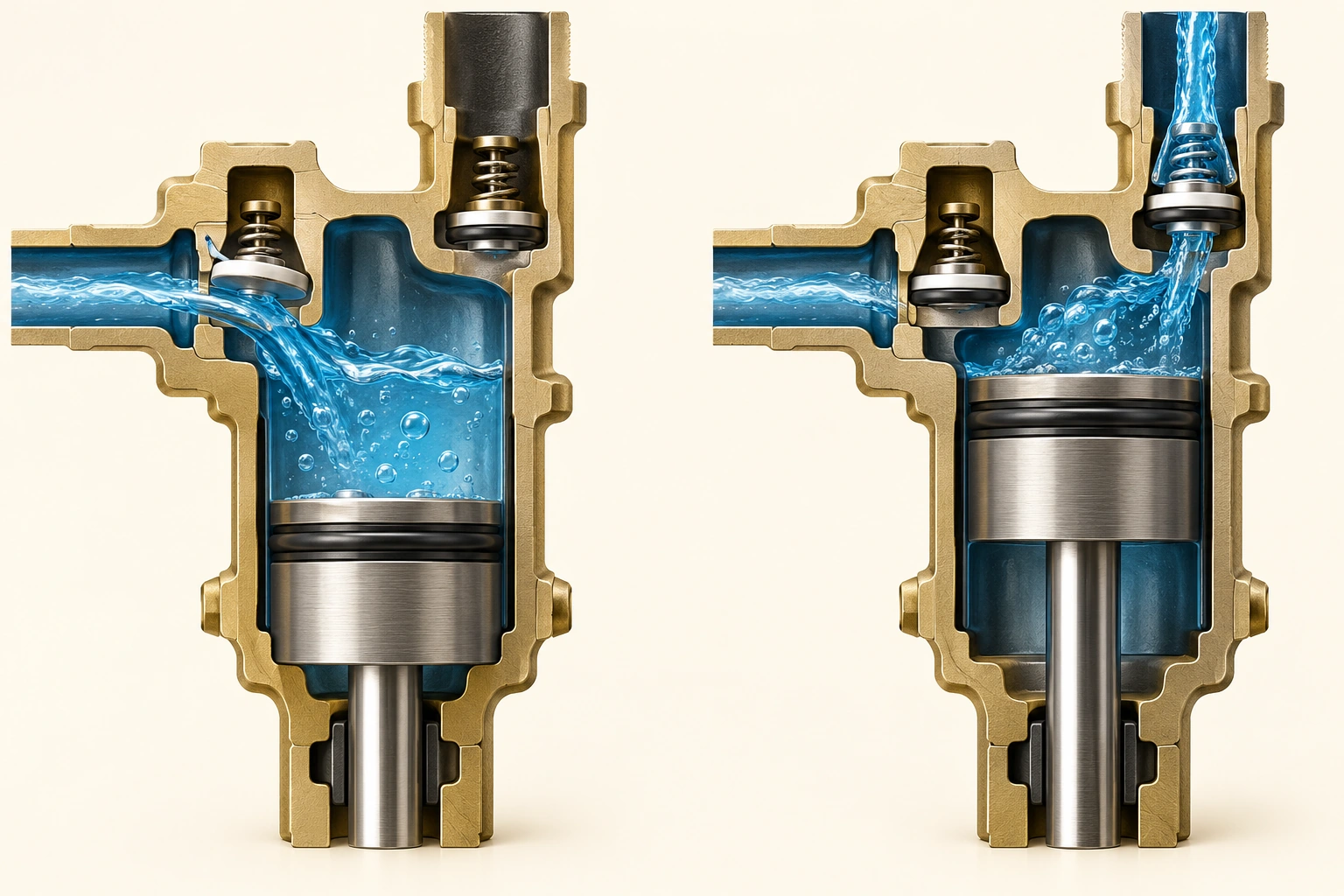
- Filling chamber
The withdrawn piston leaves a larger water space.
- Inlet valve
Open for the illustrated filling stage, seated for delivery.
- Delivering chamber
The advanced piston reduces the water space.
- Outlet valve
Seated during filling and open for the illustrated delivery.
What does this illustration leave out?
One illustrative chamber explains the named piston principle, not an actual model’s full construction, dimensions, pressures or service method. This illustration explains an idea. It is not an installation guide.
Which pump principle and control arrangement belong to the actual machine?
Explore this with HomeAI ↗Opens an editable question. Nothing is sent until you choose to send it.Why do pressure and flow need different numbers?
Pressure describes a force-per-area condition; flow describes the quantity of water passing during an interval. A pressure washer can have different published values for initial maximum pressure and ordinary loaded operation. A flow figure can also refer to a different outlet condition from the pressure figure. Read the units and test descriptions before treating the largest numbers on a box as one simultaneous operating point.
The named Sun Joe manual, for example, separately labels maximum pressure at initial discharge, rated pressure under typical load, maximum flow at minimum pressure and rated flow under typical load. This guide intentionally does not convert those model values into a recommendation. Its teaching point is the measurement boundary: a maximum from one condition should not be combined with a maximum from another to invent normal performance.
A fictional machine that delivers less visible water than expected does not automatically have insufficient pump pressure. Supply, selected nozzle, flow path, control state and wear can affect the observation. A qualified provider needs the actual model, approved accessory and relevant measurements to distinguish them. The owner’s stream photograph is not a calibrated pressure or flow test.
When comparing purchases or a proposed replacement, keep the exact rating, units, conditions and intended application together. A higher headline number cannot decide whether a roof, window joint, paint coating or soft material can tolerate the task. Material suitability, operator preparation and the product’s complete instructions remain separate from a performance comparison.
Different test conditions produce different ratings
The named2020 SPX3000-XT manual separates initial maximum and typical loaded pressure, and maximum versus rated flow. The four values are not one simultaneous operating point.
Numbers identify the parts explained below.
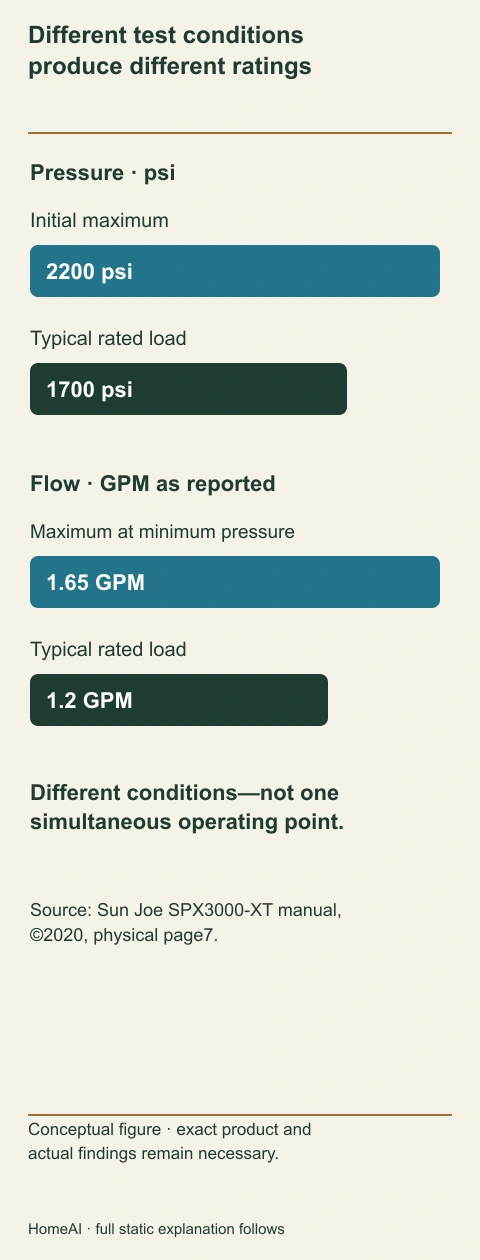
- Initial maximum pressure
2200 psi, at initial discharge per the manual’s stated test.
- Typical rated pressure
1700 psi, under the manual’s typical load.
- Maximum flow
1.65 GPM, with nozzle open at minimum pressure.
- Typical rated flow
1.2 GPM, under the manual’s typical load.
What does this illustration leave out?
Historical named-model specifications only; not a current product recommendation or a property performance test. This illustration explains an idea. It is not an installation guide.
Do the compared numbers use the same units and measurement conditions?
Explore this with HomeAI ↗Opens an editable question. Nothing is sent until you choose to send it.Different test conditions produce different ratings
The named2020 SPX3000-XT manual separates initial maximum and typical loaded pressure, and maximum versus rated flow. The four values are not one simultaneous operating point.
- Initial maximum pressure
- 2200 psi, at initial discharge per the manual’s stated test.
- Typical rated pressure
- 1700 psi, under the manual’s typical load.
- Maximum flow
- 1.65 GPM, with nozzle open at minimum pressure.
- Typical rated flow
- 1.2 GPM, under the manual’s typical load.
Figure scope: Historical named-model specifications only; not a current product recommendation or a property performance test.
A useful question: Do the compared numbers use the same units and measurement conditions?
Full wording shown in this figure
- Different test conditions
- produce different ratings
- Pressure · psi
- Initial maximum
- 2200 psi
- Typical rated load
- 1700 psi
- Flow · GPM as reported
- Maximum at minimum pressure
- 1.65 GPM
- 1.2 GPM
- Different conditions—not one
- simultaneous operating point.
- Source: Sun Joe SPX3000-XT manual,
- ©2020, physical page7.
- Conceptual figure · exact product and
- actual findings remain necessary.
- HomeAI · full static explanation follows
- The named2020 SPX3000-XT manual separates initial maximum and typical loaded pressure, and maximum versus rated flow. The four values are not one simultaneous operating point.
- Historical named-model specifications only; not a current product recommendation or a property performance test.
- Do the compared numbers use the same units and measurement conditions?
What changes when the trigger is released?
The trigger gun controls the ordinary outward water path. Releasing it changes that path, but the machine’s response depends on its design. The named Sun Joe SPX3000-XT describes a Total Stop System that responds to the flow condition and stops the motor when the trigger is released. That explains why its motor can be quiet during an intended standby condition without an equipment failure.
Stopping the motor and removing stored pressure are different events. A hose and gun can remain part of a pressurized system after a motor stops. Do not loosen a fitting, change an accessory or handle a questionable connection on the assumption that silence means no pressure. Follow the actual product’s shutdown and pressure-management instructions; this guide does not supply a generic sequence.
The same manual separately names an unloader that can reduce pressure above its preset condition, a trigger locking device and motor thermal protection. These functions are not interchangeable. A trigger lock is not an electrical isolator. A motor’s protective stop is not a declaration that the hose is depressurized. A safety control should never be bypassed to make a demonstration continue.
The native control-state diagram keeps ordinary discharge, intended standby and a protective or abnormal stop apart. Ask which state the provider identified and what evidence supports it. Repeated starting, unusual cycling or an unexplained stop can have several causes. Do not deliberately reproduce a fault, keep resetting a protective device or alter an unloader to decide which explanation seems most likely.
Motor silence is different from released pressure
The named model can stop its motor in intended standby. Its trigger lock, pressure control and thermal protection do different jobs; silence does not establish an unpressurized hose.
Numbers identify the parts explained below.
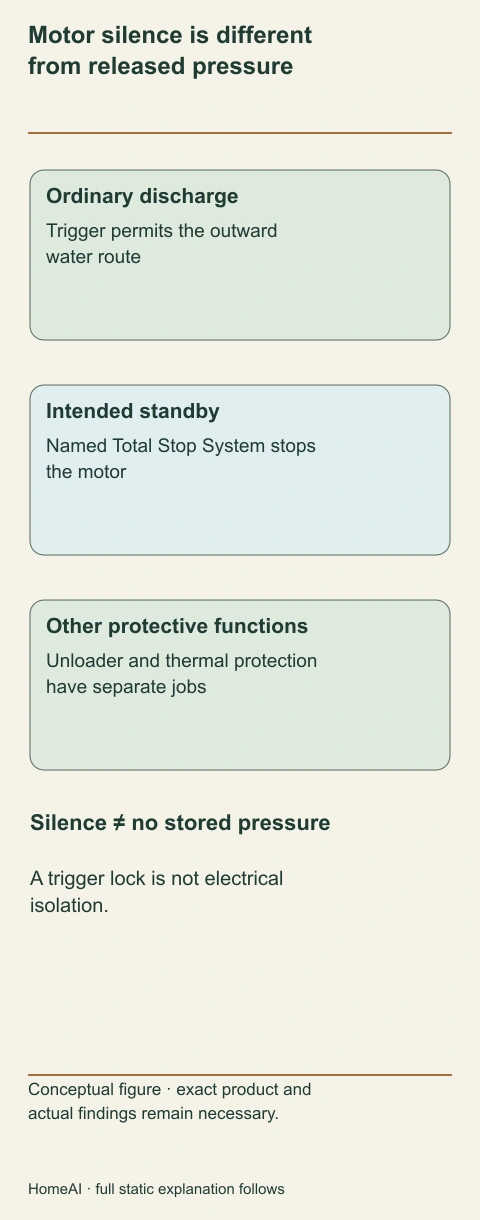
- Ordinary discharge
The trigger permits the outward water route.
- Intended standby
The named Total Stop System stops the motor.
- Other protection
Unloader and thermal functions have separate jobs.
- Remaining boundary
Stored pressure and electrical isolation still need their own instructions.
What does this illustration leave out?
Named Sun Joe control example, not every washer; no reset, bypass or pressure-release sequence. This illustration explains an idea. It is not an installation guide.
Which actual state and control function did the provider identify?
Explore this with HomeAI ↗Opens an editable question. Nothing is sent until you choose to send it.Motor silence is different from released pressure
The named model can stop its motor in intended standby. Its trigger lock, pressure control and thermal protection do different jobs; silence does not establish an unpressurized hose.
- Ordinary discharge
- The trigger permits the outward water route.
- Intended standby
- The named Total Stop System stops the motor.
- Other protection
- Unloader and thermal functions have separate jobs.
- Remaining boundary
- Stored pressure and electrical isolation still need their own instructions.
Figure scope: Named Sun Joe control example, not every washer; no reset, bypass or pressure-release sequence.
A useful question: Which actual state and control function did the provider identify?
Full wording shown in this figure
- Motor silence is different
- from released pressure
- Ordinary discharge
- Trigger permits the outward
- water route
- Intended standby
- Named Total Stop System stops
- the motor
- Other protective functions
- Unloader and thermal protection
- have separate jobs
- Silence ≠ no stored pressure
- A trigger lock is not electrical
- isolation.
- Conceptual figure · exact product and
- actual findings remain necessary.
- HomeAI · full static explanation follows
- The named model can stop its motor in intended standby. Its trigger lock, pressure control and thermal protection do different jobs; silence does not establish an unpressurized hose.
- Named Sun Joe control example, not every washer; no reset, bypass or pressure-release sequence.
- Which actual state and control function did the provider identify?
How does the nozzle change the outgoing stream?
The nozzle is the outlet that shapes the water leaving the lance. The named manual shows different spray patterns and warns that concentrated jets can damage fragile surfaces or gouge wood. The important relationship is that the outgoing pattern changes how the cleaning action is distributed. A small-looking tip is part of the system’s intended pressure and flow arrangement, not a decorative end cap.
An accessory must match the actual washer and intended task. A fitting that snaps into place is not, by itself, evidence that its pressure rating, flow characteristics, retention and material suitability are correct. Keep its identity and the manufacturer’s approved compatibility with the record. Do not enlarge a nozzle opening, substitute an unknown tip or use another product’s colour chart to select an accessory.
The native spray figure compares a broad pattern and a concentrated pattern conceptually without assigning an angle, pressure, stand-off distance or approved surface. It is a way to understand the difference, not a cleaning trial. Never point the jet at the body to feel the pattern, and do not change a nozzle while the assembly is active or still in an unsafe pressure state.
A changed pattern can justify a service enquiry but does not establish a blocked nozzle or a worn pump. The table in the named manual lists several possible causes for related symptoms. Record the original event, equipment and accessory; let the provider determine the appropriate isolated inspection or test. A pressure increase is not a suitable substitute for finding out why the original pattern changed.
A pattern changes how the stream is distributed
A broad fan and a concentrated stream distribute cleaning action differently. The outlet belongs to an approved product/accessory arrangement, not a universal colour or safe-surface rule.
Numbers identify the parts explained below.
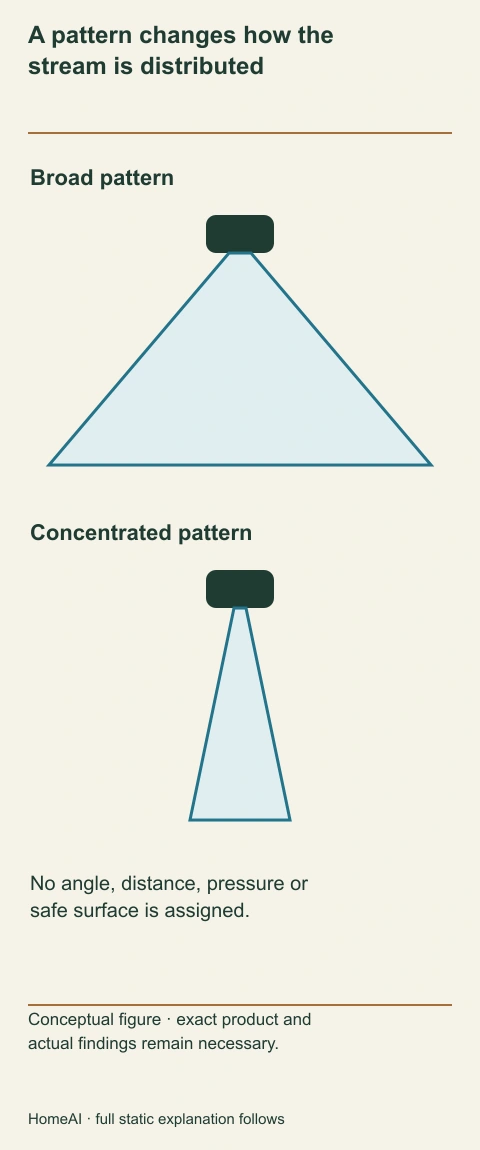
- Broad pattern
The illustration spreads the outgoing water across a wider fan.
- Concentrated pattern
The illustration focuses the outgoing stream more narrowly.
- Compatibility
A fitting that connects is not a complete rating check.
- Target
Material and assembly suitability remain separate.
What does this illustration leave out?
Conceptual patterns with no angles, pressure, stand-off distance or approved cleaning target. This illustration explains an idea. It is not an installation guide.
Which exact compatible accessory and material instructions apply to the intended job?
Explore this with HomeAI ↗Opens an editable question. Nothing is sent until you choose to send it.A pattern changes how the stream is distributed
A broad fan and a concentrated stream distribute cleaning action differently. The outlet belongs to an approved product/accessory arrangement, not a universal colour or safe-surface rule.
- Broad pattern
- The illustration spreads the outgoing water across a wider fan.
- Concentrated pattern
- The illustration focuses the outgoing stream more narrowly.
- Compatibility
- A fitting that connects is not a complete rating check.
- Target
- Material and assembly suitability remain separate.
Figure scope: Conceptual patterns with no angles, pressure, stand-off distance or approved cleaning target.
A useful question: Which exact compatible accessory and material instructions apply to the intended job?
Full wording shown in this figure
- A pattern changes how the
- stream is distributed
- Broad pattern
- Concentrated pattern
- No angle, distance, pressure or
- safe surface is assigned.
- Conceptual figure · exact product and
- actual findings remain necessary.
- HomeAI · full static explanation follows
- A broad fan and a concentrated stream distribute cleaning action differently. The outlet belongs to an approved product/accessory arrangement, not a universal colour or safe-surface rule.
- Conceptual patterns with no angles, pressure, stand-off distance or approved cleaning target.
- Which exact compatible accessory and material instructions apply to the intended job?
Why must the target be understood as an assembly?
A wall, deck or window is more than an exposed face. Finishes meet joints, openings, drainage details and materials behind them. A cleaning method that removes visible soil can also affect a coating or introduce water where it does not belong. The pressure washer’s ability to produce a jet therefore does not establish that the intended surface or junction is a suitable target.
The named manual itself warns about material damage despite describing many possible applications. Keep those examples within their actual conditions rather than turning a manufacturer’s broad marketing list into approval of an older painted wall, fragile surface or unknown seal. The relevant material supplier, equipment instructions and qualified building provider may need to answer different parts of the task.
The site picture shows a layered junction beside an idle machine. It does not show a recommended spray direction or a successful wash. Use it to name the target, surrounding openings and material uncertainty before work is arranged. The existing wall, deck, roof and older-material guides can then supply the separate assembly or hazardous-material questions where relevant.
If the surface has unknown coatings, loose material, concealed damage or an unclear water route, commission appropriate advice before a cleaning experiment. Do not use a washer to expose what lies behind a finish or to remove a suspected hazardous coating. A later clean-looking face is not a moisture assessment, a repair result or proof that concealed materials remained unaffected.
The target and surroundings belong in the plan
The idle machine stands beside a layered window-and-wall junction. The image connects a proposed cleaning target with its assembly and nearby water/electrical questions rather than approving a spray method.
Numbers identify the parts explained below.

- Target assembly
The exterior face meets joints and hidden layers.
- Idle equipment
No jet or successful wash is shown.
- Electrical boundary
The unplugged plug does not certify the location as safe.
- Receiving water
The actual route and local requirements remain to be resolved.
What does this illustration leave out?
No safe equipment location, supply, receiving-water route, target compatibility or cleaning outcome is established by the scene. This illustration explains an idea. It is not an installation guide.
Who has confirmed the target material, electrical arrangement and receiving-water scope?
Explore this with HomeAI ↗Opens an editable question. Nothing is sent until you choose to send it.Where do cleaning agents enter, and where does the water go afterwards?
A detergent arrangement adds another material and another compatibility question. The named Sun Joe example uses its specified bottle and foam-cannon accessory; the named K7 explanation describes an injector arrangement. Those are separate product examples, not two interchangeable stages in every washer. The actual manual identifies what the equipment can handle and where a permitted product enters.
Do not pour an ordinary household chemical into an inlet or assume that a product described as natural or biodegradable is suitable for the machine, the target or the receiving environment. Read the actual cleaning product label and equipment instructions together. This guide gives no dilution, dwell-time, mixing or application recipe and does not authorize bleach, solvents or another substitute.
Water leaving the target can carry the removed soil, coating particles, oil or cleaning agent. Disappearance from the surface is not disappearance from the property. The receiving route can involve landscaping, another property, a drain or a collection arrangement, each with a different question. Confirm the actual local water and waste requirements before arranging the job.
Keep cleaning and disposal scopes explicit in a contractor’s proposal. Ask who identifies contaminants, protects adjoining areas and manages the resulting water or material, and what exclusions remain. A quote limited to operating the machine should not silently become an environmental acceptance or a hazardous-material removal service. Do not infer municipal permission from a generic drain drawn in an illustration.
How do water and electricity create separate safety boundaries?
An electric washer needs its intended electrical supply while water is moving through the cleaning route. These systems should remain intentionally separated. CCOHS identifies ground-fault protection for electric equipment and warns against spraying near electrical power. The named manual also describes its own protective plug and double-insulated construction. Neither description permits water around an electrical connection.
A ground-fault circuit interrupter, or GFCI, is a protective device; it is not a guarantee that a wet cord, damaged connector or unsuitable supply is safe. Keep the actual equipment and its instructions intact. Do not bypass a protective plug, alter grounding or insulation, repair a cord with tape, increase a fuse rating or treat repeated resetting as a diagnosis.
A wet or damaged electrical part changes the response. Do not reach into water, touch a suspect connection or approach the machine to perform a powered test. Keep people away and obtain appropriate safe isolation and professional assistance. If an emergency or electric shock is involved, use emergency services. The lesson is preparation and scope, not a live electrical troubleshooting method.
Extension-cord instructions also belong to the exact product. The adopted manual discourages extension use and contains specific conditions where it discusses one; this guide does not extract a universal cord length or gauge table from those paragraphs. Identify the intended supply with the manufacturer and an appropriate electrical provider where necessary. A nearby receptacle and a long lead are not a complete supply assessment.
What can an ordinary weak or pulsing result mean?
A changed result can arise at the supplying side, within the pump or control, along the discharge route, or at the selected accessory. The named troubleshooting table includes supply, air, inlet restriction, nozzle, valve, seal and leakage possibilities. A single symptom can therefore support several questions without establishing a failed pump. Preserve the original observation before a replacement quote narrows the story.
Describe what was actually seen or heard during ordinary use: whether output changed, whether the motor was quiet or cycling, which accessory was fitted and whether water appeared at an unexpected location. Keep the date, prior storage history and any recent change in equipment together. Do not create a new trial, hold a hand over a fitting or keep operating a damaged machine to complete a log.
A visible leak also needs its own location. Water at the supply connection and water at a pressure hose involve different boundaries. Neither can be safely identified by feeling for a pinhole. The manual warns against mending a damaged high-pressure hose. Stop relying on questionable equipment and obtain the proper service and replacement advice for the exact assembly.
The native decision map gives the provider the original question rather than prescribing the answer. Ask what assessment distinguishes insufficient supply from a discharge restriction or internal fault, which measurements are included and what remains outside the task. If a proposed fix addresses only one branch, retain the others until findings justify closing them. That is a reasoned service decision, not a permanent list of unanswerable possibilities.
A weak or pulsing stream has more than one assessment path
The reported event can involve the supply, internal equipment, discharge assembly or accessory. Record the original event and let the appropriate assessment distinguish the possibilities.
Numbers identify the parts explained below.
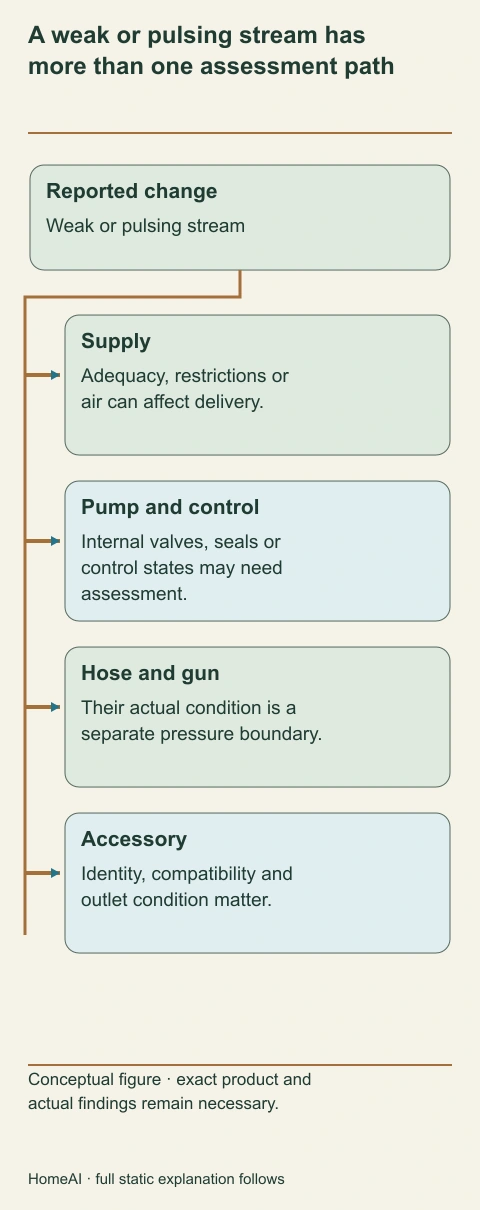
- Supply
Adequacy, restrictions or air can affect delivery.
- Pump and control
Internal valves, seals or control states may need assessment.
- Hose and gun
Their actual condition is a separate pressure boundary.
- Accessory
Identity, compatibility and outlet condition matter.
What does this illustration leave out?
Alternative questions, not fault probabilities or a powered owner test. Never feel for a pressure leak. This illustration explains an idea. It is not an installation guide.
What findings justify the proposed part or repair, and which boundary remains unassessed?
Explore this with HomeAI ↗Opens an editable question. Nothing is sent until you choose to send it.A weak or pulsing stream has more than one assessment path
The reported event can involve the supply, internal equipment, discharge assembly or accessory. Record the original event and let the appropriate assessment distinguish the possibilities.
- Supply
- Adequacy, restrictions or air can affect delivery.
- Pump and control
- Internal valves, seals or control states may need assessment.
- Hose and gun
- Their actual condition is a separate pressure boundary.
- Accessory
- Identity, compatibility and outlet condition matter.
Figure scope: Alternative questions, not fault probabilities or a powered owner test. Never feel for a pressure leak.
A useful question: What findings justify the proposed part or repair, and which boundary remains unassessed?
Full wording shown in this figure
- A weak or pulsing stream has
- more than one assessment path
- Reported change
- Weak or pulsing stream
- Supply
- Adequacy, restrictions or
- air can affect delivery.
- Pump and control
- Internal valves, seals or
- control states may need
- assessment.
- Hose and gun
- Their actual condition is a
- separate pressure boundary.
- Accessory
- Identity, compatibility and
- outlet condition matter.
- Conceptual figure · exact product and
- actual findings remain necessary.
- HomeAI · full static explanation follows
- The reported event can involve the supply, internal equipment, discharge assembly or accessory. Record the original event and let the appropriate assessment distinguish the possibilities.
- Alternative questions, not fault probabilities or a powered owner test. Never feel for a pressure leak.
- What findings justify the proposed part or repair, and which boundary remains unassessed?
Why do cold weather and storage history matter?
Water can remain in hoses, the pump and accessories after ordinary use. The named manual warns that freezing can permanently damage its pump and gives product-specific storage and winterization instructions. This makes Canadian seasonal storage history useful evidence. It does not establish that every machine found after winter is damaged, or that an apparently thawed exterior confirms the internal condition.
Keep the actual storage location and any known freezing event in the account. If the history is uncertain, say so instead of supplying an invented temperature. A crack, leak or changed function noticed after storage deserves appropriate assessment before another run. Do not warm a suspected frozen component with a flame, run the pump dry or add an unapproved chemical to see whether the symptom improves.
The product’s shutdown, water removal and preservation instructions must be read as a complete matched method. This guide does not reproduce a few isolated steps or combine different manuals into a winterizing recipe. Some preservation products and procedures also have compatibility and disposal requirements. Obtain the exact instructions and appropriate assistance before the next seasonal change.
A useful storage record states what actually occurred, who performed it and which instruction was followed. A bottle of pump protector on a shelf is not evidence that it was used correctly, and a service invoice from a previous season does not establish the condition after this one. Keep the current concern and the relevant prior work linked without treating history as an automatic diagnosis.
What should a repair or replacement assessment return?
A useful report identifies the machine and accessories, the original complaint, the method or checks performed, findings and the scope of any proposed work. Ask whether the assessment concerns the supply, electrical input, pump/control assembly, hose/gun or nozzle, and what was excluded. Separate observed events from provider findings and from proposed parts so each statement keeps its actual evidence status.
The provider should explain how its conclusion addresses the household’s result. A new pump can be relevant to a demonstrated internal problem while leaving an unsuitable target, inadequate supply or incorrect accessory unresolved. Conversely, a supply finding does not automatically assess hose condition. A complete decision connects the actual finding with the intended task rather than assuming the most expensive component explains every symptom.
Replacement comparisons need the same boundaries. Keep model identity, compatible accessories, supply needs, published rating conditions, intended cleaning task and service support together. Do not compare one headline maximum with another product’s rated value or infer a usable electrical supply from the old machine’s plug. An apparent bargain can leave the original site question untouched.
After work, retain the provider’s record of what was completed and what remains. Follow the actual return-to-use instructions and any required demonstration by the appropriate provider. This guide does not define a universal acceptance spray, pressure target or cleaning success threshold. The right closeout is a documented resolution of the scoped concern, with any separate material, supply or environmental tasks still assigned.
Why does the exact model matter for a recall enquiry?
A recall concerns identified products and a specific hazard; it is different from a generic repair suggestion for a weak stream. Health Canada’s May 14, 2026 notice RA-81923, for example, names two Generac electric-start gasoline pressure-washer models, G0088941 and G0088951. It describes a start/stop malfunction that can cause self-starting and a carbon-monoxide hazard in a confined space.
That dated example does not mean all gasoline washers, all electric-start products or the electric Sun Joe example are recalled. It explains why a brand name or a photograph of similar equipment is insufficient. Match the actual label and all identifiers required by the current notice. Do not operate a suspect unit to see whether its fault occurs or use an absence of previous trouble as evidence that the notice does not apply.
The cited Canadian notice directs consumers with an affected product to stop using it and contact the company for the stated repair route. This guide does not reproduce its alternative-start workaround, promise present appointment availability or tell the owner to remove a battery. Obtain the current complete direction for the exact affected product, and keep the contact and repair documentation with its identity.
Recall review also differs from a general inspection. A provider may address the named recall while an unrelated hose, electrical, supply or target problem remains; conversely, an ordinary service does not prove the recall action was completed. Ask each report which task it covers. For an inherited or second-hand machine, preserve any uncertainty about identity and prior work until the relevant product authority resolves it, rather than treating a seller’s clean demonstration as the missing recall record.
How would a fictional owner compare a pump quote with a supply finding?
Fictional owner Owen reports a pulsing stream from an electric washer after winter storage. A new accessory was also fitted before the first noticed change. He has an old pump-replacement quotation, but it contains no record of an assessment. The scenario supplies no actual pressure, flow, freezing temperature, electrical measurement or result from a home test.
Owen preserves the model and accessory identities, dates and existing observations, stops using the questionable assembly and commissions an appropriate assessment. In the invented provider report, the accessory is confirmed incompatible and the supply arrangement needs correction before performance can be assessed. The report expressly leaves the internal pump condition unconfirmed. It is a finding about two boundaries, not proof that the pump is healthy.
One decision path is to address the identified compatibility and supply tasks with the appropriate providers, then obtain the defined remaining equipment assessment. Another is to replace the washer, but that option still needs a suitable supply and target plan. Owen asks each proposal to separate those tasks, costs and assumptions instead of comparing an unassessed replacement quote with a completed diagnostic conclusion.
For the fictional household, the useful change is to defer the unsupported pump order and commission the named prerequisites and remaining assessment. No repair outcome, saving or permission to resume use is invented. Owen retains the original complaint, the provider’s findings and the unresolved pump question together. A later report can close that question; a quiet motor or a clean patio cannot substitute for the missing scope.
Keep learning about the connected parts
- Drinking-water backflow: understand connections and protection
- Why does a breaker trip? Understand GFCI and AFCI protection
- Brick walls: what the layers, openings and stains can tell you
- Deck boards, supports and the house connection: what to ask
- Buying an older home: asbestos, lead paint and renovation questions
- Build a home-care record that the next person can understand
Canadian context and authorities · Visual atlas · Learning labs
Practice the distinction.
Owen’s pulsing stream and two unassessed changes
A fictional electric washer pulses after storage, with a new accessory and an old pump quote but no assessment record.
Reported observations
- The accessory changed before the first reported output change.
- Storage history is uncertain; no freezing or damage finding is supplied.
- The original quotation contains no diagnostic result.
Compare the explanations
Expand each possibility to see the evidence needed to distinguish it. Similar symptoms can have different mechanisms.
Supply or accessory conditions prevent a fair equipment assessment
The fictional provider identifies incompatibility and an unresolved supply task.
Exact product/accessory identities, supply findings and a defined remaining assessment.
An internal equipment question remains
Resolving prerequisites does not establish that the pump or controls are sound.
Appropriate isolated assessment and its actual findings, without a household repeat-fault trial.
A useful next question
Owen defers the unsupported pump order, commissions the identified compatibility and supply work and retains the remaining pump assessment as an explicit next task.
Fictional decision only; no actual pressure, flow, repair success, saving or permission to resume use.
Know what the words mean.
- Flow
- Water quantity passing during an interval, with units and measurement conditions.
- Pressure
- A force-per-area condition; it is distinct from the quantity delivered during an interval.
- Piston chamber
- A pump space whose volume changes as the piston moves in the named teaching example.
- Inlet valve
- The intended one-way entrance to the illustrative pumping chamber.
- Discharge valve
- The intended onward route from that chamber during its delivery stage.
- Trigger gun
- The assembled control for ordinary discharge through the lance and nozzle.
- Total Stop System
- The named Sun Joe model’s automatic motor-stop function related to its flow/control state; not a universal design.
- Unloader
- The named manual’s separate pressure-control function; not an owner adjustment instruction.
- Injection injury
- An injury in which a high-pressure stream enters tissue; urgent medical assessment is required.
- Receiving route
- Where water and removed material go after leaving the cleaning target.
Questions to bring
to the conversation.
- Which actual machine, supply, protective electrical arrangement and accessory are identified?
- Which state and ordinary event were reported without staging another trial?
- What findings distinguish a supply, control, discharge or internal equipment question?
- Which material and receiving-water requirements must be resolved before the intended job?
Separate a showing observation, an existing record and a new professional assessment. Unknown means a question remains; it does not automatically mean a defect.
Use the evidence planner ↗Go to the source.
Original HomeAI explanation informed by these public references. Sources support the underlying guidance; they have not reviewed or endorsed HomeAI. Diagrams are conceptual, and calculator outputs depend on your inputs.
Read October20,2026 (America/Edmonton). Canadian CCOHS hazard education, the named Sun Joe SPX3000-XT2020 English manual and a complete Swiss-German Kärcher K7 manufacturer explanation have different scopes. The K7 pump example is not every washer. The old US mechanism URL actually returned unrelated hot-water marketing and is held. No rated value, water-saving estimate, owner repair/test, potable-supply connection permission, cleaning recipe or municipal runoff acceptance is generalized. The worked household is fictional.
Publication & source review
First published .
Sources reviewed .
Have a question about your home?
Start with the symptom, timing and what you have observed.
Ask HomeAI