- A clear camera run describes the visible interior at the time of inspection; it does not certify every buried condition.
- Age changes the questions, but a new service can still need construction and acceptance evidence.
- A repair decision needs an identified location, a qualified interpretation and confirmed responsibility.
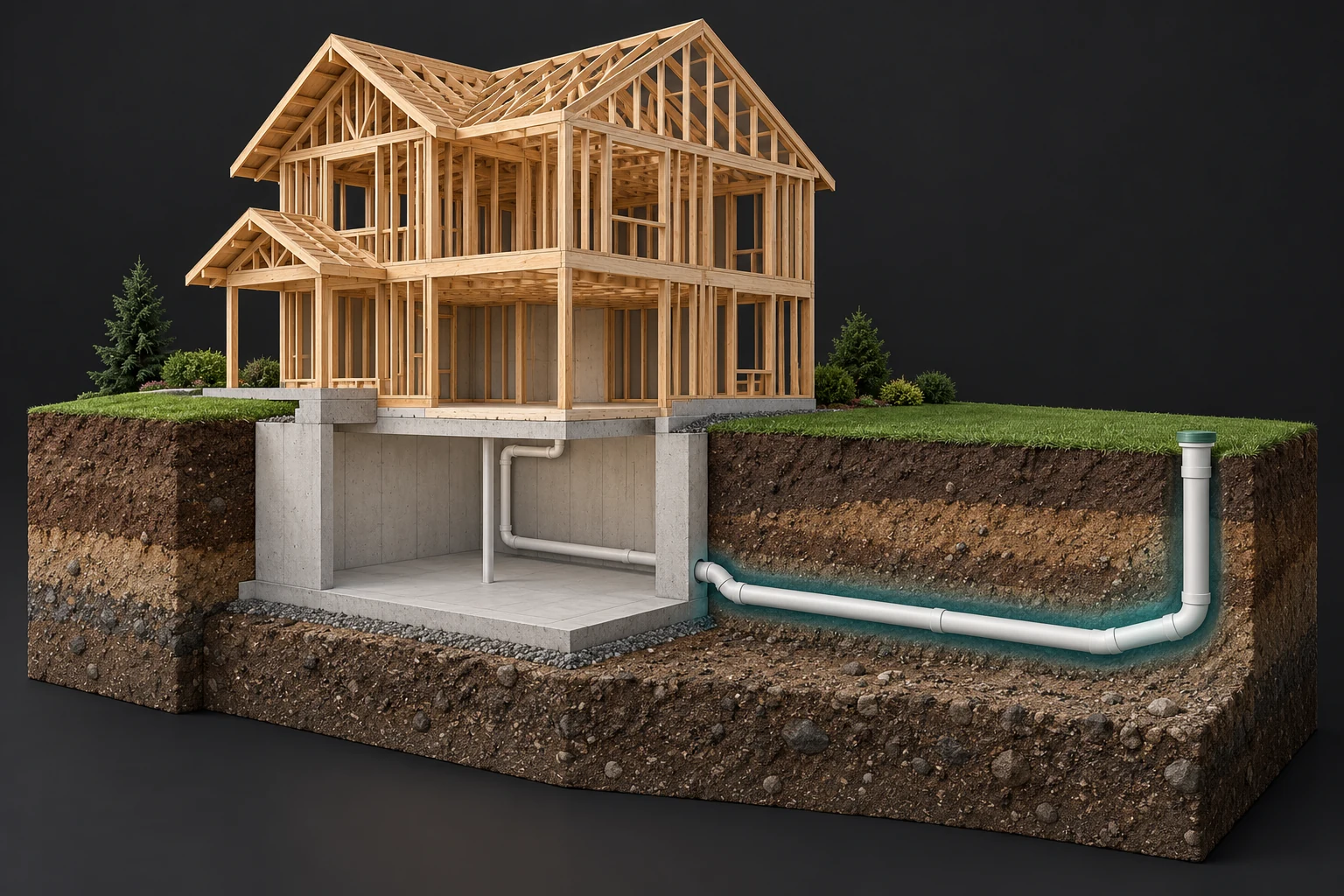
Conceptual architecture. Layout, sizes and routes are illustrative; the picture does not describe your home’s condition.
Explore this in the visual atlas ↗7 picture lessons appear beside the questions in this guide. Use them to understand the explanation, then consider what it means for your home.
How far does the evidence reach?
Move an illustrated sewer camera. Separate the length reached, image visibility and the questions footage cannot answer.
Explore the sewer-scope lesson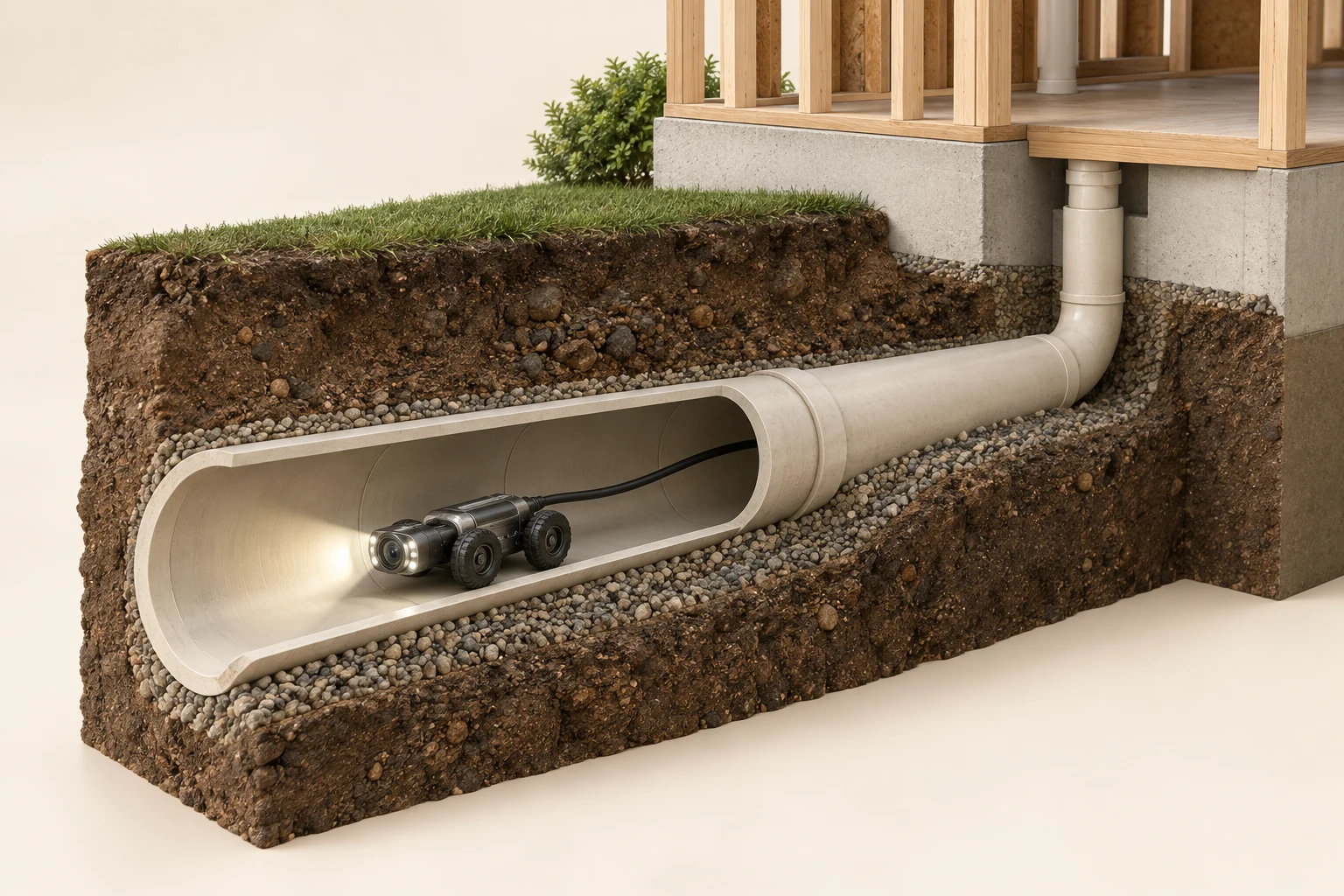
Start with the question you need answered
A sewer service is the route between a building drainage system and the receiving sewer or other approved disposal system. Most of that route is hidden. A house can present beautifully while its buried service has little documentary history. Conversely, an older service may remain functional. The useful question is how much of this particular route has been examined and what uncertainty remains, rather than whether every old pipe is bad or every new pipe is safe.
For a purchase, define the consequence you are investigating: recurring blockage, unexplained backup, a proposed addition, an unknown service route or simply the absence of recent evidence. For a sale, assemble the history before ordering another test. Dates of clearing, repair invoices and previous footage can reveal whether a concern recurs at the same position. A single statement that the drains work does not answer those questions.
New construction changes the evidence request
A newly installed service has not accumulated decades of wear, but it has passed through excavation, installation, backfilling and site construction. Connections, alignment and protection during those stages matter. In Calgary, municipal plumbing inspections occur at defined construction stages, including checks before basement piping is covered. A record of one inspection should be read for its actual scope. It is not interchangeable with a complete camera survey of every buried service segment.
Ask the builder what was inspected, when it was inspected and whether work continued afterwards. Request the servicing plan, installed route, relevant inspection results and any required acceptance footage or reports. If those records do not exist or cannot be supplied, record the gap. That gap does not prove a defect, but it also cannot support a claim that the hidden installation has been independently verified.
See what finishes can conceal
Open framing, insulation specimens, closed equipment and an illustrative buried sanitary route are exposed.
Numbers identify the parts explained below.
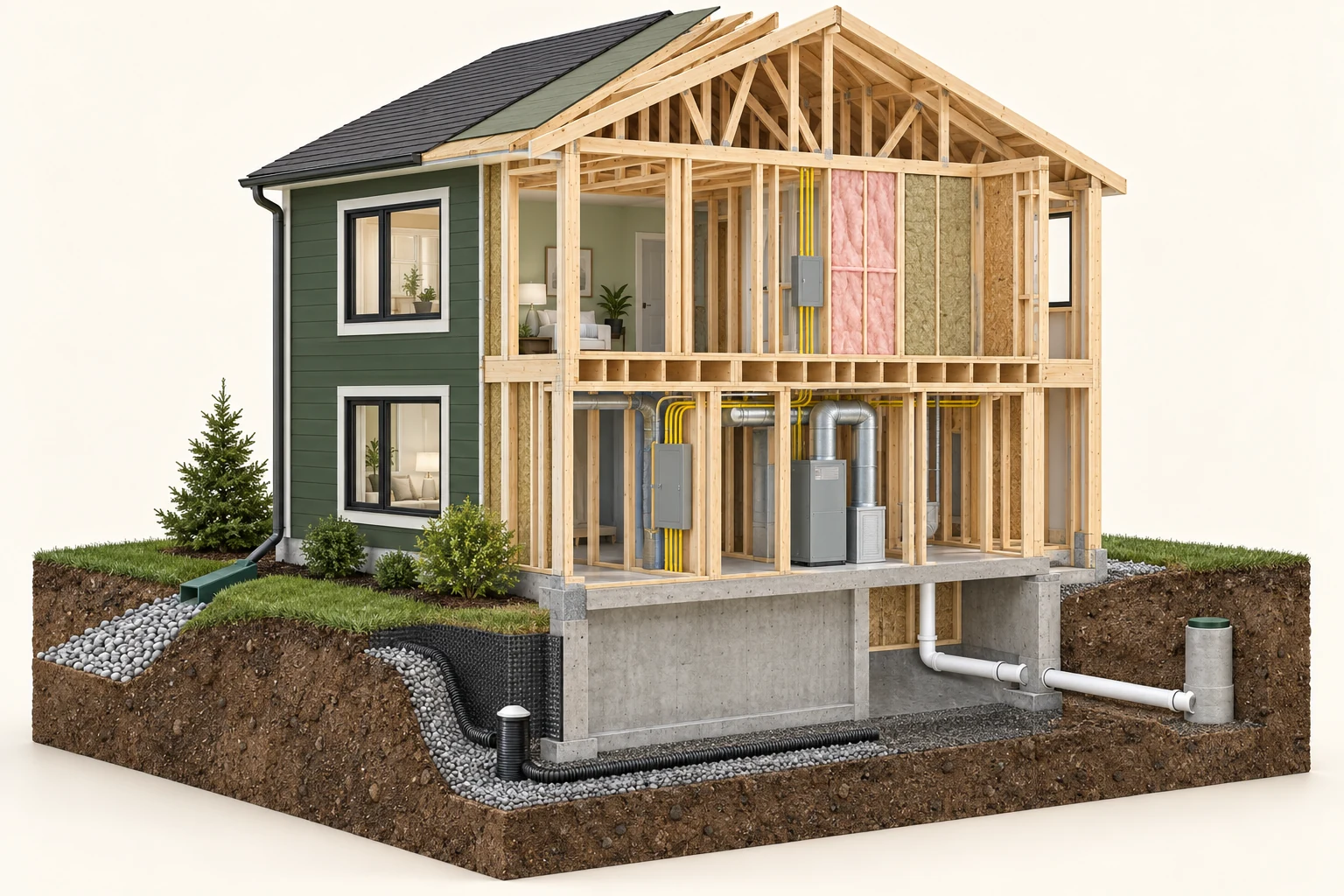
- Exposed stage
Stage records can document specific work before it disappears behind finishes.
- Closed services
Ask for installation, inspection and commissioning records; keep hazardous equipment closed.
- Buried routes
The white sanitary route and dark foundation-drainage context are separate. Gaps are cutaway simplifications, not a defect finding.
What does this illustration leave out?
Member capacity, connections, assembly continuity, commissioned performance and pipe support are not certified by this model. This illustration explains an idea. It is not an installation guide.
Which new-build stages and commissioning records should I review, and what remains outside each inspection scope?
Explore this with HomeAI ↗Opens an editable question. Nothing is sent until you choose to send it.Agree the camera scope before the appointment
A useful commission identifies the starting access, intended endpoint and deliverables. Ask the drainage specialist whether the accessible route includes the building drain, the private service and the connection of concern. Confirm how they will handle an obstruction or an inaccessible endpoint. If cleaning is proposed, establish why it is needed and whether there will be evidence before and after. Do not remove a cleanout cap, enter a chamber or handle sewage to prepare for the visit yourself.
Request the complete recording rather than selected screenshots alone. The written report should relate observations to positions along the run, explain the distance reference, identify apparent materials where possible and distinguish observed conditions from interpretation. Have the specialist state where visibility was reduced by standing water, deposits, a bend or the camera position. A report that simply says satisfactory without identifying the inspected extent leaves a major question unanswered.
Build a short recording index that another reviewer can use: report identifier, video filename, inspection date, reported access, travel direction, counter reference and intended endpoint. Ask the operator to distinguish planned coverage from achieved coverage. An access labelled front cleanout does not identify the route on its own, and a zero displayed on screen needs its stated reference. Keep any camera withdrawal, restart or changed reference understandable in the supplied record rather than joining separate clips into an assumed continuous trip.
Toronto’s TS409 municipal specification is an example of documenting recording/report relationships, visibility and incomplete runs. Its prescribed contract formats and inspection tolerances are not residential requirements across Canada. The linked index was modified in2026 while the captured specification remains the September2019 edition. Read those dates separately. For your actual engagement, agree readable deliverables and limitations with the specialist instead of importing a municipal contract as an owner checklist.
The camera sees an inspected stretch
The crawler and illuminated pipe interior illustrate what a camera can view within the accessible stretch. This is an illustration, not footage of an inspected home.
Numbers identify the parts explained below.
- Camera and light
A recording needs a defined start, direction, endpoint and visibility limits. A camera picture alone does not establish inspected reach.
- Visible interior
An interior observation can prompt a question; the exterior soil and hidden connections are outside this view.
- Continuing route
The pipe beyond the recorded endpoint remains uninspected. A distance counter is not a survey or a legal boundary.
What does this illustration leave out?
The complete route, uninspected remainder, actual material, leaks, external support, measured grade, surface location and ownership require separate records or assessment. This illustration explains an idea. It is not an installation guide.
Which stretch does the sewer recording actually cover, and what evidence is still needed for the unseen route, location or support?
Explore this with HomeAI ↗Opens an editable question. Nothing is sent until you choose to send it.A camera appointment needs an explicit inspected route and stop point.
The crawler and illuminated pipe interior illustrate what a camera can view within the accessible stretch. This is an illustration, not footage of an inspected home.
Numbers identify the parts explained below.
- Camera and light
The visible crawler illustrates the inspection method. It supplies no actual counter reading, located position or completed appointment.
- Illuminated interior
The pictured lit region is a limited illustrative view. An actual report must state access, visible extent, exclusions and any reason the camera stopped.
- Continuing route
The pipe continuing toward the foundation is conceptual. Establish the actual start, downstream endpoint and route rather than assuming full coverage.
What does this illustration leave out?
The complete route, uninspected remainder, actual material, leaks, external support, measured grade, surface location and ownership require separate records or assessment. This illustration explains an idea. It is not an installation guide.
What exact access, inspected route, stopping reason, unviewed sections and report deliverables were agreed before this home’s sewer camera appointment?
Explore this with HomeAI ↗Opens an editable question. Nothing is sent until you choose to send it.Read an observation without turning it into a diagnosis
Footage may show a displaced joint, a visible opening, roots, deposits or a segment containing water. The importance depends on extent, location, service function and the confidence of the interpretation. Water visible at one moment is evidence to assess, not a measured survey of the entire pipe slope. Likewise, an apparently clean inner surface tells little about surrounding bedding, external soil support or an unseen section beyond the camera endpoint.
Ordinary video and a measurement service are different deliverables. Some specialist systems combine inspection with sensors that record a pipe route in three dimensions or measure elevation. IBAK documents examples of these methods. That does not mean a routine residential scope includes them. If grade, position or depth is central to the decision, ask which method is proposed, how its measurements are checked, the reported accuracy and which segments it can assess. Do not infer a quantified grade from a camera image, or assume every inspection system has the same capabilities.
Ask the reviewer to separate three statements: what the image shows, the likely mechanism, and what would confirm that mechanism. If a quotation is based on a suspected low section, ask how its position and repair length were established. If the specialist cannot evaluate a submerged segment, the honest outcome is incomplete inspection with a proposed next step. That is more useful to a buyer than converting uncertainty into either reassurance or a worst-case prediction.
When reading a reported observation, put its video time and displayed counter beside the corresponding visible view. Ask what portion of the bore can actually be seen there. A favourable upper view can coexist with an unobserved lower region; neither supplies an invented condition for the hidden area. If a still is cropped or disconnected from its surrounding recording, ask for that context. Report language should keep observed, interpreted and unassessed portions distinct.
The fictional walkthrough below supplies three stops in one stated recording, so its chronology is explicit. The displayed values are teaching data, not surveyed pipe lengths. Its middle stop has reduced visibility and its final stop does not identify the intended connection. The useful question is which conclusion the supplied evidence supports. A clear first frame cannot resolve later limits, while an obscured frame cannot establish a particular defect or cause.
A visible joint-and-root specimen does not identify this home’s cause.
The enlarged specimen depicts fine roots at an illustrative joint opening. It is separate from the main scene and not to scale.
Numbers identify the parts explained below.
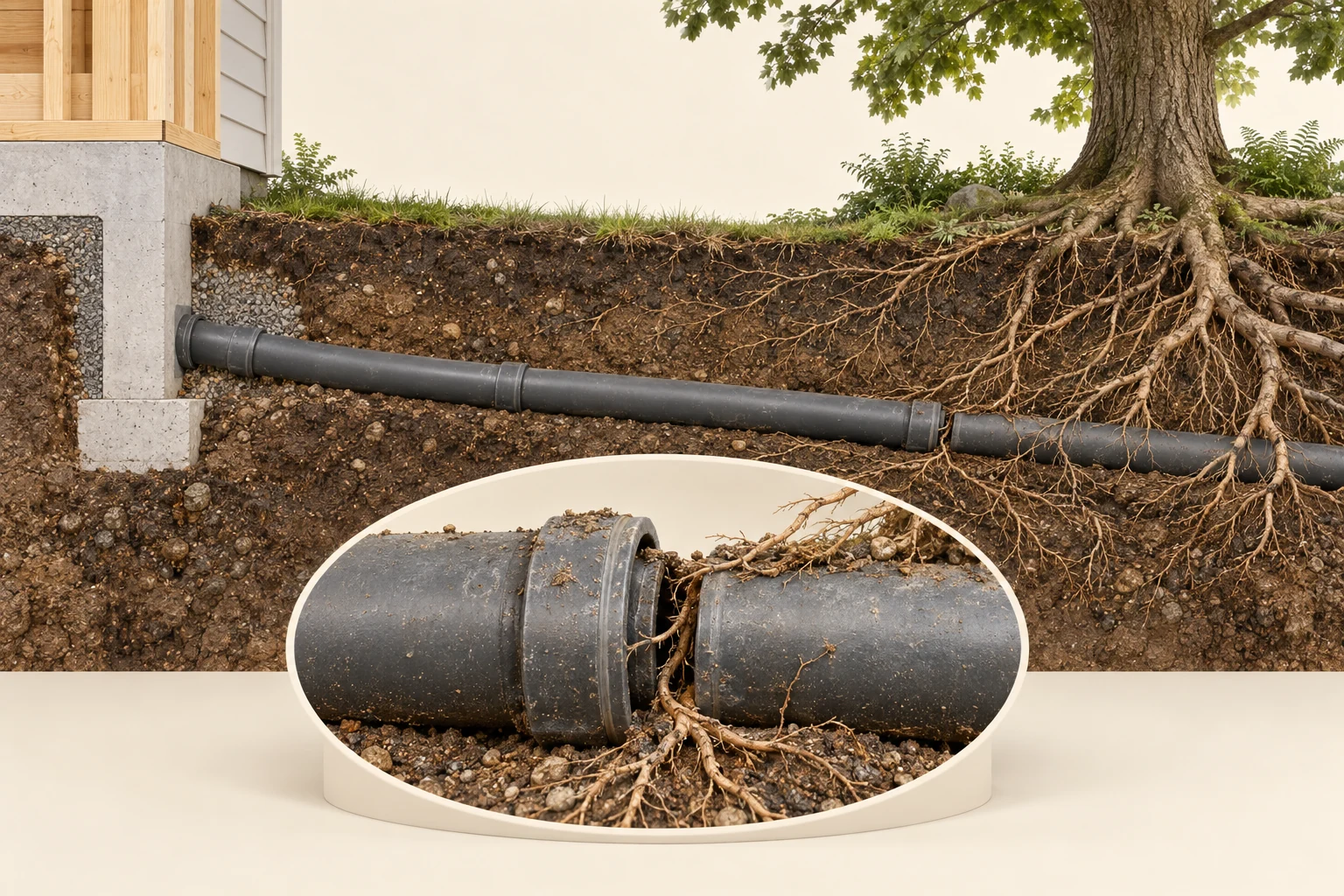
- Tree and soil context
Tree proximity introduces a possible mechanism. It cannot establish roots in the actual pipe, a failure cause or responsibility.
- Illustrated buried route
The exterior route does not reveal actual pipe material, support, gradient or watertightness; a sewer camera also cannot see the exterior soil shown here.
- Separate enlarged joint
Fine roots and an open joint are visible in the enlarged specimen. It is not footage, a scale measurement or proof of how a real defect originated.
What does this illustration leave out?
Material, joint condition, root presence, support, grade and responsibility at a real property need their own evidence. This illustration explains an idea. It is not an installation guide.
What did the actual camera record visibly show, at which documented reference, and which cause, exterior-support, location or responsibility questions remain unestablished?
Explore this with HomeAI ↗Opens an editable question. Nothing is sent until you choose to send it.Walk a fictional report against three recording stops
One explicitly fictional recording, stated chronological stops, displayed counter values with an unverified physical reference. No real property or inspected condition is represented.
Reported access: house cleanout; reported direction: toward the street; intended endpoint: service connection. The supplied example does not independently establish the counter datum, surface route or completed endpoint.
- 00:00 · displayed0.0
- 00:45 · displayed7.8
- 01:22 · displayed12.4
These are fictional report-reading stops, not inspection criteria or a defect score. The pipe picture is conceptual; timestamps/counter values do not survey a route, diagnose a cause or assign responsibility.
The middle visibility limit and final endpoint question stay beside their own evidence. A favourable first view cannot clear the hidden region or complete the route. Counter values deliberately have no physical unit in this teaching record.
Construction loads are a conditional risk
For flexible buried pipe, the pipe and surrounding soil act together. Soil beside the pipe helps resist a change in its shape as loads act above it. Support therefore depends on the installed soil envelope as well as the pipe itself; missing or unsuitable support can matter even where the visible interior initially looks clear. Calgary’s engineering reference describes the importance of embedment and native soil support, and requires project-specific consideration before excessive construction loads cross a trench. A heavy vehicle or material stack over a service may therefore be a concern depending on cover, soil conditions, pipe type, installation and the load. There is no universal vehicle weight or shallow-cover rule that can establish safety from a driveway photograph.
If you have documented construction traffic or storage over the suspected route, give the chronology and location to the builder and a qualified drainage or civil specialist. Ask whether protection was designed and whether inspection occurred after the loading. A camera may identify an interior consequence, but it cannot reconstruct every load or prove the cause of damage by itself. Avoid assigning blame from equipment photos without the installation evidence and appropriate technical review.
See what finishes can conceal
Open framing, insulation specimens, closed equipment and an illustrative buried sanitary route are exposed.
Numbers identify the parts explained below.
- Exposed stage
Stage records can document specific work before it disappears behind finishes.
- Closed services
Ask for installation, inspection and commissioning records; keep hazardous equipment closed.
- Buried routes
The white sanitary route and dark foundation-drainage context are separate. Gaps are cutaway simplifications, not a defect finding.
What does this illustration leave out?
Member capacity, connections, assembly continuity, commissioned performance and pipe support are not certified by this model. This illustration explains an idea. It is not an installation guide.
Which new-build stages and commissioning records should I review, and what remains outside each inspection scope?
Explore this with HomeAI ↗Opens an editable question. Nothing is sent until you choose to send it.Locate the concern and confirm responsibility
A distance counter describes progress along the pipe from its reference point. It is not automatically a surface map. Where a repair may be needed, ask whether the camera position was located at the surface, what depth estimate was obtained and what accuracy limitations apply. Compare that result with available servicing records. A specialist should resolve discrepancies before a contractor prices excavation through paving, landscaping or a building.
Ownership and maintenance boundaries must be confirmed locally. Calgary distinguishes its infrastructure connection inspection from privately owned site servicing. Other municipalities and shared-service arrangements can differ. Also, a sewer camera locating result is not a substitute for the required utility-locate process before ground disturbance. Utility Safety Partners explains that privately owned buried facilities may need separate locating arrangements. Request written clarification where the route crosses a boundary or serves more than one property.
Keep the video reference and surface-location evidence in different columns. A timestamp identifies a moment; a counter describes the operator’s stated internal distance reference; a locating result has its own method, position and limits. A nearby driveway mark or property boundary cannot silently become the location of the reported concern. Ask which record connects them before expanding a camera observation into an excavation area.
Then confirm the local responsibility question independently. Winnipeg’s guidance states that a property owner’s private sewer service extends to the City main, including the portion beneath the street. This named local example shows why a street location alone cannot decide ownership. Calgary’s defined servicing and connection-inspection context remains a separate example in the existing sources. Neither municipality’s page decides your actual contractual, warranty or legal responsibility.
Turn the report into a reviewable decision
Organize the result into verified extent, observed concern, missing evidence and proposed action. A repair proposal should identify the affected segment, access assumptions, permits or approvals to confirm, restoration work and how completion will be checked. Obtain an appropriately qualified second review when the proposed work is substantial or when the report and quotation appear to describe different locations. A low price without a defined scope is difficult to compare with a complete repair.
Active sewage backup is a different situation from planned purchase diligence. Keep people away from contaminated areas and seek the local utility’s emergency guidance and qualified plumbing assistance. Calgary’s backup guidance helps distinguish City-side investigation from internal plumbing work. Do not continue using fixtures to demonstrate the problem for a camera operator when wastewater is already entering the building. Document from a safe position and prioritize stopping exposure and further damage.
Use a claim-to-evidence row for each consequential statement: the exact reported claim, linked video moment, visible extent, measurement or locating evidence if supplied, and the remaining question. If the stated conclusion is limited to visible portions, retain that qualification when sharing the report with the buyer, seller or builder. Do not rename it entire service satisfactory. A specialist can explain what additional evidence would change the decision and which uncertainty remains outside the agreed scope.
A useful decision file connects observations, locations and scoped recommendations.
The soil block exposes the exterior of three coloured pipe stretches. Two dark band-like joints separate the middle stretch. The left mouth is open; the right stretch meets the far soil edge. A blank notebook and a separate cream-coloured hollow specimen sit on the plinth.
Numbers identify the parts explained below.
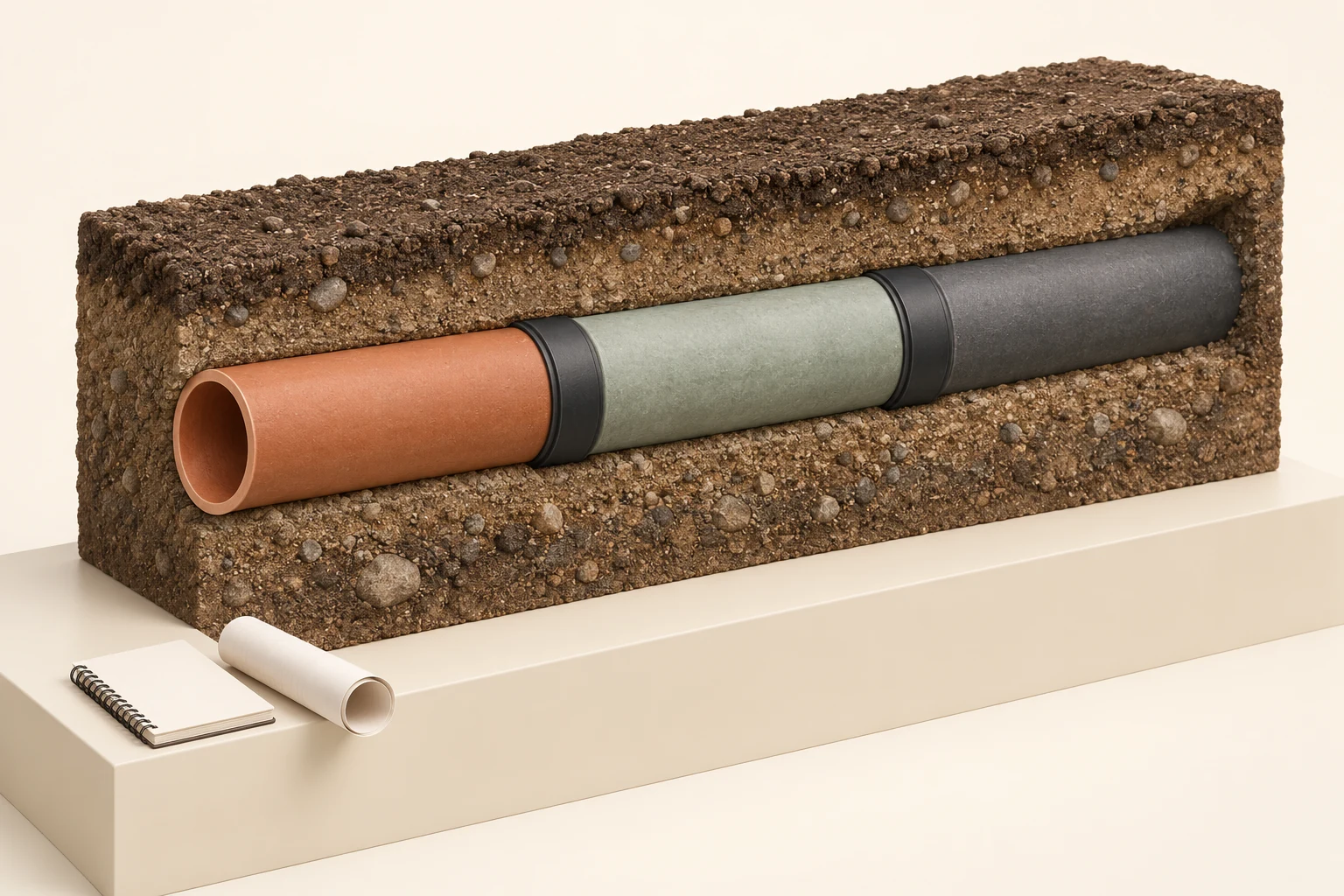
- Blank notebook
The prop has no finding. Read the actual report author, date, camera route, observations, exclusions and recommendation before deciding.
- Left band-like joint
The visible boundary is not a surveyed endpoint, actual defect reference or ownership boundary. The real location needs its own method and record.
- Right exterior stretch
The route continuing through soil is a reminder to name what remains outside the actual camera or work scope. Colour establishes no material or repair method.
What does this illustration leave out?
Colours establish no material identity, product, age or repair method. The exterior view shows no longitudinal interior inspection, liner bond, watertightness, diameter, gradient, bedding adequacy, located endpoints or legal boundary. The model is not footage, an actual repair, an approval or a condition finding. This illustration explains an idea. It is not an installation guide.
Which report observations, footage references, qualified location evidence and scoped next step form a reviewable sewer decision, and what remains outside that evidence?
Explore this with HomeAI ↗Opens an editable question. Nothing is sent until you choose to send it.Use the evidence fairly in a transaction
A buyer can use a defined report to decide whether further investigation, an allowance or a completed repair is worth discussing with their real estate and legal advisers. An uninspected segment belongs in that discussion explicitly. A seller can make the evidence more useful by supplying full footage, the report, invoices and any follow-up verification together. Passing along only a favourable still image loses the inspection context.
Neither party should describe a scope as a lifetime guarantee or a blanket approval of the whole drainage system. Keep the date, property, access point and limitations attached to the conclusion. Where a repair has been made, ask for the completion record and what post-repair inspection covered. The objective is a defensible understanding of this service today, with a clear route for resolving what remains unknown.
Confirm where the camera route leads
A camera assessment of a building drain or sewer should identify the route and endpoint it actually reached. Confirm whether the property connects to a municipal sewer, a private shared line or an onsite wastewater system. If onsite treatment is involved, clear pipe footage does not assess the tank, controls or treatment area. The camera question and the complete wastewater-system question need separate scopes and appropriate providers.
Ask the report to retain access point, direction, distance reference and the limits of any locate. A visible connection does not settle ownership, an easement or maintenance responsibility. Keep physical findings separate from the relevant municipal, property and contractual documents. A new installation or newly landscaped site provides context but does not replace evidence about the reached pipe and the rest of the system.
Turn a limited view into a targeted follow-up
An obstruction, water-filled portion or unreached segment is an assessment limit that should remain in the record. Ask which additional method could answer the consequential unknown and what permission or access it needs. Do not assume a second camera run will establish external bedding, soil support or causation. Different methods can add different evidence; the specialist should explain their purpose and limits.
If excavation or repair is proposed, obtain an actual scoped assessment and quote addressing locating, access, restoration and uncertainty. Keep proposed responsibility separate from the technical diagnosis. A transaction allowance or warranty discussion does not identify the physical cause, and a physical defect does not by itself determine who must pay. HomeAI can organize those questions without deciding the legal or engineering conclusion.
At the fictional last stop, the recording ends before the intended connection is identified. That is an endpoint question, without proving the cause of stopping or the condition beyond it. Ask the original operator what was reached, why coverage ended and whether a further scoped assessment can answer the buyer’s consequential question. Additional clips, access or a different method have different purposes; none should be demanded as a universal purchase condition merely because a field in the teaching exercise is unknown.
The camera sees an inspected stretch
The crawler and illuminated pipe interior illustrate what a camera can view within the accessible stretch. This is an illustration, not footage of an inspected home.
Numbers identify the parts explained below.
- Camera and light
A recording needs a defined start, direction, endpoint and visibility limits. A camera picture alone does not establish inspected reach.
- Visible interior
An interior observation can prompt a question; the exterior soil and hidden connections are outside this view.
- Continuing route
The pipe beyond the recorded endpoint remains uninspected. A distance counter is not a survey or a legal boundary.
What does this illustration leave out?
The complete route, uninspected remainder, actual material, leaks, external support, measured grade, surface location and ownership require separate records or assessment. This illustration explains an idea. It is not an installation guide.
Which stretch does the sewer recording actually cover, and what evidence is still needed for the unseen route, location or support?
Explore this with HomeAI ↗Opens an editable question. Nothing is sent until you choose to send it.Keep learning about the connected parts
Practice the distinction.
A camera route stops short of a planned site change
A fictional buyer receives a sewer-scope report before planning landscaping beside the house.
Reported observations
- The report identifies a reached endpoint.
- The planned work area is close to the reported buried-service route.
Compare the explanations
Expand each possibility to see the evidence needed to distinguish it. Similar symptoms can have different mechanisms.
Interior evidence available
The footage may describe the observed pipe interior along the reached route.
Continuous footage, report, access point, locator record and exclusions.
External loading question
Planned work may require separate assessment of location, cover, soil, pipe and construction method.
Verified utility information and qualified design or construction advice for the proposed work.
A useful next question
Confirm ownership and the actual service location before assessing the site change with the appropriate specialist.
The example does not diagnose damage, establish load capacity or imply that camera footage verified external support.
Know what the words mean.
- Reached endpoint
- The documented end of the actual camera assessment, not every downstream component.
- External support
- Conditions outside the pipe that an interior image alone cannot establish.
Questions to bring
to the conversation.
- What exact pipe segment was inspected, from which access point, and how far did the camera reach?
- Will I receive the complete footage, a written defect report and any locating results?
- Which sections could not be evaluated, and what further investigation is proposed?
- Who has confirmed the ownership boundary and the scope of any repair quotation?
Separate a showing observation, an existing record and a new professional assessment. Unknown means a question remains; it does not automatically mean a defect.
Use the evidence planner ↗Go to the source.
Original HomeAI explanation informed by these public references. Sources support the underlying guidance; they have not reviewed or endorsed HomeAI. Diagrams are conceptual, and calculator outputs depend on your inputs.
Publication & source review
First published .
Sources reviewed .
- City of Calgary · Current water and sewer construction specifications
- City of Calgary · Flexible pipe design and construction practice (2009 engineering reference)
- City of Calgary · Water and sewer connections
- City of Calgary · Sewage backups and responsibility
- Utility Safety Partners · Public and private utility locate questions
- City of Calgary · New house construction and inspection stages
- IBAK · Specialist pipe route and height measurement methods
- Government of Ontario · SepticSmart: understanding your home wastewater system
- Province of British Columbia · Onsite sewage system guidelines and owner resources
- Natural Resources Canada · Flood mapping types and process
- City of Toronto · TS409: CCTV inspection of pipelines
Where this reference applies
Jurisdiction: Toronto municipal engineering contract specification; an evidence-record example, not a private residential inspection requirement
Edition: TS409, September2019; exact publication day unknown; bounded PDF pages3,10–11,13
Bounded recording/report identifiers, distance reference, obscured view and incomplete inspection passages. Contract file formats, coding systems, prescribed accuracy/speed/distances, ventilation and operating procedures are excluded. This example does not establish residential compliance, cause, grade, route or ownership.
- City of Toronto · Sewer and watermain specification index
Where this reference applies
Jurisdiction: Toronto municipal engineering publication index
Publisher publication date: 2017-11-17
Publisher modification date: 2026-09-28
Current captured index lists the September2019 TS409 PDF. The index modification date is not a revision date for the linked specification and creates no private residential contract requirement.
- City of Winnipeg · Private sewer pipe responsibilities
Where this reference applies
Jurisdiction: Winnipeg, Manitoba; local private-service ownership/maintenance and City investigation context
Opening private-service ownership/maintenance statement includes the portion beneath the street; City-main versus private-service investigation and location are separate questions. No nationwide boundary, cause/liability finding, financial-assistance eligibility, repair duration or insurance coverage is inferred. Authoritative publication/modification date not established.
Have a question about your home?
Start with the symptom, timing and what you have observed.
Ask HomeAI