Jump to a question in this guide
- What question should a treatment device answer?
- Does the device treat one tap or the whole incoming supply?
- How does a particle filter catch material?
- Why does activated carbon work differently from a screen?
- What happens inside a reverse-osmosis system?
- How does ultraviolet treatment affect microbes?
- Why do a filter and a UV unit often appear together?
- What should a certification claim actually match?
- Why might the treated tap deliver less water?
- How should routine care fit into normal ownership?
- How do samples help verify treatment?
- How can two treatment proposals be compared fairly?
- How would a fictional owner work through a confusing system?
- What should the next owner be able to understand?
- Identify the treatment objective and which outlets the equipment actually serves.
- Particle capture, carbon adsorption, membrane separation and UV exposure are different mechanisms with different requirements.
- Match the actual product and claim, care plan and target-specific verification before relying on a treatment arrangement.

A device near the water entry can serve the downstream household supply. A point-of-use device treats water at a particular outlet, such as a dedicated drinking-water tap. These two locations answer different questions: what water reaches the home, and what water reaches the outlet you use for drinking. Identify the actual routes before comparing products or interpreting a sample.
About this illustration
The drawn branches are simplified; all valves, outlets, hot-water production and connections are not shown. The generic housings identify no treatment claim, approved installation or actual water quality. This is a conceptual teaching model, not an assessment of your home.
4 picture lessons appear beside the questions in this guide. Use them to understand the explanation, then consider what it means for your home.
What question should a treatment device answer?
A home water-treatment device should have a clear job. A particle filter catches selected material; activated carbon can hold selected dissolved substances; a reverse-osmosis membrane separates water into different streams; ultraviolet light treats microbes passing through a chamber. Understanding that job helps you ask why the device is there and what care keeps it useful.
Start with the actual reason for treatment. A taste preference, a laboratory finding and an instruction from the water supplier are different starting points. Write the reason in a sentence before comparing equipment. “Improve the kitchen water’s taste” asks a different question from “address the contaminant identified in this report.” A larger appliance is not automatically the better answer.
Health Canada says additional treatment for health reasons is generally unnecessary when a community supply meets Canadian drinking-water guidelines. Ask the supplier about your actual supply. For an individual source, local public-health advice and appropriate water analysis help establish the treatment question. The private-well guide explains that source investigation in depth.
This guide teaches the equipment between the supply and the tap. It helps owners understand functions, compare proposals and organize verification. It does not select treatment from a photograph or replace advice about an unsafe supply. If an advisory, concerning result or suspected contamination is present, obtain the responsible authority’s immediate water-use instructions before continuing routine research.
Does the device treat one tap or the whole incoming supply?
Point-of-use treatment serves a particular use location, such as a dedicated drinking-water tap. Point-of-entry treatment is placed where water enters the home and serves the connected downstream supply. Those names describe reach. They do not identify the technology, prove treatment effectiveness or tell you whether every fixture is actually connected to it.
Picture a kitchen branch leaving the main indoor supply. A device fitted only to that branch can have a useful kitchen job while the bathroom follows another route. A device on the incoming supply may serve many branches, but an existing bypass or later alteration can change the arrangement. Ask the provider to explain the actual treated destinations.
A simple component map should name the incoming source, treatment devices, treated outlets and any confirmed untreated branches. Have a qualified provider resolve concealed connections. You can gather existing diagrams and safely visible identity information without operating valves or tracing hidden pipes yourself. The finished map should be understandable to a person who did not install the equipment.
Use the map when discussing maintenance, samples or a sale. A report from the kitchen needs its location beside the result. A replacement under the sink needs the exact device beside the invoice. This prevents a useful local improvement from becoming an unsupported claim about every drop supplied throughout the building.
Where the device sits changes which water it treats
A device near the water entry can serve the downstream household supply. A point-of-use device treats water at a particular outlet, such as a dedicated drinking-water tap. These two locations answer different questions: what water reaches the home, and what water reaches the outlet you use for drinking. Identify the actual routes before comparing products or interpreting a sample.
Numbers identify the parts explained below.
- Treatment near the entry
A point-of-entry arrangement treats water on the incoming route. Ask which downstream branches the actual device serves and whether any bypass or untreated outlets exist.
- Treatment at an outlet
The small under-sink device illustrates a separate point-of-use location. A finding at that treated tap does not automatically describe bathroom or other water.
- Match the water question
Ask what problem the identified device is intended to address and which outlets matter. Use local water-supplier or health advice to decide what assessment is useful.
What does this illustration leave out?
The drawn branches are simplified; all valves, outlets, hot-water production and connections are not shown. The generic housings identify no treatment claim, approved installation or actual water quality. This illustration explains an idea. It is not an installation guide.
Which water outlets does this exact device serve, and which concern is its verified treatment claim intended to address?
Explore this with HomeAI ↗Opens an editable question. Nothing is sent until you choose to send it.How does a particle filter catch material?
A mechanical filter places a physical medium in the water’s path. Water passes through spaces in that medium while particles the medium is designed to retain are held back. A cartridge is the replaceable filtering component inside many housings. The housing contains the component and water; its outside colour tells you little about the component’s job.
As retained material accumulates, passage through the medium can become more difficult. This explains why restricted flow can be part of a filter enquiry. It also explains why “still letting some water through” is an incomplete description of condition. The applicable manual and service assessment determine how that particular device is monitored and maintained.
A pore or particle rating describes a specified filtering characteristic, rather than a promise to remove every dissolved substance or microbe. Ask what the rating means for this exact product and which performance claim has been independently verified. Do not compare two unqualified numbers as though their test methods and stated removal tasks were identical.
The useful service question is what the filter is catching and whether the incoming water fits its intended use. A quickly recurring restriction can justify investigating the supply and pretreatment as well as the cartridge. Opening the housing to inspect trapped material is not needed for an owner’s observation log; report the delivery change and obtain the appropriate service scope.
Why does activated carbon work differently from a screen?
Activated carbon has an extensive internal surface. In adsorption, selected substances attach to that surface as water makes contact with the carbon. Adsorption is different from absorption into a sponge and different from a screen catching large particles. Carbon equipment can combine more than one function, so identify the actual claims instead of assuming every carbon cartridge behaves alike.
The carbon has a finite ability to hold the substances being treated. When that ability is used up, the treatment task can deteriorate even though water continues to pass through. That is exhaustion. It differs from blockage: a passage can remain open while the medium no longer supplies the intended reduction.
AAFC’s rural-water explanation separates clearing trapped particles from restoring exhausted carbon. That distinction is useful when reading a service proposal. Ask whether the proposed job addresses physical accumulation, the treatment medium’s remaining usefulness or another issue. Do not transfer its generic rural maintenance examples into instructions for a household cartridge.
If taste returns, record which outlet is affected and when you first noticed the change. Taste can prompt an enquiry, but it is not a measurement of every health-related contaminant. Ask the specialist whether the concern is the original treatment target, an unrelated supply change or an equipment issue. Keep the verified claim and the observation together without treating one as the other.
What happens inside a reverse-osmosis system?
Reverse osmosis, usually shortened to RO, uses pressure to move water through a selective membrane. The membrane is a thin separating barrier. One stream becomes treated product water; another carries material rejected by the process away from the membrane. Both streams are part of the explanation. A diagram showing only a clean outlet leaves out an important water and drainage job.
A household RO installation may also include pretreatment, a product-water storage tank and a dedicated tap. Pretreatment prepares incoming water for the membrane’s requirements. Storage can make previously produced water available at the tap. The actual combination depends on the identified system; a familiar-looking set of cylinders is not a complete component list.
Ask how the installer determined suitable incoming conditions, delivery and discharge arrangements. A membrane’s rated performance belongs with its stated test and operating conditions. Neither a larger tank nor a longer list of stages by itself demonstrates better treatment for your target. Extra stages may have different supporting jobs.
For ownership planning, request the matched component list, consumables and service requirements. Ask which provider maintains the membrane, storage and other treatment stages, and how the desired result will be verified. This guide supplies no drain-connection method, tank-pressure adjustment or universal waste-water percentage; those would require the actual product and installation assessment.
How does ultraviolet treatment affect microbes?
Ultraviolet treatment uses light rather than a material-catching screen. Water passes through a chamber where it is exposed to UV light. The light affects microorganisms’ ability to reproduce. The UV source is commonly separated from the water by a protective sleeve. The chamber, source and sleeve therefore have different jobs within one treatment step.
The passing water must receive suitable exposure for the identified system. Particles and colour can interfere with light reaching microbes; deposits on the protective sleeve can also interfere. This is why pretreatment and maintenance belong in the UV explanation rather than appearing as optional accessories in a sales photograph.
Health Canada distinguishes Class A and Class B systems under NSF/ANSI 55. Class A addresses disinfection of contaminated water within the stated application limits; it is not for raw-sewage contamination. Class B supplies additional bactericidal treatment to water already safe for consumption. Ask which class and exact claim fit the actual source question.
A visible lamp indication or reassuring glow in an illustration is not a delivered-water result. Ask the provider what the actual controller monitors, what its messages mean and what response applies to an alarm or loss of treatment. Do not open a UV unit, expose a lamp, bypass treatment or reset an unfamiliar fault to investigate it.
Catching particles and disinfecting water are different jobs
A cartridge filter can retain particles as water passes through its media. A UV unit uses light to inactivate microbes in water passing the chamber. Suitable water conditions matter to that process, which is why a treatment plan may include preparation before UV. A cleaner-looking cartridge outlet and an illuminated lamp answer different questions from a verified microbial treatment result.
Numbers identify the parts explained below.
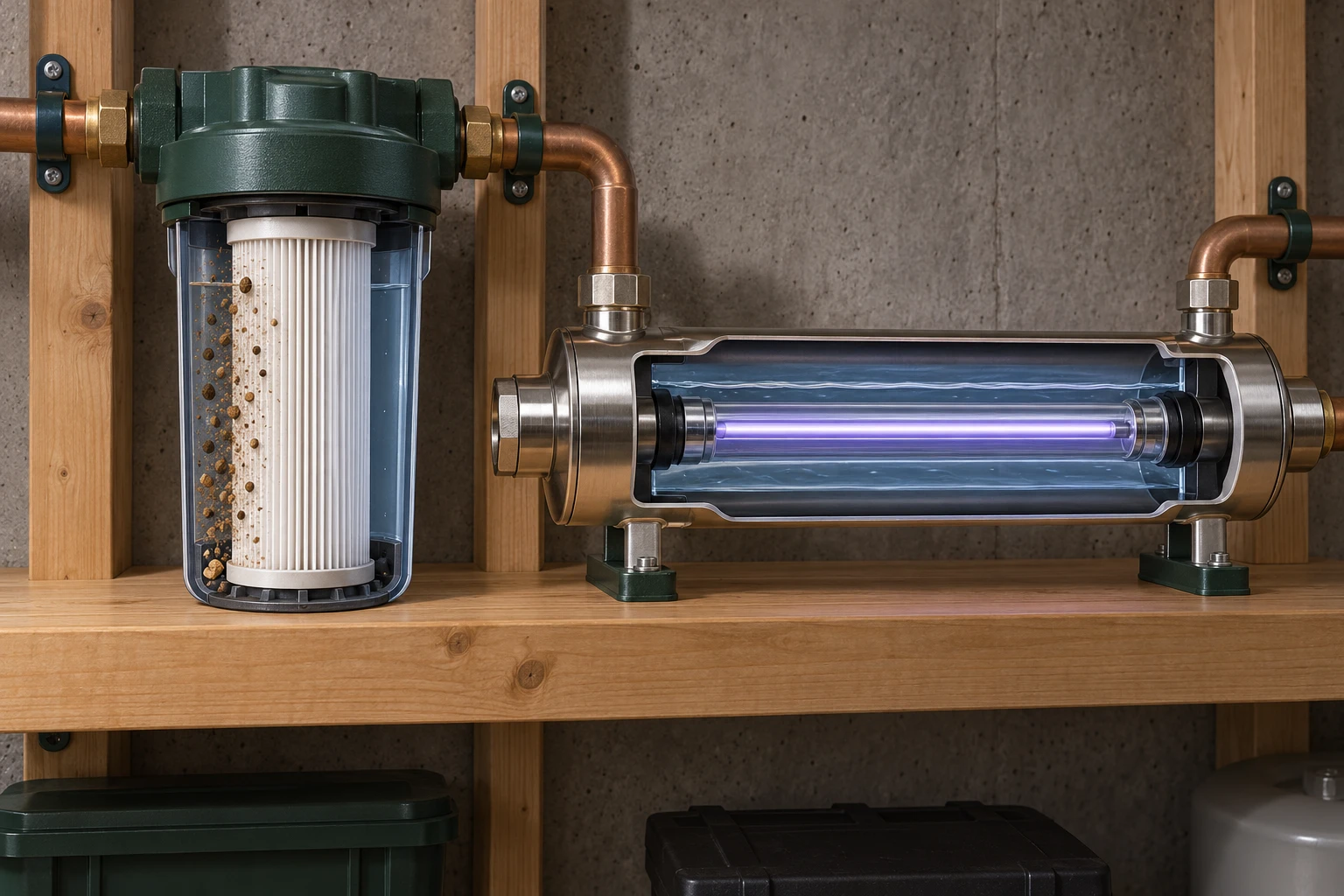
- Cartridge and particles
The pleated media and coarse particles illustrate physical retention. Ask which particle or contaminant claim belongs to the actual cartridge; a generic sediment filter is not a universal disinfection device.
- Lamp and surrounding water
The central lamp represents UV treatment of water passing around it. Ask about the exact unit, appropriate water quality and operating limits rather than relying on visible light.
- Maintenance and verification
A service record identifies work on the device. Water-quality findings need their own sampling purpose, location and date. Match the two records instead of treating either as a guarantee.
What does this illustration leave out?
The violet light is an illustrative tint, not a visible indicator of effective UV treatment. No flow direction, UV dose, controller, complete sleeve design, performance rating or service procedure is established. The drawn components are generic. This illustration explains an idea. It is not an installation guide.
What preparation and operating limits apply to this UV unit, and how will the actual water-quality question be checked?
Explore this with HomeAI ↗Opens an editable question. Nothing is sent until you choose to send it.Why do a filter and a UV unit often appear together?
Different stages can prepare water for different tasks. A filter may reduce particles before water reaches a UV chamber; the chamber then provides its specified microbial treatment. This is a sequence of complementary jobs. It does not mean that attaching any filter to any light creates an appropriate drinking-water system.
Ask the specialist to explain the sequence using the actual source-water analysis and equipment requirements. Which incoming characteristics need attention? Which stage addresses each one? What happens if a required stage is out of service? A diagram should make those dependencies understandable without becoming a universal installation drawing.
Keep the separate softener question in view when it is relevant. Softening principally changes hardness and has its own service and regeneration mechanism. It is not a substitute for a verified microbial treatment claim. The existing softener guide explains the resin, regeneration and drinking-water considerations rather than repeating them here.
A useful explanation ends at the fixtures the household uses. If a branch avoids the treatment sequence, the drawing should say so. If the route is unconfirmed, ask for confirmation before relying on the illustration. A treatment train is the connected sequence of devices; learning that term helps you read a proposal without accepting an unexplained bundle of equipment.
Four treatment mechanisms answer different questions
Filtration retains particles in media. Activated carbon can adsorb certain dissolved substances, meaning they stick to its surfaces. Reverse osmosis uses a membrane and separates treated water from a reject stream. UV uses light for microbial disinfection. Choose by the identified water concern and the exact verified product claim, rather than by calling every device a purifier.
Numbers identify the parts explained below.
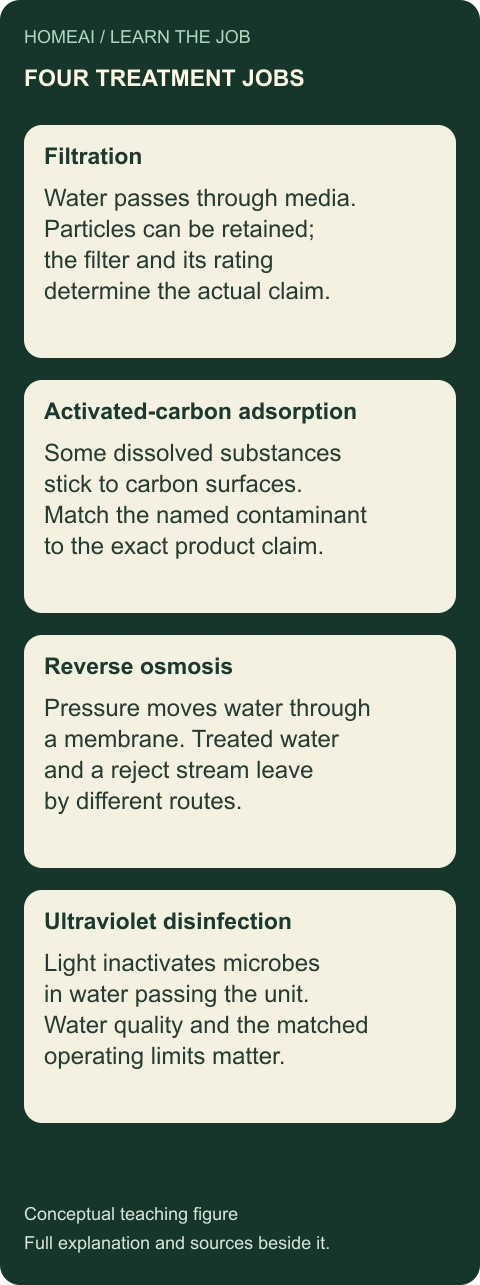
- Filtration
Water passes through media that retain particles. The exact filter, rating and certified claim determine what that statement means for a particular concern.
- Activated-carbon adsorption
Some dissolved substances attach to carbon surfaces. The word adsorption describes that attachment; it does not establish that every chemical or microbe is removed.
- Reverse osmosis
Pressure moves water through a membrane, producing a treated stream and a reject stream. Ask which verified claim, source-water limits and ongoing care apply to the identified unit.
- Ultraviolet disinfection
UV light inactivates microbes in passing water. Match the exact unit and its operating conditions to the microbial concern; it does not supply a universal chemical-removal claim.
What does this illustration leave out?
These mechanisms are a comparison, not a recommended treatment train. No device rating, contaminant removal percentage, UV class, installation or approval is specified. This illustration explains an idea. It is not an installation guide.
Which named contaminant or treatment goal does the exact model address, and what does its certification actually cover?
Explore this with HomeAI ↗Opens an editable question. Nothing is sent until you choose to send it.Four different treatment jobs
- Mechanical filtrationTraps selected particles in a filtering medium.
- Activated-carbon adsorptionSelected substances attach to the carbon surface; the matching claim matters.
- Reverse osmosisPressure drives separation through a membrane into product and reject streams.
- UV disinfectionLight affects microbes in the passing water; suitable water and exposure matter.
Conceptual mechanisms, not a treatment selection, device rating or installation drawing.
Further reading: Agriculture and Agri-Food Canada · Filtration: How does it work?; Agriculture and Agri-Food Canada · Polishing methods: Distillation and reverse osmosis; Agriculture and Agri-Food Canada · Disinfection: Why is it necessary?.
What should a certification claim actually match?
Match the complete device identity and replacement element to the contaminant claim. The cabinet name, cartridge name and model can matter separately. Health Canada’s guidance says certification verifies the performance claims covered by the applicable standard. It does not turn every promotional claim on the package into a verified result.
NSF’s current consumer resource offers separate searches for different contaminant-reduction claims. That is a useful model for your enquiry: start with the contaminant, then check the actual listed product. This guide has not searched or approved an installed model. A provider should show the relevant current listing and explain how it matches the supplied equipment.
A proposal should state the treatment objective in ordinary language, identify the certified claim relied on and name the operating conditions that matter. Ask for the manufacturer’s performance information and applicable manual rather than relying only on a badge in an advertisement. Preserve those documents with the quotation so substitutions can be assessed openly.
Read replacements the same way. A cartridge that fits the housing has not thereby inherited every claim of the original assembly. Ask whether the exact replacement belongs to the verified system and intended use. This is a product-matching question for the manufacturer, certifier or qualified treatment provider, not a reason to improvise parts from appearance.
Why might the treated tap deliver less water?
Describe where the change occurs before naming a cause. Is the concern confined to the dedicated treated tap, present at several ordinary fixtures or noticed only after prolonged use? Those distinctions help the provider decide whether to investigate treatment, a fixture, storage, supply pressure or more than one part of the system.
A filter with accumulated material is one plausible restriction. An RO system also has a production and storage arrangement to consider. Other household plumbing conditions can produce a weak stream independently of treatment. The water-pressure guide owns the wider delivery observation log; here the useful addition is identifying which treatment route serves the affected outlet.
Record ordinary-use circumstances: the outlet, date, approximate duration of use and whether another normal household demand was occurring. Report a sudden or substantial change promptly. Do not create a high-demand challenge, adjust pressure equipment or bypass the device to compare streams. The professional can choose suitable measurements within an agreed assessment.
Ask the completed explanation to connect the finding to the mechanism. “Filter serviced” names a task; an explanation of the identified restriction and subsequent check is more useful. If several causes remain plausible, the provider can state what additional assessment would separate them. Treatment quality and delivery should remain distinct questions even when they share equipment.
Keep delivery questions and quality questions distinct
- A weaker stream at one treated tapDescribe the location and ordinary-use context; ask about the actual treatment and fixture route.
- A cartridge replacementIdentifies stated work; confirm the exact element and matched system.
- A treatment controller indicationInterpret through the applicable manual and provider’s response plan.
- An accredited-laboratory reportInterpret its measured target, sampling location and circumstances.
These roles organize a professional enquiry; none supplies an owner bypass, reset or equipment-opening procedure.
Further reading: Health Canada · Well water and health: Treat your well water; Health Canada · Drinking water and health: Treatment.
How should routine care fit into normal ownership?
Make the care plan specific to the installed system. Name the device, component, applicable manual and responsible provider. Record the manufacturer’s maintenance requirements in the home file with the basis for any service reminder. A general article cannot supply one cartridge or lamp calendar that suits all products, water conditions and household use.
Separate the jobs in a service visit. Replacing a component, cleaning a permitted part, checking a controller and verifying water treatment are different deliverables. Ask which are included. A receipt should identify the actual component and work so a future owner can understand what changed rather than inheriting a vague “water system done” note.
Include a response plan for an interrupted treatment function. Ask what the household should do if power is lost, an alarm appears, the home is reopened after an absence or service has changed the arrangement. Obtain the matched provider’s instructions and local health advice where needed; do not compose a restart procedure from unrelated manuals.
Keep routine observation simple. Safely visible exterior status wording, a reported delivery change and existing paperwork can help the provider. Water near electrical equipment, a leak or unsafe access changes the task to obtaining appropriate assistance. There is no need to remove covers, sample inside equipment or manipulate valves to make the ownership file useful.
How do samples help verify treatment?
The device’s intended job determines the sampling question. Health Canada directs well-treatment users to accredited-laboratory testing of water entering and exiting the device to check whether desired contaminants are being removed. The provider and laboratory should agree the relevant parameter, locations, collection instructions and interpretation for the actual installation.
Keep a before-device location separate from an after-device location on the component map. Then retain the original reports with the collection date, parameter, units and circumstances supplied to the laboratory. If a tap serves stored water or a different branch, that context needs to be clear before the result is presented as evidence about one treatment stage.
A carefully scoped comparison can answer a treatment question while leaving others open. For example, measuring the selected chemical target is different from assessing microbial quality or delivery. Ask the laboratory to explain what its analysis covers and which follow-up is appropriate. Do not turn a home display or a taste improvement into a substitute for the agreed measurement.
Use the result to update the next action. The provider may recommend continuing the plan, investigating a stage or reconsidering the treatment design. Preserve its interpretation rather than converting the file into an unsupported permanent “safe water” score. For private sources, the separate well-care plan remains relevant to the source as well as the device.
Follow the water before comparing test results
A result becomes useful when you know where the sample came from and which device was operating on that route. Start with the water concern, identify the treated outlet, agree the sample locations with the laboratory or adviser, then keep results beside the device and service history. This makes a before-and-after comparison understandable without pretending that one sample describes every outlet or future condition.
Numbers identify the parts explained below.
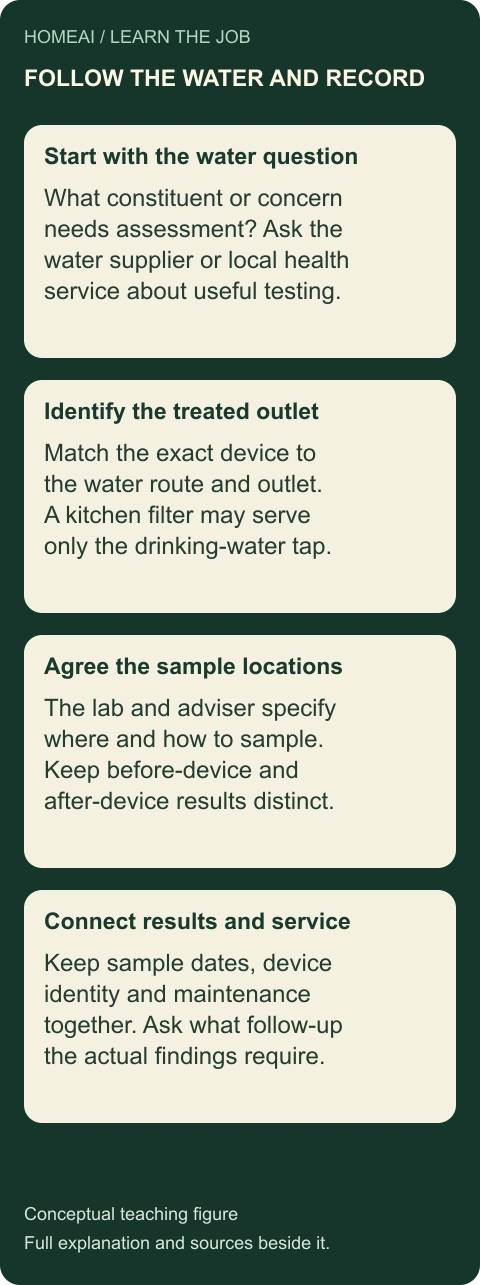
- Water concern
Ask the supplier or local health service which microbial or chemical question needs assessment. Taste and appearance alone are not a complete water-quality assessment.
- Device and outlet
Record the exact model and the outlets it serves. Identify whether the sample concerns incoming water, a treated drinking-water tap or another location.
- Agreed sample locations
The laboratory and adviser specify appropriate locations and collection instructions. Keep before-device and after-device samples clearly distinguished.
- Results and service history
Keep sample dates, reported constituents, interpretation and relevant maintenance together. Ask what the actual findings mean for follow-up and continued use.
What does this illustration leave out?
This is a record sequence, not a sampling procedure, universal testing interval or actual treatment result. Follow the laboratory and local health instructions for the circumstances. This illustration explains an idea. It is not an installation guide.
Do these results concern the same source, outlet and treatment conditions, and what follow-up does the adviser recommend?
Explore this with HomeAI ↗Opens an editable question. Nothing is sent until you choose to send it.How can two treatment proposals be compared fairly?
Start with the same question and source information for both providers. Ask each to name the target, intended treated outlets and proposed sequence of functions. One quote may concern a kitchen preference while another proposes whole-home treatment. Put that difference in writing before comparing totals.
Next compare the supporting work: source analysis, product matching, installation assessment, required local approvals, commissioning, ongoing verification and instruction for the household. Ask who coordinates each part. A proposal that supplies equipment only may leave other necessary work to you or another provider; that can matter more than the number of stages advertised.
Build an ownership comparison from actual quoted consumables and service requirements. Record included labour, replacement components, verification work and any separate charges. Ask how an identified issue or later change in source water would be handled. No generic annual cost or guaranteed service life is supplied here because the actual system and local proposal determine those quantities.
Seek clear handover teaching: explain the normal exterior indications, where the instructions are kept, who responds to a problem and how the treatment objective will be followed. Qualified treatment, plumbing, electrical and public-health roles may differ. A good proposal makes that coordination understandable instead of asking one reassuring product label to answer the entire water question.
Compare proposals using the same treatment question
- Purpose and destinationsWhich target or preference, which incoming water, which treated outlets?
- Functions and productsWhich stage does each job, using which matched device and claim?
- Installation and handoverWho confirms the actual arrangement, applicable approvals and household instructions?
- Ongoing care and verificationWhat components, service, laboratory work and response plan are included?
A scope worksheet; no quoted cost, service life, brand recommendation or approval is supplied.
Further reading: Health Canada · Drinking water and health: Treatment; Health Canada · Well water and health: Treat your well water.
How would a fictional owner work through a confusing system?
Fictional owner Noor moves into an invented home with an under-sink device, a separate treatment unit near the incoming supply and an invoice naming a replacement element. Noor notices that the dedicated kitchen tap slows after ordinary use. The equipment identities and actual treated branches have not yet been confirmed. No contaminated source or failed device is assumed.
Noor first asks the seller for the manuals, original treatment purpose and service paperwork. The provider’s first deliverable is a component map and matched model list. This could show whether the kitchen device is RO, another type of filter or something else, and whether the incoming unit serves the kitchen branch. The enquiry begins with functions rather than a shopping decision.
The delivery complaint is described separately: which tap, when it changed and the normal use immediately beforehand. A specialist can assess restriction, storage and supply conditions as appropriate. Noor does not open a housing, operate a bypass or force a controller reset. Any immediate unsafe-water instruction would take priority over this routine investigation.
The verification request then follows the identified treatment objective. The provider and laboratory agree the relevant entering and treated-water questions. Their reports and service findings are retained together. The example ends with a better-defined scope, not an invented laboratory concentration, a guaranteed repair or a declaration that the home’s water is safe.
What should the next owner be able to understand?
Leave a concise explanation of the installed treatment train, its purpose and the outlets it serves. Include the exact device and component identities, applicable manuals, certified claims used in selection and the provider’s contact. Someone opening the file should be able to explain what each stage does before trying to interpret its service history.
Preserve completed work and future tasks separately. A service entry belongs with its date and component; a laboratory result belongs with its sample context and interpretation. A requested model identification or unresolved route remains an open task. This makes the file useful for daily care, another service provider and a future handover.
Canadian conditions vary by source, local water supplier, public-health service and installation jurisdiction. National treatment education does not decide those local arrangements. Ask the responsible authority about applicable approvals and use the manufacturer’s actual Canadian-market instructions for equipment. Shared buildings also need the authorized operator involved in shared-system decisions.
The goal is practical understanding: know which job is needed, how the selected device performs that job, what preserves its function and how the result is checked. That gives owners a useful basis for maintenance and purchasing decisions without asking an appliance photograph, generic rating or single document to carry the whole answer.
Keep learning about the connected parts
- Know what your private well is supplying
- Water softeners: understand service, regeneration and the limits
- Water-service lines and lead: understand the evidence before buying
- Low water pressure: build a useful observation log
- How home plumbing works: supply, drains, vents and pipe materials
- Build a home-care record that the next person can understand
- Rainwater collection: follow the roof, the store and the overflow
Canadian context and authorities · Visual atlas · Learning labs
Practice the distinction.
A slow treated tap and two unidentified devices
Fictional Noor has an under-sink device, an incoming-supply unit and a replacement-element invoice. The actual models and branches need identification.
Reported observations
- The dedicated kitchen tap reportedly slows after ordinary use.
- An invoice identifies an element without a confirmed complete system match.
- No actual source-water or treated-water finding is supplied.
Compare the explanations
Expand each possibility to see the evidence needed to distinguish it. Similar symptoms can have different mechanisms.
A treatment or storage condition affects delivery
The identified system may require assessment of its filter, production, storage or other operating conditions.
A matched component map and provider’s scoped delivery assessment.
Another plumbing condition affects the outlet
A delivery complaint may involve the fixture or supply independently of treatment.
Appropriate professional measurements linked to the actual route and observed symptom.
A useful next question
Identify the devices and routes, scope the delivery assessment and agree target-specific verification without owner manipulation.
Fictional only; no measured contaminant, failed device, approved repair, health clearance or treatment performance is claimed.
Know what the words mean.
- Point-of-use treatment
- Treatment serving a particular use location, such as a dedicated drinking-water tap.
- Point-of-entry treatment
- Treatment at the incoming home supply serving the connected downstream plumbing.
- Filter medium
- The material water passes through in a filter; its intended particle or treatment task must be identified.
- Adsorption
- Attachment of selected substances to a surface, such as activated carbon, as water contacts it.
- Carbon exhaustion
- Loss of available capacity for the carbon’s intended adsorption task, which can occur while water still passes through.
- Reverse osmosis
- Pressure-driven movement of water through a selective membrane, producing treated and reject streams.
- Product water
- The treated-water stream produced by a membrane treatment process.
- Reject stream
- Water carrying material left behind by the membrane process toward the specified discharge arrangement.
- UV disinfection
- A treatment step exposing passing water to ultraviolet light to affect microorganisms’ ability to reproduce.
- Treatment train
- The connected sequence of treatment stages, each with its own function and operating requirements.
Questions to bring
to the conversation.
- What problem or preference is the device intended to address?
- Which outlets pass through it, and which confirmed branches do not?
- What does each stage do, and what incoming conditions does it require?
- Which exact model and replacement element match the claimed performance?
- Who defines maintenance, alarm response and laboratory verification for this installation?
Separate a showing observation, an existing record and a new professional assessment. Unknown means a question remains; it does not automatically mean a defect.
Use the evidence planner ↗Go to the source.
Original HomeAI explanation informed by these public references. Sources support the underlying guidance; they have not reviewed or endorsed HomeAI. Diagrams are conceptual, and calculator outputs depend on your inputs.
Source bodies were read October 10–11, 2026, with the actual date and retained extent recorded for each source; this guide was reviewed October 11. Federal guidance, AAFC rural-process examples and international certification resources have different scopes. Their generic numerical design values and maintenance intervals are not transferred to an installed home system. No disinfection, cartridge-opening, wiring, valve, bypass, pressure or restart procedure is provided. Current local water-use advice and the identified equipment’s applicable instructions govern the actual situation.
Publication & source review
First published .
Sources reviewed .
- Health Canada · Drinking water and health: Treatment
Where this reference applies
Jurisdiction: Canada; federal consumer treatment guidance
Edition: Page details December 5, 2025.
Source reviewed: 2026-10-11 · America/Edmonton
Reading scope: Complete substantive web body read October 10 and retained in web-primary-bodies.json. Ordinary HTTP timed out; no raw HTML capture is claimed.
Treatment need, exact certified performance claims, applicable standards and the distinction between Class A and B UV. No brand recommendation or installed-system approval.
- Health Canada · Well water and health: Treat your well water
Where this reference applies
Jurisdiction: Canada; individual well-water treatment context
Edition: Page details August 2, 2024.
Source reviewed: 2026-10-11 · America/Edmonton
Reading scope: Complete substantive web body, including all treatment and disinfection sections, read October 10 and retained in web-primary-bodies.json; ordinary HTTP timeout retained separately.
Point-of-use versus point-of-entry, contaminant-matched devices, entering/exiting accredited-laboratory verification and particle interference with UV. Shock-disinfection procedures are deliberately not reproduced.
- Agriculture and Agri-Food Canada · Filtration: How does it work?
Where this reference applies
Jurisdiction: Canada; rural-water process education
Edition: Date modified September 13, 2024.
Source reviewed: 2026-10-11 · America/Edmonton
Reading scope: Complete substantive body independently captured and read October 11 in independent-full-web-source-read.json, lines 18–107. Earlier web-primary-bodies.json contains metadata only for this source.
Particle trapping, activated-carbon adsorption, accumulation, flow restriction and exhaustion as distinct mechanisms. No rural design values, filter service intervals or universal household specification transferred.
- Agriculture and Agri-Food Canada · Polishing methods: Distillation and reverse osmosis
Where this reference applies
Jurisdiction: Canada; rural-water process education
Edition: Date modified September 13, 2024.
Source reviewed: 2026-10-11 · America/Edmonton
Reading scope: Complete substantive ordinary HTTP HTML/text captured and read October 10, including all mechanism, membrane, replacement and product-water sections.
Pressure-driven membrane separation, product/reject streams, pretreatment and storage functions. Historical generic membrane types, percentages, capacities and replacement intervals are not adopted as present product instructions.
- Agriculture and Agri-Food Canada · Disinfection: Why is it necessary?
Where this reference applies
Jurisdiction: Canada; farm/rural surface-water process education
Edition: Date modified September 13, 2024.
Source reviewed: 2026-10-11 · America/Edmonton
Reading scope: Complete substantive ordinary HTTP HTML/text captured and read October 10, including chlorination and UV; generic chemical values are not used.
UV exposure in a chamber, effect on microbial reproduction, particle/colour interference and sleeve deposits. No universal dose, flow, chemical programme or treatment design.
- NSF · Contaminant Reduction Claims
Where this reference applies
Jurisdiction: International certification body; product-claim lookup, not Canadian installation law
Edition: No substantive revision date established; current site copyright is not an edition.
Source reviewed: 2026-10-11 · America/Edmonton
Reading scope: Complete substantive body independently captured and read October 11 in independent-full-web-source-read.json, lines 24–111. Earlier web-primary-bodies.json contains metadata only for this source.
Shows separate contaminant-specific product searches. This guide makes no finding about a named product or whether any current listing covers it.
Have a question about your home?
Start with the symptom, timing and what you have observed.
Ask HomeAI