Jump to a question in this guide
- What does drain-water heat recovery actually recover?
- How can heat cross a wall without the water crossing it?
- Why does a shower offer a different opportunity from a bath?
- Where does the preheated clean water go next?
- Why are heat recovery and water delivery separate checks?
- What does a product rating tell me about my home?
- What can I safely record about an existing unit?
- What should a retrofit scope explain before work begins?
- Fictional example: does a copper coil prove energy savings?
- Which records should remain with the home?
- Heat crosses a wall; used water does not become clean supply water.
- Simultaneous flows and the actual onward supply route matter.
- Product ratings, completed plumbing work and household energy evidence answer different questions.
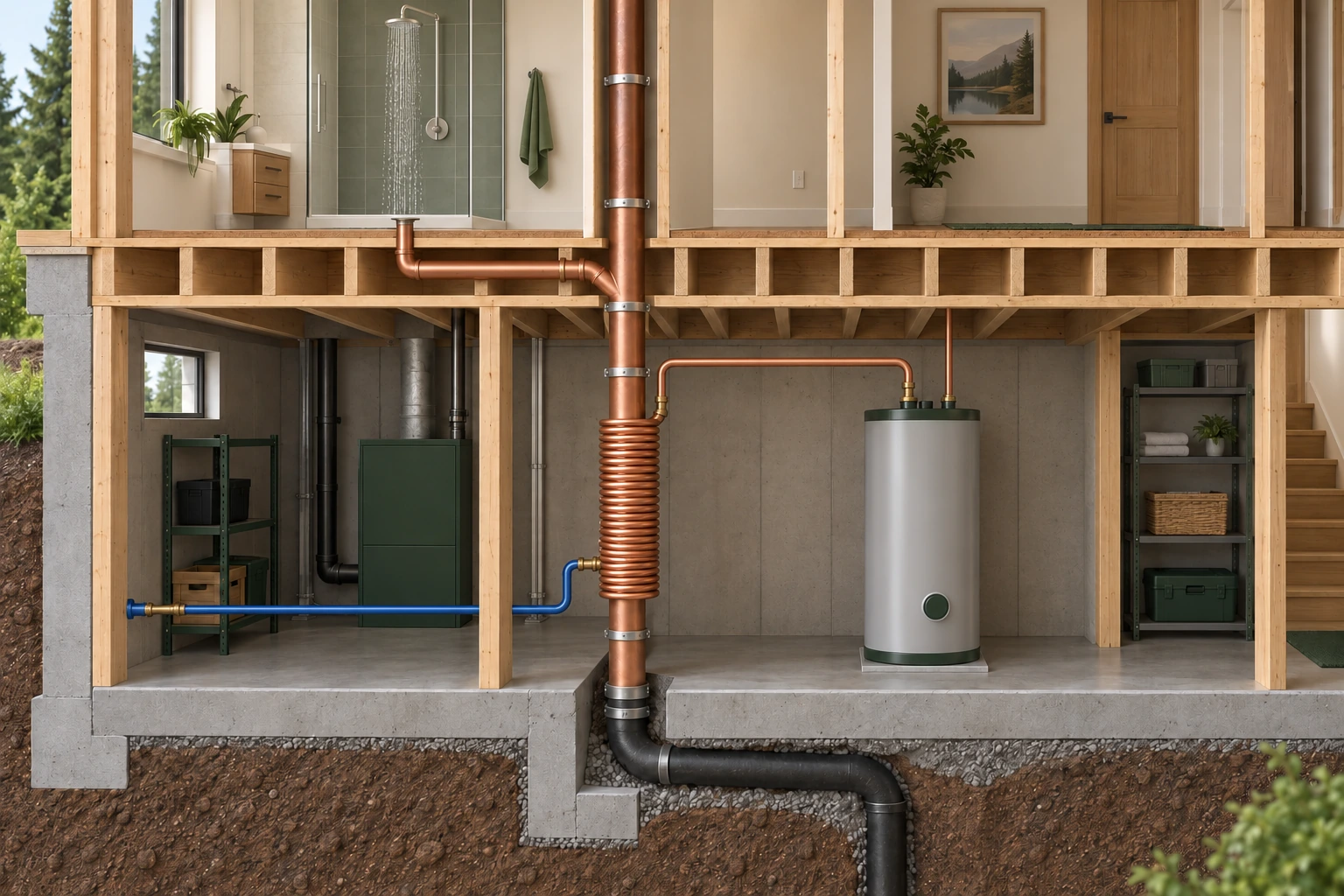
Used shower water follows the central drainage passage while the separate clean-water line enters the surrounding coil and continues toward the heater. Heat can pass between the separated streams. The shower trap and vent, full tank/control plumbing and mounting details are omitted.
About this illustration
Conceptual heat-recovery relationship, not complete plumbing: no approved route, pipe size, slope, mounting, mixing arrangement, water-quality finding or measured saving. This is a conceptual teaching model, not an assessment of your home.
6 picture lessons appear beside the questions in this guide. Use them to understand the explanation, then consider what it means for your home.
What does drain-water heat recovery actually recover?
A drain-water heat recovery unit recovers some heat from used water. It does not recover that water for drinking or send it back to the shower. In the copper-coil arrangement explained by Natural Resources Canada, warm water travels down a drain passage while incoming clean water travels through a separate passage around it. Heat passes through metal between them. The water streams stay separate.
Think of three different jobs. The shower receives supplied water for use. The drain carries used water away. The recovery unit lets some outgoing heat warm incoming water before that water continues through the documented supply arrangement. A water heater still has its own heating and temperature-control job. A copper coil beside a tank does not replace the heater or establish what any concealed pipe serves.
Start with that distinction when reading a renovation proposal. Does it describe heat recovery, water reuse, a new heater or a change in hot-water distribution? Those are different projects. A description such as efficient plumbing leaves the owner unable to see which job changes. Ask for a plain explanation of the proposed route and retain the actual product documents beside it.
This guide owns the heat-transfer and connection question. The water-heater guide owns equipment identification and care; the plumbing guide owns supply, drain and vent functions; the apartment-water guide owns shared distribution and management. Use those links rather than treating one heat-recovery purchase as an assessment of the whole water system. The drawings here are conceptual lessons, not layouts to copy.
Shower use connects two separate water journeys
Used shower water follows the central drainage passage while the separate clean-water line enters the surrounding coil and continues toward the heater. Heat can pass between the separated streams. The shower trap and vent, full tank/control plumbing and mounting details are omitted.
Numbers identify the parts explained below.
- Shower
Receives supplied water for use, then sends used water toward the drain.
- Drain passage
Carries used water away through its own identified route.
- Separate coil
Carries clean supply water beside the warm drain passage for heat transfer.
- Onward supply
Its actual destination needs documents and qualified confirmation.
What does this illustration leave out?
Conceptual heat-recovery relationship, not complete plumbing: no approved route, pipe size, slope, mounting, mixing arrangement, water-quality finding or measured saving. This illustration explains an idea. It is not an installation guide.
Which shower drain and clean-water route did the provider actually identify?
Explore this with HomeAI ↗Opens an editable question. Nothing is sent until you choose to send it.How can heat cross a wall without the water crossing it?
In the illustrated exchanger, the drain passage and surrounding coil are adjacent but separate. Warm used water is on one side of the heat-transfer walls and colder supply water is on the other. The wall provides a path for heat, while the passages give each water stream its own route. The incoming stream can leave warmer without containing the outgoing stream.
The useful distinction is between energy movement and material movement. Heat moving across the metal does not mean wastewater moves through it. A diagram that joins both water streams into one pipe would teach the wrong mechanism. The close-up therefore keeps separate passage boundaries visible, while the text explains heat passing through the metal between them. The static explanation remains complete without animation.
This principle does not establish the condition of an installed exchanger. Product construction, its suitability for the application and the actual connections need their own documentation and qualified assessment. Do not infer water quality, absence of leakage or approval from an attractive cutaway. A drawing can teach what separation means while leaving the real product unidentified.
Ask the plumber to identify both ends of the clean-water route and the drain route in the actual proposal. Where a route is concealed, request the relevant drawing or assessment rather than guessing from proximity. Never open a connection, remove insulation or feel hot pipework to prove transfer. The useful owner task is to understand the explanation and keep its evidence, not conduct an improvised exchanger test.
Heat crosses metal while the water stays separate
The central used-water passage and the exterior clean-water coil remain separate, with metal between them providing the heat-transfer relationship. Multiple exposed coil ends belong to this sectioned illustration; they do not depict an opened or leaking installation.
Numbers identify the parts explained below.
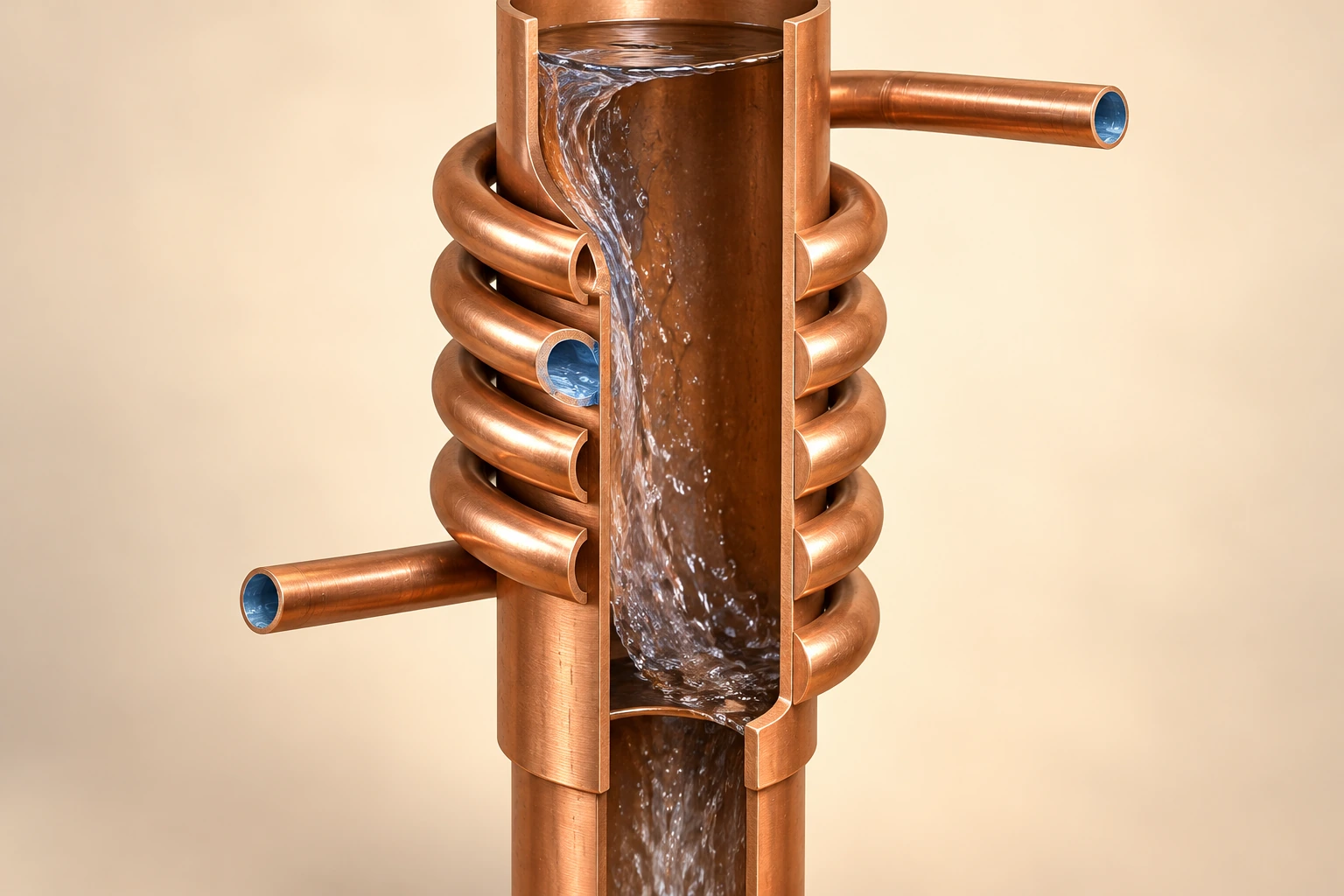
- Used-water passage
Keeps outgoing water on the drainage side.
- Metal between streams
Provides the heat-transfer relationship while separating passages.
- Clean-water passage
Keeps incoming water on its own onward supply route.
What does this illustration leave out?
Conceptual section, not exact product construction, wall dimensions, integrity, approval, water temperature or drinking-water condition. This illustration explains an idea. It is not an installation guide.
What documents identify the actual product and both water routes?
Explore this with HomeAI ↗Opens an editable question. Nothing is sent until you choose to send it.Why does a shower offer a different opportunity from a bath?
Recovery needs an available warm stream and a receiving stream under the arrangement being considered. NRCan highlights showering because warm water can be leaving through the drain while cold supply water is being drawn at the same time. The important word is simultaneous: the two useful flows overlap. The familiar shower journey makes that relationship easier to understand than a promise about annual savings.
Consider a bath as a contrasting timing question. Filling and draining can happen at different times. Do not assume that every litre of warm water used in the home presents the same recovery opportunity. Nor should an owner assume every fixture reaches the pictured drain route. Ask which ordinary uses and connected fixtures the provider included in the assessment.
The timing figure compares overlapping and separated events qualitatively. It uses labelled event bands rather than invented temperature or saving curves. There is no recommended shower duration, flow or temperature. Longer use is not offered as a way to improve a household result. Record existing household use only as far as needed for the provider to explain the proposed system.
A household with different routines may need a different assessment even when the unit is identical. The question is not how many people could theoretically use hot water; it is which ordinary uses the proposal actually assumes and how those assumptions connect to the heat-recovery route. Ask that before accepting a payback statement. A daily-use description is context, not a metered energy study or permission to repeat wasteful draws.
Recovery needs flows that overlap
A shower can send warm water down the drain while clean water is being drawn. Separated fill and drain events ask a different timing question; these bands show sequence only.
Numbers identify the parts explained below.
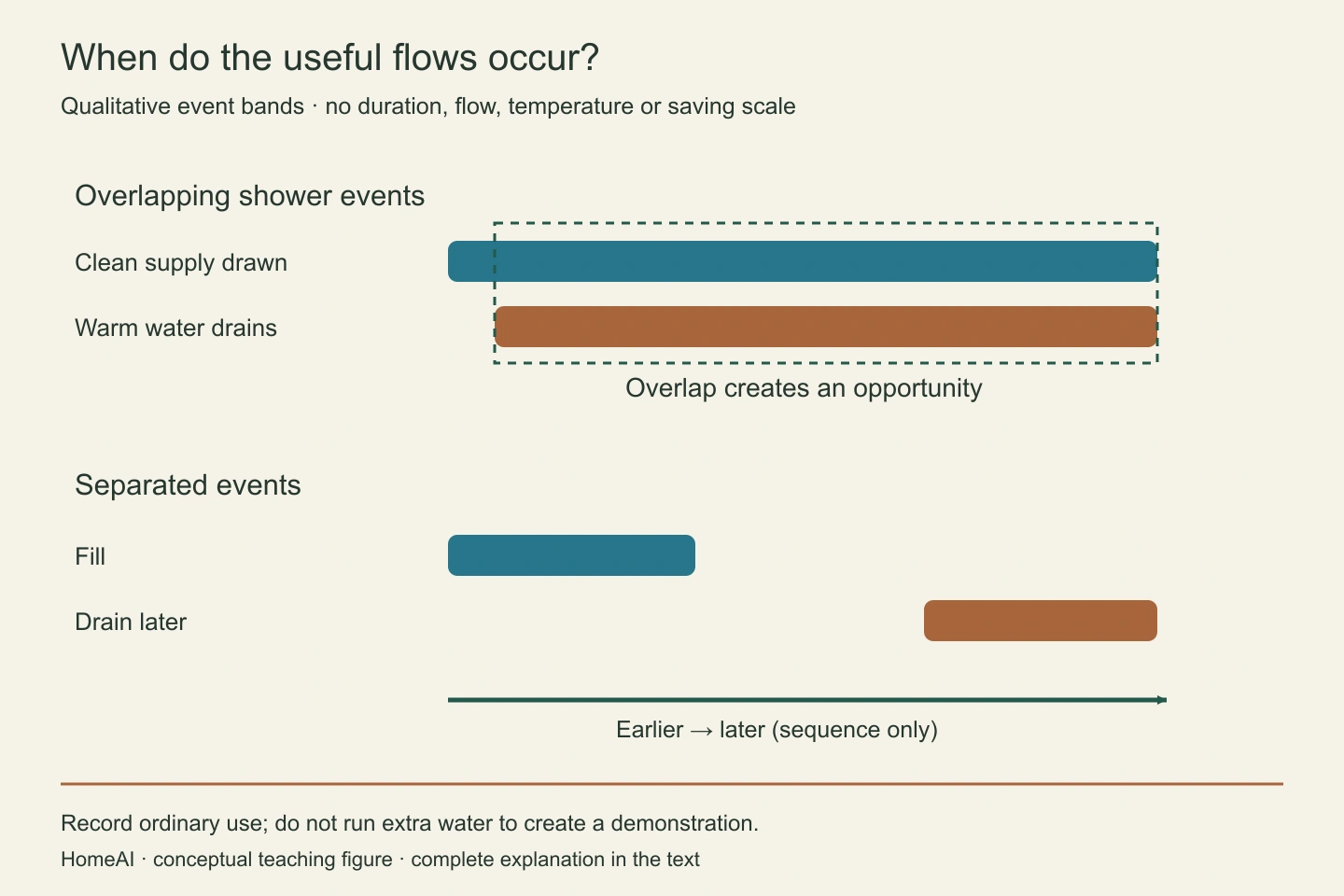
- Shower supply draw
Clean-water demand overlaps the warm drain event in this conceptual example.
- Warm shower drainage
Outgoing warm water supplies the heat opportunity while the receiving stream moves.
- Separated fill and drain
Warm drainage later does not establish the same simultaneous opportunity.
What does this illustration leave out?
Conceptual learning figure; no property measurement, approved installation or owner test. This illustration explains an idea. It is not an installation guide.
Which ordinary uses and connected routes did the assessment include?
Explore this with HomeAI ↗Opens an editable question. Nothing is sent until you choose to send it.Where does the preheated clean water go next?
The outlet route matters alongside the exchanger. A July 2025 National Research Council report studied selected arrangements sending preheated water toward a heater, a shower supply or both. Its Ottawa test-house work held the intended shower conditions comparable while examining different plumbing configurations. The broad lesson is that the surrounding plumbing can change the result from the same exchanger.
The native route map uses alternative, separately framed concepts. It does not present three branches as a single installation or tell a homeowner to change valves between them. The provider must identify the actual intended route, temperature-control arrangement and applicable requirements. A coil alone cannot reveal those relationships.
Ask where the proposal begins and ends. Does it include the shower drainage, exchanger, affected supply piping, retained heater connections and any relevant mixing controls? A mixing control blends streams to deliver its intended temperature under its design; it is not the same job as exchanging heat through a wall. Its exact relationship needs the actual documents and qualified explanation.
Keep the proposed route separate from the installed route. A sales sketch may show an option; an installation record should describe the completed work and changes. If the provider cannot confirm a concealed connection, leave it unknown. This guide supplies no preferred configuration, pipe size, slope, mixing setting or installation sequence. Regional examples in research are not current instructions for every Canadian address.
The outlet route changes the system question
Three separately framed concepts show preheated supply continuing toward the heater, shower supply or both. They are alternatives for professional explanation, not one installation or a valve-changing exercise.
Numbers identify the parts explained below.
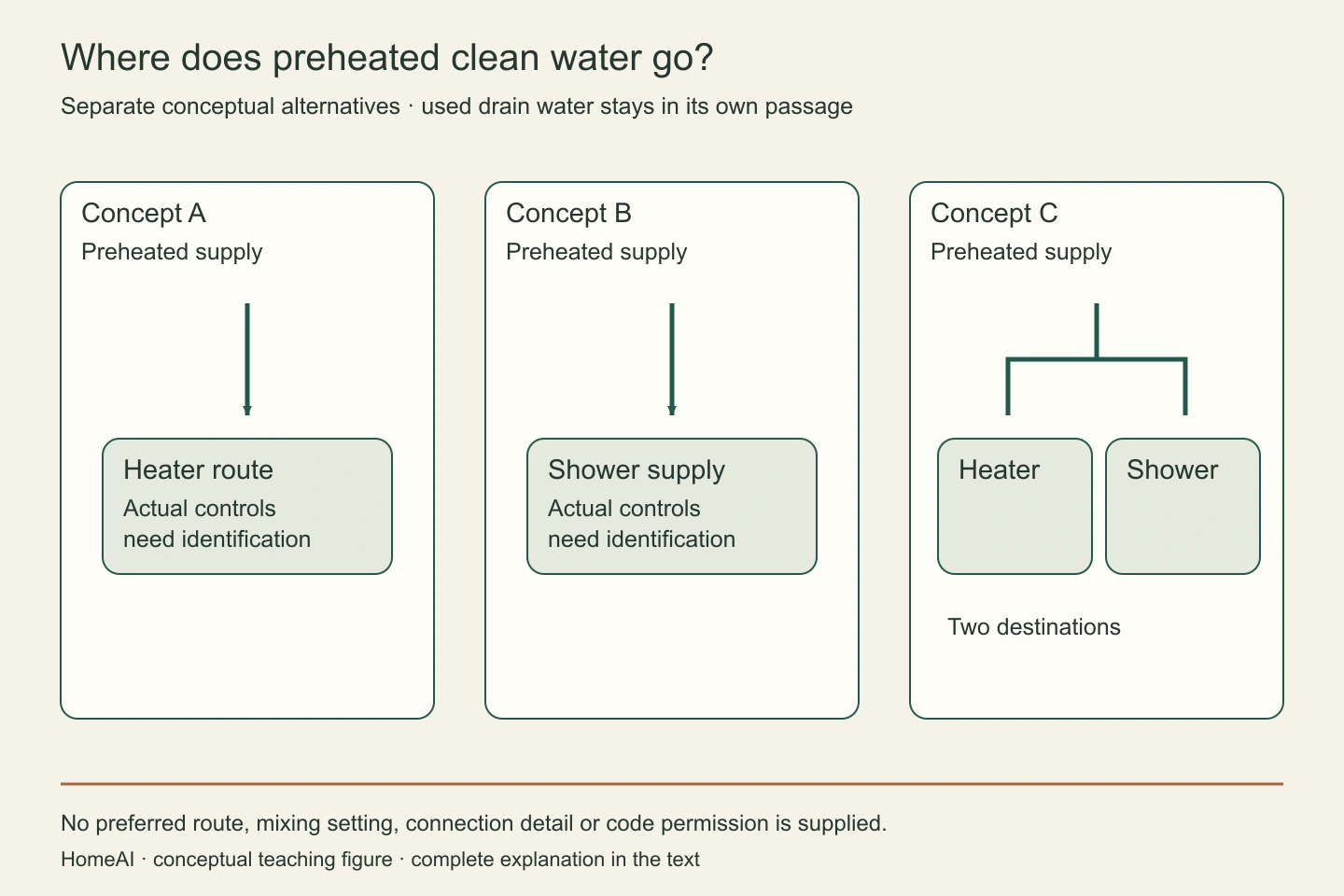
- Toward heater
Ask how the preheated stream joins the identified heating arrangement.
- Toward shower supply
Ask about the actual fixture and temperature-control relationship.
- Toward both
Ask how the two destinations affect the complete assessed arrangement.
What does this illustration leave out?
Conceptual learning figure; no property measurement, approved installation or owner test. This illustration explains an idea. It is not an installation guide.
What route and temperature-control arrangement are actually proposed?
Explore this with HomeAI ↗Opens an editable question. Nothing is sent until you choose to send it.Why are heat recovery and water delivery separate checks?
A useful proposal should explain both the intended energy job and continued water delivery. An exchanger can be discussed in terms of recovered heat while its connected clean-water route raises a separate flow and pressure question. Pressure describes the push at a location and condition; flow describes the amount passing over time. Neither can be established by looking at the coil.
The NRC report measured temperatures, flow and pressure at identified places. It showed why configuration and measurement boundary belong with a performance conclusion. Its particular test house, equipment and experimental conditions do not establish the effect of adding an exchanger in another home. Do not copy the report’s numerical results into a household quotation as guaranteed outcomes.
Ask the professional what assessment is appropriate for the current supply, existing equipment and proposed route. If the household already reports weak delivery or temperature changes, include those concerns before the work scope is agreed. A later complaint needs a qualified investigation rather than an assumption that the new unit must be responsible or could not be responsible.
Keep evidence by question: recovery performance, water delivery, temperature control and connection condition. One successful check should retain its defined scope. A record that the shower operated during handover is useful but does not measure annual energy, certify every connection or establish water quality. Do not run several fixtures, alter controls or attach instruments to create a home test. Let the appropriate professional choose and explain any required verification.
Each finding needs its measurement boundary
Temperatures, flow and pressure answer different questions at identified locations. A provider’s check needs its method and conditions; an annual saving requires a different comparison.
Numbers identify the parts explained below.
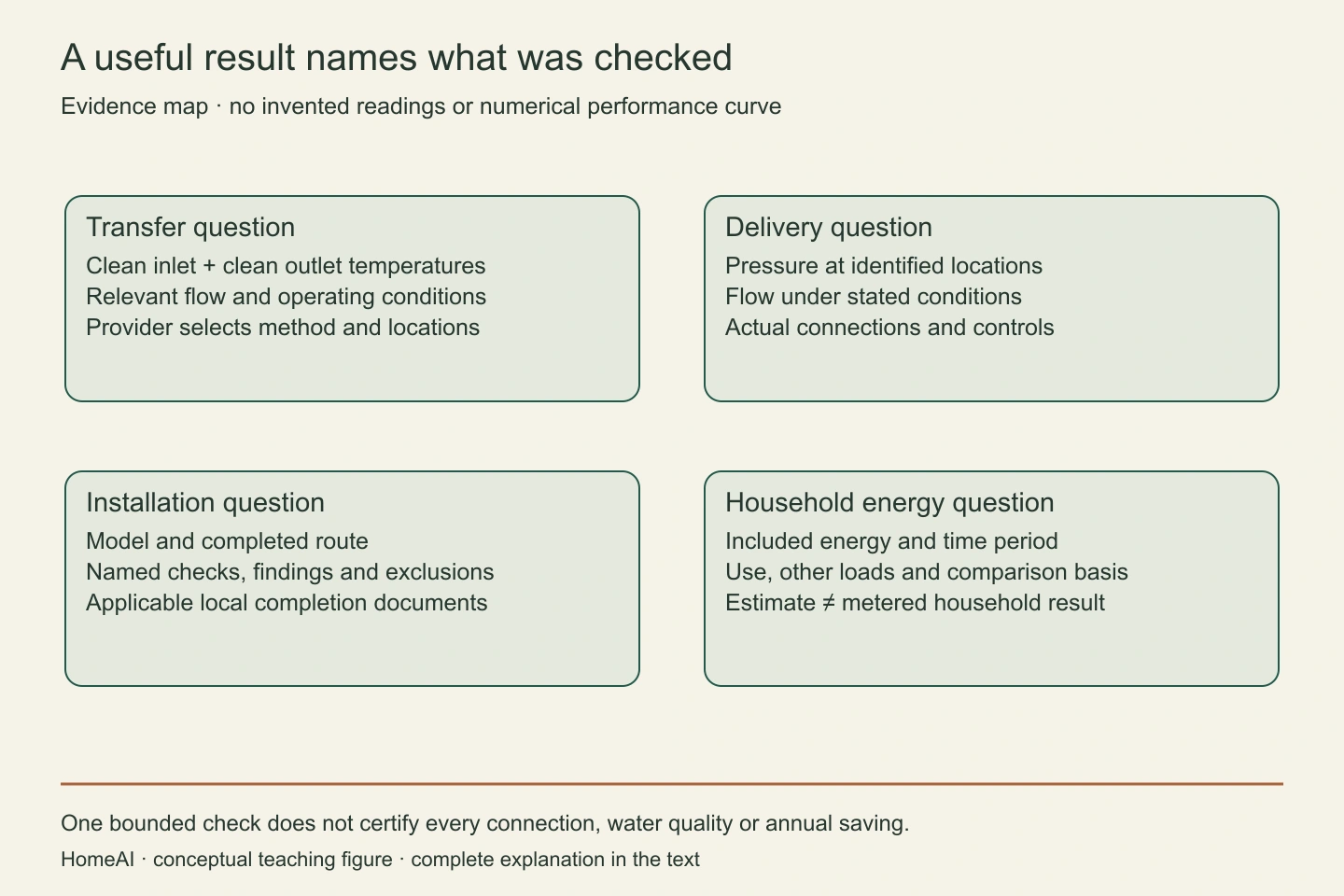
- Transfer measurement
Identify clean inlet and outlet temperatures, relevant flow, operating conditions and the provider’s chosen method.
- Delivery measurement
Name pressure locations, flow conditions, actual connections and controls; amount-over-time and push-at-a-location are different quantities.
- Installation record
Identify the model, completed route, named checks, findings, exclusions and applicable local completion documents.
- Energy comparison
State included energy and time period, use, other loads and comparison basis. An estimate is different from a metered household result.
What does this illustration leave out?
Conceptual learning figure; no property measurement, approved installation or owner test. This illustration explains an idea. It is not an installation guide.
Which method answers the household’s actual decision?
Explore this with HomeAI ↗Opens an editable question. Nothing is sent until you choose to send it.What does a product rating tell me about my home?
A rating belongs to an identified product and stated test basis. A household outcome belongs to an installed arrangement, conditions and use over a period. Keep those identities separate when reading efficiency claims. Ask which model, test method and configuration the supplier means, then ask how the proposal relates that information to the actual home. A prominent percentage without its basis is an unanswered question.
NRCan’s older listing page illustrates a source trap. The page explicitly warns that its displayed list is not up to date and points to an updated database. Its footer date does not refresh every legacy row. It also says NRCan does not endorse a product or contractor. This guide adopts no old model rating, eligibility claim or incentive from that list.
For an estimate, request the assumptions: connected uses, timing, incoming conditions, existing heating arrangement, included energy and local account basis. Ask whether the result is modelled, measured or a general example. Equipment cost, access work, restoration, service and financing are different entries again. This guide supplies no current tariff, quotation, payback period or saving percentage.
A before-and-after bill comparison also includes weather, occupancy, other water uses and other energy loads. Different bills can be real without isolating the exchanger’s effect. The existing energy-record guide helps organize quantities and periods. A specialist should explain what comparison can answer the investment question, rather than the owner assuming that the next lower bill proves the installation’s contribution.
What can I safely record about an existing unit?
Begin with paperwork: the installed model, matching instructions, invoice, route description, commissioning account and any applicable completion documents. Add the location and date of each record. A photograph from ordinary safe access can describe an already exposed closed unit, but a copper-looking coil does not authenticate the product or identify concealed connections. Leave absent details unknown until the provider confirms them.
Record an ordinary concern without reproducing it. Useful descriptions name where water was already noticed, which fixture changed, when the concern began and whether relevant work was recorded nearby. Separate a household report from a professional finding. Water near an exchanger could raise a connection, appliance or nearby-source question; its location alone does not identify the source.
Do not touch hot surfaces, dismantle piping, open cleanouts, remove finishes or change heater and mixing settings for evidence. Keep clear of wet electrical surroundings and obtain appropriate help. An active leak calls for the established household or building response and qualified assistance. Documentation should follow immediate safety, rather than prolonging exposure while photographs are collected.
Ask what care applies to the actual product and installation. No moving parts in the heat exchanger does not mean the surrounding plumbing needs no attention or that every condition can be assessed visually. Keep manufacturer instructions and provider advice together, including the responsible contact. No generic chemical cleaner, flushing recipe, temperature check or service interval is provided by this educational guide.
What should a retrofit scope explain before work begins?
A retrofit concerns the home around the device. Ask the provider which drain route is relevant, what supply route would change, what access is needed and what existing equipment remains. A visible basement stack does not establish that it serves the intended shower. The proposed location must be assessed using the actual product documents and local requirements, not selected from a generic picture.
Access and restoration belong in the written scope. If work affects walls, ceilings or shared services, ask who assesses and restores the affected assembly and who authorizes access. An exchanger invoice does not automatically include every surrounding finish or system. In a condominium or rental arrangement, confirm responsibility through the appropriate manager or owner before commissioning changes.
Ask which professional roles and authority processes apply at the address. Plumbing suitability, energy modelling and building responsibility are different tasks; one provider may cover several only when that scope is explicit. No nationwide permit rule or professional credential is assumed here. Request the actual required records and preserve proposed, authorized, installed and checked as separate stages.
Compare alternatives against the goal. Identifying unnecessary hot-water use, resolving a delivery complaint, maintaining existing heating equipment or assessing a different heating option may address different questions. A recovery project can be useful without being the first answer to every hot-water concern. Have the provider explain why the proposed work fits this household and what remains outside it, then use the existing contractor guide for changes and completion.
Fictional example: does a copper coil prove energy savings?
This example is entirely fictional. Noor finds a closed copper-coloured unit in an accessible utility area and an invoice saying heat recovery installed. A renovation drawing names a shower, but its status is unclear. Noor has no product model, confirmed route or recovery measurement. The available file shows reported work and a visible object; it does not establish the whole installed arrangement.
Noor asks the plumber to identify the equipment and explain the actual drain and clean-water routes. A hypothetical response supplies the matching manual and confirms the described shower connection, while excluding a concealed branch from assessment. Noor retains the confirmed scope and exclusion together. The story does not invent a defect or assume the missing branch is connected.
Two possible next questions remain distinct. If the purpose is routine care, the provider can explain the applicable instructions. If the purpose is assessing an energy claim, the provider needs the relevant use, system and comparison basis. A later lower bill would remain a whole-account observation until its attribution was supported. Noor does not run extra showers or change temperature controls to produce a result.
The fictional outcome is a clearer record and assignment, not a saving, installation approval, quote or water-quality result. Noor’s worksheet has fields for model identity, route status, document source, assessed finding and remaining question. An unknown stays visibly unknown. That makes a future service visit easier to specify without turning a photograph or short invoice into evidence it never contained.
Turn a visible coil into a precise record request
The fictional Noor record starts with a visible object and invoice, then asks for product and route identification. A finding and its exclusion remain together rather than becoming a blanket conclusion.
Numbers identify the parts explained below.
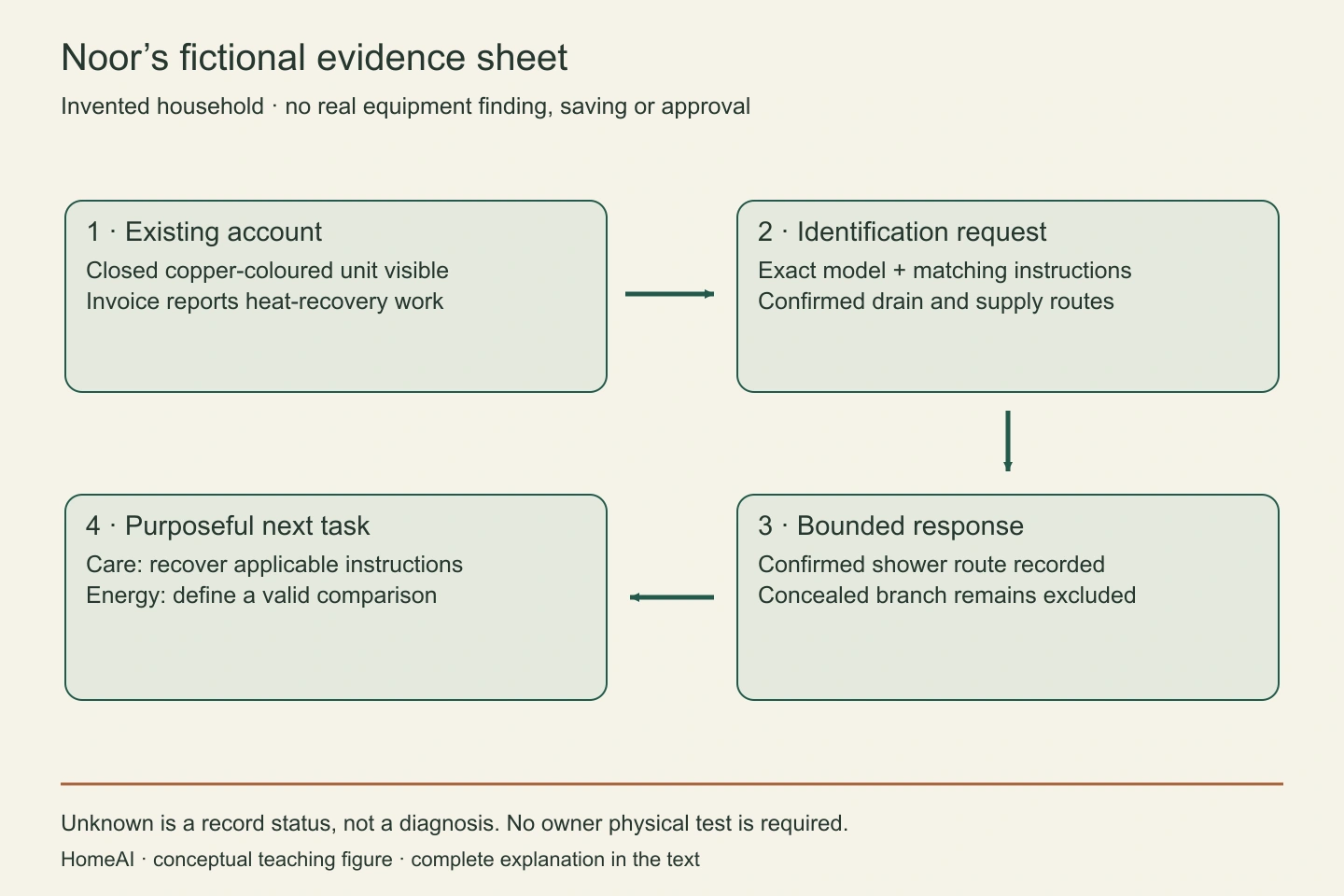
- Observed or reported
Keep a safe photograph and invoice labelled by what each says.
- Identified
Match the actual product, instructions and route to the provider’s account.
- Assessed scope
Retain the confirmed finding and excluded concealed branch together.
- Remaining decision
Routine care and an energy claim require different follow-up evidence.
What does this illustration leave out?
Conceptual learning figure; no property measurement, approved installation or owner test. This illustration explains an idea. It is not an installation guide.
What is established, and which remaining question needs a professional?
Explore this with HomeAI ↗Opens an editable question. Nothing is sent until you choose to send it.Which records should remain with the home?
Keep a short plain-language system account with the original documents: which fixture drainage is identified, where clean water enters and leaves the recovery unit, how the heater and temperature controls relate, and who confirmed each point. Label a conceptual drawing, proposed drawing and completed route record correctly. Preserve older versions when work changes the arrangement so later readers can understand the sequence.
The completion file should name actual equipment, work date, affected extent, checks and findings, applicable authority records and exclusions. Ask who will respond to a future concern and what care the matching instructions require. Completed installation, professional assessment and estimated energy benefit should remain separate entries. None automatically proves the other, and no record guarantees unchanged future condition.
Canadian source scope matters. NRCan offers federal education; NRC’s cited study concerns an Ottawa test house; actual building and plumbing requirements depend on the jurisdiction and work. Confirm them with the relevant local authority and qualified provider. Do not transfer a research report’s code discussion or a supplier’s preferred route into a national installation rule.
A useful owner should now be able to explain the mechanism: used water leaves, clean water arrives through a separate passage, heat can cross the metal between them, and the documented onward route determines how that preheat joins the system. The next practical step is to complete the evidence sheet from existing safe records and send the remaining specific question to the appropriate professional. No physical owner test is needed to make that request useful.
Keep learning about the connected parts
- Your water heater: build the right maintenance record
- How home plumbing works: supply, drains, vents and pipe materials
- Apartment water systems: risers, central hot water and shared response
- Hiring a repair contractor: carry evidence into scope, changes and completion
Canadian context and authorities · Visual atlas · Learning labs
Practice the distinction.
Noor’s fictional copper coil
An invented visible unit and short installation invoice lack model and route confirmation.
Reported observations
- A closed copper-coloured unit was visible from safe access.
- An invoice reports heat recovery work.
- The route drawing status is unknown.
Compare the explanations
Expand each possibility to see the evidence needed to distinguish it. Similar symptoms can have different mechanisms.
The file may identify a useful installed recovery route
Only product identification and qualified route confirmation can establish its extent.
Matching documents and the provider’s bounded findings.
The energy claim remains a separate enquiry
An installation record does not quantify this household’s savings.
Defined assumptions and suitable energy comparison.
A useful next question
Request model and route identification, then commission only the remaining decision-specific assessment.
All people and events are fictional; no actual saving, approval, defect, quotation or water result.
Know what the words mean.
- Heat exchanger
- A device that lets heat pass between separated streams through its intended construction. It does not imply that their water mixes.
- Preheated water
- Incoming water warmed before continuing through its documented supply route. The actual onward connection needs identification.
- Simultaneous flow
- Two relevant streams moving during overlapping time. It describes a recovery opportunity, not a recommended longer draw.
- Configuration
- The identified plumbing route and equipment relationships surrounding the exchanger.
- Pressure and flow
- Pressure describes a push at a location and condition; flow describes an amount of water passing over time. They need distinct measurement context.
Questions to bring
to the conversation.
- Which actual model and manual identify the closed unit?
- Which shower drain and clean-water routes were confirmed, by whom and when?
- What assessment covers delivery, temperature control and the proposed work?
- What comparison supports an energy estimate, and what remains excluded?
Separate a showing observation, an existing record and a new professional assessment. Unknown means a question remains; it does not automatically mean a defect.
Use the evidence planner ↗Go to the source.
Original HomeAI explanation informed by these public references. Sources support the underlying guidance; they have not reviewed or endorsed HomeAI. Diagrams are conceptual, and calculator outputs depend on your inputs.
Sources were read October 15, 2026. NRCan federal education and the NRC Ottawa research study have distinct scopes. The legacy product list is explicitly stale; no legacy model, grant, performance figure or current installation rule is adopted. The worked household is fictional and illustrations are conceptual.
Publication & source review
First published .
Sources reviewed .
Have a question about your home?
Start with the symptom, timing and what you have observed.
Ask HomeAI