Jump to a question in this guide
- What are you buying when a house includes a standby generator?
- How does fuel become electricity?
- What does the transfer equipment do?
- What happens through an automatic outage-and-return cycle?
- Which household functions would really remain available?
- Why do starting demand and load management matter?
- How do piped natural gas and stored propane change the enquiry?
- Why does the outdoor site matter as much as the cabinet?
- What starts the engine when utility power is missing?
- Does a scheduled engine run prove the house is backed up?
- If it runs but the house loses power, what could be different?
- Which installation and commissioning records should fit together?
- How should service history and present condition affect the decision?
- What needs to transfer to the next household?
- How would a fictional buyer evaluate a reassuring generator claim?
- What should a clear generator purchase summary say?
- Follow fuel, engine, alternator, transfer, selected loads and their dependencies as one system.
- An exercise run, transfer check, load verification and approval record answer different questions.
- Match the actual models, fuel/site conditions, service plan and intended household use; leave internal work and outage testing to qualified providers.

Fuel-burning generation, transfer equipment and connected loads work together. The outside cabinet represents the generator; the closed basement cabinets locate the power-distribution question. Heating, refrigeration and pumping have their own equipment and non-electrical dependencies. Start with the household function, then ask which actual installation and professional findings support it.
About this illustration
This conceptual house is not an approved generator site or circuit map. Cabinet internals, complete fuel/control paths, clearances and supplied loads are unverified. The illustration does not reconcile Health Canada’s six-metre public guidance with a specific fixed-unit installation. This is a conceptual teaching model, not an assessment of your home.
9 picture lessons appear beside the questions in this guide. Use them to understand the explanation, then consider what it means for your home.
What are you buying when a house includes a standby generator?
A standby generator is one part of a backup-power system. The engine uses fuel to turn an alternator, the alternator produces electricity, and transfer equipment connects the intended household loads to the appropriate source. Fuel supply, controls, starting power and a suitable outdoor location support that chain. Buying the cabinet does not tell you whether the chain serves the household functions you need.
Start with the reason the equipment matters to your purchase. Perhaps the house has a well, a groundwater sump, electrically dependent heating or a location where interruptions are inconvenient. List those functions in ordinary language. Then ask which actual equipment and connections support each one. A seller may accurately remember a successful outage without having evaluated your different heating equipment, occupancy or intended renovations.
The word whole-home can describe the connected arrangement without promising unlimited simultaneous use. A transfer switch serving the main distribution does not enlarge the engine or remove load-management decisions. Conversely, a smaller selected-load installation may intentionally cover the household priorities. Compare the design with the intended job rather than ranking systems by the largest number on a brochure.
This guide concentrates on an installed fuel-burning standby system during a property transaction. Portable equipment, home batteries and solar have different arrangements, covered in their established guides. An automatic standby system may include several brands or generations of equipment. Obtain identities for the generator, transfer equipment and any separate load controls before borrowing a manual or accepting a general explanation.
Keep your showing visit observational. Ask for records and view only normally accessible, closed equipment from a safe position. Do not open cabinets, start the engine, change a mode, interrupt utility power or ask someone to improvise a demonstration. If a CO alarm sounds, leave immediately for fresh air and call emergency services from outside; do not investigate the machine first.
The generator supports a chain of household functions
Fuel-burning generation, transfer equipment and connected loads work together. The outside cabinet represents the generator; the closed basement cabinets locate the power-distribution question. Heating, refrigeration and pumping have their own equipment and non-electrical dependencies. Start with the household function, then ask which actual installation and professional findings support it.
Numbers identify the parts explained below.
- Generator cabinet
The closed outdoor cabinet locates the power-producing equipment. Ask for its exact model, fuel configuration and service records.
- Transfer and distribution
The separate closed cabinets illustrate different jobs between sources and household loads. Their appearance does not identify their internal connections.
- Household equipment
The pump, heating equipment and refrigerator illustrate different useful functions. Ask which equipment and dependencies are actually supplied or managed.
What does this illustration leave out?
This conceptual house is not an approved generator site or circuit map. Cabinet internals, complete fuel/control paths, clearances and supplied loads are unverified. The illustration does not reconcile Health Canada’s six-metre public guidance with a specific fixed-unit installation. This illustration explains an idea. It is not an installation guide.
Which functions does the identified installed system actually support, and what remains outside its confirmed scope?
Explore this with HomeAI ↗Opens an editable question. Nothing is sent until you choose to send it.Follow a matched standby system from source change to supplied loads
Choose any stage or play the lesson. A complete pass from stage 1 lasts 64 seconds, with eight seconds per reading stage during playback. Paused and manually selected stages remain available as long as you need. These highlights are not physical cycle times, control settings, measured performance or a test result.
Conceptual sequence for the retained Generac 10–24 kW 60 Hz air-cooled family (2020 manual) and named Canadian RXSW transfer-switch family (2025 Rev D). Timing, capacity, fuel configuration and operation remain installation-specific. Ontario ESA requirements are labelled local.
- Utility source: The usual incoming electrical supply.
- Closed controller and starting system: Monitor the matched system and manage its automatic sequence; fuel and battery are separate dependencies.
- Engine and alternator: Convert fuel energy through mechanical motion into electrical output.
- Transfer equipment: Selects the supplying source and prevents feedback between the two sources.
- Selected loads: Depend on documented capacity, circuit coverage and any configured load management.
Paused at stage 1 of 8.
Keyboard: use Tab to reach a control and Enter or Space to activate it. On a stage button, Left/Right selects the previous/next stage; Home/End selects the first/last stage.
The utility normally supplies the connected loads
The normal source reaches the connected loads through the transfer equipment. The standby generator is another source, not a cord to connect to a household receptacle. The drawing omits wiring and switching instructions.
Useful question: Which circuits and transfer equipment are actually documented?
All eight reading stages
The utility normally supplies the connected loads
The normal source reaches the connected loads through the transfer equipment. The standby generator is another source, not a cord to connect to a household receptacle. The drawing omits wiring and switching instructions.
Useful question: Which circuits and transfer equipment are actually documented?
The matched controls recognize a source change
In the named automatic system, controls monitor utility conditions and manage the start sequence when the configured conditions are met. A utility interruption does not guarantee a successful generator start. Settings and delays belong to the actual equipment.
Useful question: What establishes the automatic configuration and its service status?
Fuel and battery support starting and operation
The engine needs its configured fuel supply, and the starting system depends on its battery and associated equipment. They have different jobs from the electrical transfer path. No fuel conversion, battery work or manual start procedure is supplied.
Useful question: What records identify fuel configuration, battery care and qualified service?
The engine drives the electrical generator
The fuel-burning engine provides mechanical motion to the alternator, which produces electrical output. Exhaust is a separate hazardous route outdoors. A running engine alone does not prove acceptable output or that a household load is being supplied.
Useful question: What professional findings establish output and safe exhaust conditions?
The transfer equipment selects the supplying source
The matched transfer equipment changes the load connection when its operating conditions are satisfied and prevents electrical feedback between utility and generator sources. The drawing never joins both sources together. Do not open or operate transfer equipment to replay it.
Useful question: What identifies the transfer model and completed professional verification?
Capacity and priorities determine the supplied loads
Connected coverage is not a promise that every appliance can run together. The named transfer family supports load-management options that can shed specified loads. Actual capacity, starting demands and configured priorities need their own records.
Useful question: Which loads and priorities were verified under the documented scope?
Utility return leads to the matched return sequence
The automatic system follows its configured conditions for returning loads to utility and completing the generator shutdown sequence. This lesson supplies no delay, threshold or manual switching instruction. Exercise running is also different from verified household load supply.
Useful question: What do the actual manual and commissioning record establish about return and exercise?
Keep safety, coverage and maintenance evidence distinct
Retain model, transfer, supplied-load and service records. Keep people away from hazardous equipment and exhaust. If a CO alarm sounds, leave immediately for fresh air and call emergency services from outside. A successful start, a transfer and an observed load outcome are separate findings.
Useful question: Who holds the service plan and the unresolved coverage or safety questions?
Use the source notes in this guide to check the named examples, adopted scope and limits.
How does fuel become electricity?
An engine converts fuel energy into mechanical movement. Inside the engine, the moving parts turn a shaft. The connected alternator converts that rotation into electrical output. This is why a standby generator needs both an engine-service plan and an electrical assessment: a running engine and electricity successfully delivered to household loads are different parts of the same system.
The conceptual cutaway shows a shaft connecting the engine and alternator. It shows a generic engine and alternator. The actual cylinder count, internal construction and service access belong to the identified generator model. The important relationship is that fuel, combustion, mechanical rotation and electrical generation have successive jobs. A photograph of a closed outdoor cabinet cannot reveal whether each is currently functioning as intended.
The reviewed Generac family uses natural gas or vapour from liquid propane, depending on its installed configuration. Other equipment must be identified on its own terms. Fuel type affects the applicable information and provider questions; the same external cabinet shape does not establish fuel configuration, output or the adequacy of the supply serving it.
Electricity also needs suitable characteristics for the loads and transfer equipment. The technical provider interprets the actual voltage, frequency, rating and protective arrangements for the identified system. These are not quantities a buyer should measure at open terminals. Request the professional findings and conditions rather than trying to reproduce commissioning from a simplified educational picture.
An engine makes heat and exhaust while producing useful power. Cooling air and exhaust therefore remain essential even if the engine sounds smooth. The outdoor enclosure manages and protects equipment; it does not make exhaust harmless or authorize an improvised shelter. Treat any proposed acoustic screen, landscape change or nearby building addition as a question for the installer and applicable authority before altering the site.
The conversion chain also helps you read a service scope. Engine work concerns the machinery producing rotation; electrical-output findings concern what the alternator and associated equipment deliver; household-load findings concern the installation beyond that point. Ask the provider to locate its findings along this chain. Clear boundaries make referrals useful instead of suggesting that one trade’s completed task must answer every connected question.
The engine turns the alternator; the alternator produces electricity
The engine produces mechanical rotation from fuel. The shaft carries rotation toward the alternator, where electrical output is produced. Those successive jobs explain why an engine run and a household-power finding are different evidence. The engine cutaway makes the mechanical relationship visible without asking a buyer to open an installed machine.
Numbers identify the parts explained below.
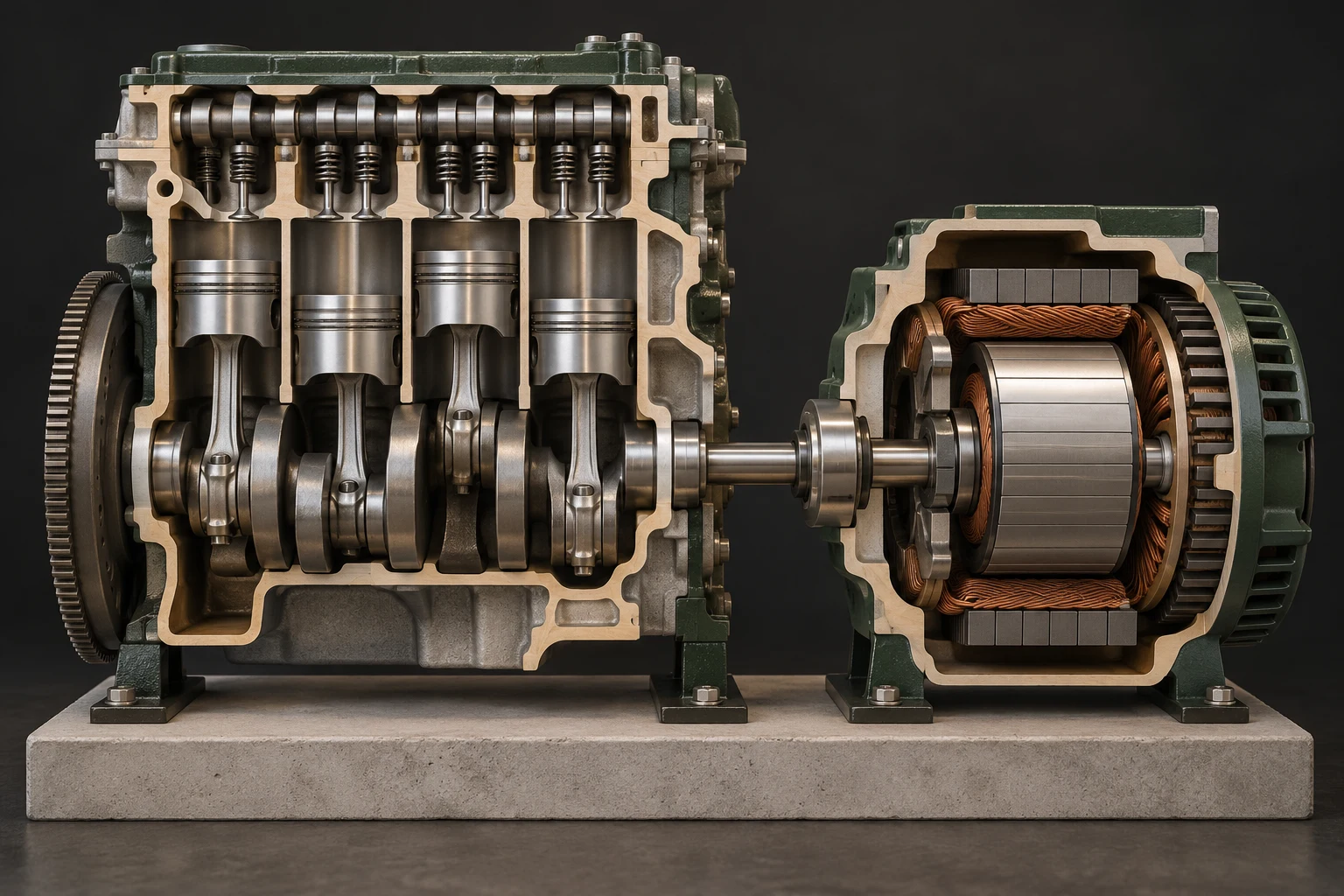
- Engine mechanism
The section shows pistons and a crankshaft as a conceptual engine mechanism. The useful lesson is conversion to rotation, not a service method.
- Connecting shaft
The shaft links mechanical rotation to the alternator. Ask which part of this chain the actual service finding concerns.
- Alternator section
The rotor and surrounding winding forms represent electrical generation. They establish no voltage, frequency, output or condition for real equipment.
What does this illustration leave out?
This generic multi-cylinder engine cutaway is not the reviewed air-cooled generator model, its actual cylinder count or service-access arrangement. No fuel system, output rating, live terminal, internal design approval or operating test is shown. This illustration explains an idea. It is not an installation guide.
Does the record concern engine operation, electrical output, transfer or the household load beyond it?
Explore this with HomeAI ↗Opens an editable question. Nothing is sent until you choose to send it.What does the transfer equipment do?
The transfer equipment chooses which source supplies the connected household loads. In the ordinary condition, those loads receive utility power. In the intended backup condition, they receive generator power through the designed transfer arrangement. The equipment also prevents generator power from feeding back into the utility system. That protective boundary is central to the installation, not an optional convenience.
Power connections and control connections do different jobs. Power connections carry the electricity serving loads. Control and sensing functions communicate source conditions and coordinate starting or transfer. The reviewed residential manuals describe both. A conduit between closed cabinets may contain relevant connections, but its appearance cannot establish the actual wiring, compatibility or functions within it.
The closed-cabinet teaching view helps locate the utility source, transfer equipment and distribution. It deliberately leaves live internal parts out of view. A separate native diagram explains the two-source relationship. Neither image is a connection drawing: neutral, grounding, protective equipment and installation details require the actual design and appropriately qualified professional assessment.
Ask who identified the installed transfer model and confirmed its match with the generator and service arrangement. Record separate accessories rather than assuming they are inside the main box. An installation invoice may name a generator package while omitting a later transfer replacement. Matching the actual equipment list to the drawing and work history helps reveal that specific gap.
Never connect a generator to a wall outlet or improvise a path into house wiring. Do not open or manually operate transfer equipment to settle an uncertainty during a purchase. Ontario ESA explains its notification and Licensed Electrical Contractor pathway; the appropriate authority elsewhere must explain the local process. A Canadian product designation does not establish that this installation has completed those steps.
Transfer equipment sits between sources and household distribution
The intended transfer arrangement selects which source serves the connected household loads and prevents unwanted feedback into the utility. Keeping the cabinets closed preserves the important buyer question: identify the actual transfer equipment and its match with the generator and distribution. A separate native sequence explains the automatic stages without exposing internal connections.
Numbers identify the parts explained below.

- Utility-source area
The meter-like enclosure locates the normal-source question. Ask which actual utility and service arrangement the professional identified.
- Closed transfer cabinet
The centre cabinet represents transfer equipment. Its two-source and control functions require the actual model and design records.
- Distribution and generator route
The right-hand cabinet and conduit toward the outside machine locate the connected-load question; hidden wiring remains unknown.
What does this illustration leave out?
The illustration contains simplified and duplicated meter-like forms. It does not verify a particular electrical topology, neutral/bonding scheme, service rating, control route, installation or clearance. No cabinet should be opened to reproduce this teaching view. This illustration explains an idea. It is not an installation guide.
Which equipment performs source transfer, and which professional records cover its installed functions?
Explore this with HomeAI ↗Opens an editable question. Nothing is sent until you choose to send it.What happens through an automatic outage-and-return cycle?
In a compatible automatic system, controls monitor the utility source. When the defined interruption condition persists, the system requests engine start. The engine starts and warms, and the system evaluates the conditions needed before transferring the connected loads. This sequence explains why engine noise can begin before household power returns. Those stages should be taught together, without turning the explanation into owner switching instructions.
After transfer, the engine and alternator supply the selected connected loads within the system limits. Loads can change as appliances cycle or people use equipment. Separate load-management devices may delay or shed particular equipment. The experience inside the home therefore depends on the installed arrangement, not simply on hearing an engine running outside.
When the utility returns, the control sequence verifies the applicable return conditions and transfers loads back. The engine may continue running during a cooldown phase before stopping. A short engine run after household lights return is not automatically a malfunction. Equally, this general sequence cannot explain every actual event; use the matched manual and the service provider’s interpretation of the recorded status.
The reviewed manuals contain model and setting dependent delays, conditions and exceptions. This guide intentionally gives no universal transfer time or promise of uninterrupted electricity. Equipment that must not lose supply even briefly needs its own continuity assessment. A household generator should not be assumed to meet a medical device’s requirements; involve the care team and an independent contingency plan.
For handover, ask the provider to explain each stage in plain language and identify what the actual commissioning checked. Request what happens if the utility recovers during starting, a protective shutdown occurs or a selected load is unavailable. Keep the explanation with the system identity and date. Do not simulate a utility failure or defeat a protective condition to see the sequence yourself.
Follow the complete automatic outage-and-return cycle
Controls detect the defined utility interruption and request engine start. The engine warms and suitable source conditions are considered before transfer. The generator then supplies connected loads while installed management may act. When utility return meets the intended conditions, loads transfer back and the engine completes cooldown. These stages explain the journey without prescribing a switch or control action.
Numbers identify the parts explained below.
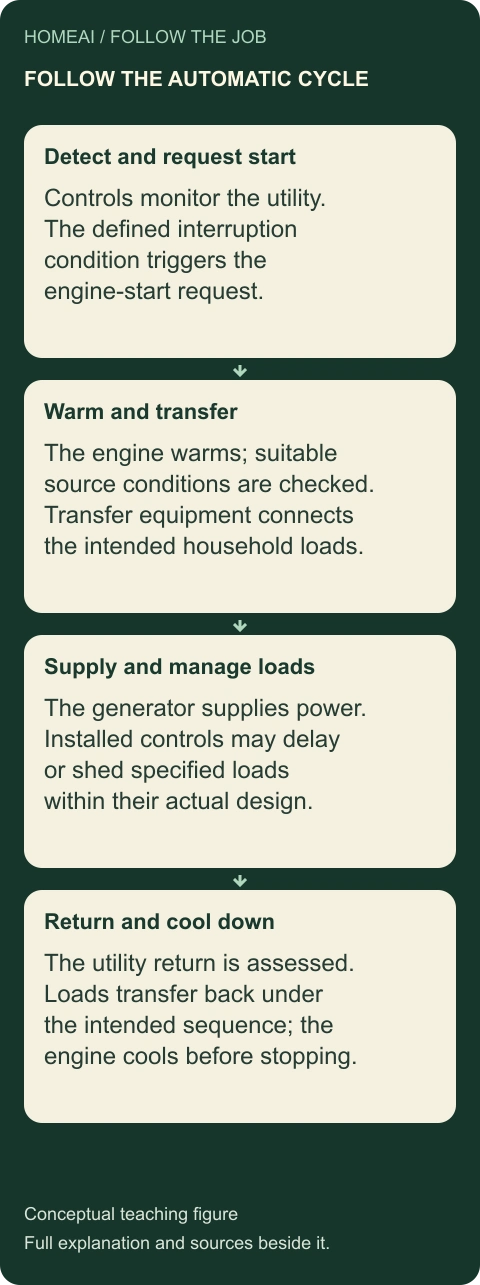
- Detect and request start
Controls monitor the utility. The defined interruption condition triggers the engine-start request.
- Warm and transfer
The engine warms; suitable source conditions are checked. Transfer equipment connects the intended household loads.
- Supply and manage loads
The generator supplies power. Installed controls may delay or shed specified loads within their actual design.
- Return and cool down
The utility return is assessed. Loads transfer back under the intended sequence; the engine cools before stopping.
What does this illustration leave out?
Conceptual model-dependent sequence, not universal timings, settings, uninterrupted power, a completed test or owner switching instructions. This illustration explains an idea. It is not an installation guide.
Which of these stages did the qualified provider actually verify, for which equipment and loads?
Explore this with HomeAI ↗Opens an editable question. Nothing is sent until you choose to send it.Four different jobs in the backup chain
- Engine and alternatorConvert fuel into mechanical rotation and electrical output.
- Transfer equipmentSelects the appropriate source for the connected loads and prevents unwanted feedback.
- Load managementTemporarily prioritizes or sheds identified equipment under defined conditions.
- Household functionDepends on the actual supplied equipment, controls and non-electrical services.
Conceptual function comparison, not an installation drawing, wiring method or approval.
Further reading: Generac · 60 Hz Air-Cooled Generators owner manual, A0000973303 Rev. A; Generac · RXSW100A3CUL / RXSW200A3CUL transfer-switch owner manual, 10000022845 Rev. D; Electrical Safety Authority · Generator safety.
Which household functions would really remain available?
Begin with a function and follow all its dependencies. Keeping a house warm may require fuel, a furnace or other heat source, controls, an air-moving or water-circulating device and suitable distribution. Supplying electricity to one labelled circuit does not by itself establish that the whole heating function remains available. Ask the relevant providers to identify the actual chain.
Water service may depend on a well pump and its controls, while a groundwater sump has a separate collection, pumping and discharge job. Backup electricity can support a pump without proving that its water route is clear, its controls function or its receiving route is appropriate. The existing sump and well guides own those mechanical and water questions; the backup schedule should connect to them explicitly.
Refrigeration, lighting and communications also need precise descriptions. A kitchen circuit entry may not identify every appliance or outlet. A router with electricity still relies on the relevant network equipment and an available external service. Ask what was actually included and verified rather than replacing an equipment list with reassuring room names.
Request a backup-load schedule showing confirmed supplied equipment, excluded equipment and managed equipment. Managed means that the system may temporarily prevent or delay operation under defined conditions; it should not silently be presented as always available. Retain the person and method that established the schedule. A handwritten panel directory can help identify a question without becoming a verified circuit map.
Tell the designer about planned changes. A new electric heater, vehicle charger, heat pump, workshop or suite can change the intended demand and priorities. The original scope may have suited a different household. This is a reason for a specific design review, not a reason to run every appliance during a showing or assume a larger generator is the only solution.
A useful worksheet has one row per household function. For the invented water-pump row, write the actual pump identity, controls, confirmed backup connection, any managed status and the relevant provider’s finding. Put the discharge or well-delivery concern in a separate field rather than marking water simply protected. For heating, use the same approach with the heat source, air or water mover and controls. This makes excluded dependencies visible while avoiding an unqualified circuit diagram. The provider can correct the worksheet against the installation; the buyer’s first draft remains a question list.
Heating and pumping need their complete working chains
The refrigerator, heating equipment and pump perform different household jobs. Electrical backup can support a connected device while fuel, air or water routes still need their own assessment. The picture helps organize those dependencies so a backup schedule names the useful function and the parts that make it possible.
Numbers identify the parts explained below.

- Refrigeration
Identify the actual appliance and confirmed backup connection rather than assuming every kitchen outlet is supplied.
- Heating and air movement
The heating cabinets and duct represent heat production and distribution. The picture does not establish their configuration or performance.
- Pumping and discharge
The pump and visible pipe illustrate lifting water toward a separate discharge route. Electrical supply cannot prove the complete water function.
What does this illustration leave out?
The pump-pit section is a conceptual exposed teaching view, not an owner-access or lid arrangement. Complete electrical circuits, heating design, pump controls, water collection and discharge destination are not established. No shown equipment is confirmed powered. This illustration explains an idea. It is not an installation guide.
Which load and non-electrical dependencies remain necessary for the household function you intend to rely on?
Explore this with HomeAI ↗Opens an editable question. Nothing is sent until you choose to send it.Why do starting demand and load management matter?
Power describes the rate of electricity supplied or used. Several loads operating together create a combined demand, and some motor-driven equipment has a different starting requirement from its running requirement. A system that can support an established running combination may face another question when equipment starts. The designer must consider the actual loads and operating conditions, not just a monthly electricity bill.
The transfer switch’s current rating and the generator’s power rating describe different components. A large transfer enclosure or service rating does not establish generator output. Read the actual product data with units, fuel configuration and conditions intact. Avoid converting one number into a whole-home promise or treating a supply breaker label as a measured amount of power available.
Load management organizes demand. The reviewed Canadian CUL-model manual describes priorities and shedding of specified loads to help avoid overload. A practical explanation should name which household equipment is managed, how that affects availability and which assumptions were used. It should also distinguish installed controls from optional catalogue features that were never supplied.
For example, a fictional design might prioritize a water pump while managing an optional large appliance. That priority describes a design intention; it does not prove the actual pump starts or the management device responds. Ask which professional verification covered the installed combination and how the operating result was recorded. No fictional power figure is needed to make the dependency understandable.
A changed load list deserves review with the generator provider and electrical contractor. A larger energy source does not resolve incompatible controls, unassessed wiring or a missing transfer path. Do not create an overload, repeatedly cycle motors or disable management to challenge the system. The useful buyer deliverable is an explained design and a bounded professional finding for the equipment you intend to rely on.
Trace the complete function before calling it protected
A household need can depend on several pieces of equipment and non-electrical routes. Identify the heating chain or pumping chain first, then distinguish confirmed supplied loads from managed or excluded ones. Keep the provider’s verification boundary visible so a room name does not become a promise about every appliance, control or downstream function.
Numbers identify the parts explained below.
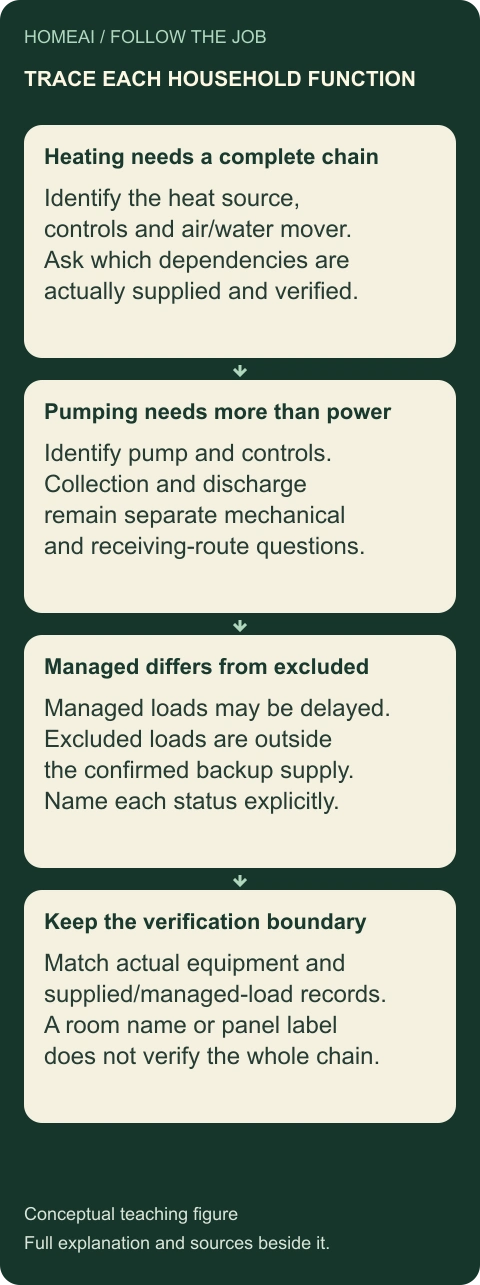
- Heating needs a complete chain
Identify the heat source, controls and air/water mover. Ask which dependencies are actually supplied and verified.
- Pumping needs more than power
Identify pump and controls. Collection and discharge remain separate mechanical and receiving-route questions.
- Managed differs from excluded
Managed loads may be delayed. Excluded loads are outside the confirmed backup supply. Name each status explicitly.
- Keep the verification boundary
Match actual equipment and supplied/managed-load records. A room name or panel label does not verify the whole chain.
What does this illustration leave out?
This is a question worksheet, not an actual circuit schedule, wiring diagram, installed load-control configuration or proven household result. This illustration explains an idea. It is not an installation guide.
Can the actual backup-load schedule explain every dependency of the household function?
Explore this with HomeAI ↗Opens an editable question. Nothing is sent until you choose to send it.How do piped natural gas and stored propane change the enquiry?
A piped natural-gas installation receives fuel through a service and connected gas piping. A propane installation uses stored fuel and a suitable delivery arrangement for the identified engine. Both still require the actual supply and equipment to be matched. Seeing a meter or a tank identifies part of the fuel story without establishing pressure, available delivery, configuration or current condition.
Ask the qualified gas provider how the generator demand was considered alongside other connected appliances. An existing house gas service is not automatically evidence that a later generator addition was fully assessed. Preserve the fuel work description, applicable approvals and commissioning findings with the electrical records. These are related disciplines with different responsibilities.
For stored fuel, identify the tank, ownership or supplier arrangement, service responsibility and replenishment plan. Ask the provider what information is relevant to dependable supply for this installation and climate. Tank appearance, a remembered delivery or a simple volume division cannot guarantee outage duration. Demand changes, usable supply and delivery conditions require the actual equipment and provider’s assessment.
Keep the contract question separate from technical suitability. A tank or monitoring device may be owned, rented or supplied under an agreement. Your transaction and legal advisers should establish what transfers, which permissions or notices are needed and what ongoing obligations apply. Do not assume a visible tank is included outright or that a seller’s service account becomes yours automatically.
When comparing two properties, compare complete fuel arrangements rather than ranking natural gas against propane in the abstract. One file may contain a matched demand assessment and a clear service responsibility; another may leave the supply configuration unidentified. The difference is the evidence available for your intended reliance. Ask each provider the same questions about the actual equipment, supply, seasonal conditions and continuity limits. Do not turn a supplier’s general availability statement into a promise that fuel will always reach the engine throughout a widespread emergency.
The two-picture fuel comparison shows separate conceptual properties, not two approved alternatives at one address. It supplies no pipe sizing, regulator adjustment, tank placement or conversion procedure. If gas is smelled or a fuel leak is suspected, keep away from the concern and obtain the local emergency/utility response from a safe location. A purchase enquiry must never delay immediate safety action.
Piped fuel and stored fuel need different supply questions
The left concept illustrates a pipe-fed fuel arrangement; the separate right concept illustrates stored fuel. Both require the actual generator configuration, suitable delivery and responsible provider to be identified. For stored fuel, the tank and supplier agreement add ownership and replenishment questions. Compare complete arrangements and evidence rather than choosing from cabinet appearance.
Numbers identify the parts explained below.

- Pipe-fed concept
The meter and pipe locate the supply question. The qualified provider must assess the actual demand, route and installation.
- Stored-fuel concept
The tank-shaped vessel locates storage and delivery questions. Ask which actual agreement and responsibilities apply.
- Separate generator configurations
Similar cabinets do not establish identical fuel configuration, output or suitability. Match each exact model and provider’s assessment.
What does this illustration leave out?
These are separate conceptual properties, not approved siting alternatives. No pipe size, regulator detail, tank capacity, setback, actual fuel identity from colour, Canadian approval or guaranteed supply is established. Site clearances must not be copied from this picture. This illustration explains an idea. It is not an installation guide.
What technical fuel evidence and actual supplier or ownership agreement belong with this installation?
Explore this with HomeAI ↗Opens an editable question. Nothing is sent until you choose to send it.Why does the outdoor site matter as much as the cabinet?
The generator needs its intended cooling airflow and a location where exhaust does not create an indoor exposure hazard. Nearby doors, windows, air intakes, buildings and landscape changes therefore matter to assessment. A cabinet manufactured for outdoor use is not evidence that every outdoor position is suitable. Ask the installer to explain the actual site using applicable instructions and local requirements.
Health Canada’s current public guidance says fuel-burning generators belong outdoors at least six metres from buildings, with exhaust directed away from openings. Fixed standby manuals can contain installation-specific provisions. Do not resolve a difference by choosing the shorter distance or measuring a teaching picture. Require the qualified installer and responsible authority to reconcile the actual model, site and current Canadian guidance.
Snow, vegetation, water and later construction can change a previously understood site. Ask about the location in the season when the equipment may be needed. The reviewed generator manual warns against blocked airflow, standing water and water directed toward the equipment. The winter illustration makes those relationships visible without proving a drainage result or establishing a snow-clearing method.
Request the actual cold-weather provisions and their maintenance responsibilities for this model. An accessory visible on a quotation may be absent, unsuitable or later altered. A general operating-temperature statement does not guarantee identical starting or output in every local condition. Keep cold-weather equipment, fuel, starting battery and service arrangements in the same discussion rather than substituting a vague Canadian-climate assurance.
Observe site changes from a safe ordinary route, with equipment closed and no contact. Do not cover the machine, build a shelter, clear within hazardous areas while it can start, or hose the cabinet to investigate water. Following submersion or flooding, obtain qualified advice before reliance or operation. Exterior neatness and one dry-weather visit leave important seasonal conditions unobserved.
Snow, airflow and water routes belong in the site assessment
The outdoor generator needs its intended airflow and a professionally assessed exhaust location. Roof drainage, pumping discharge, snow and later landscape changes create separate site questions. This view puts them together so the buyer can ask how the actual installation was considered in the season when it may be needed.
Numbers identify the parts explained below.
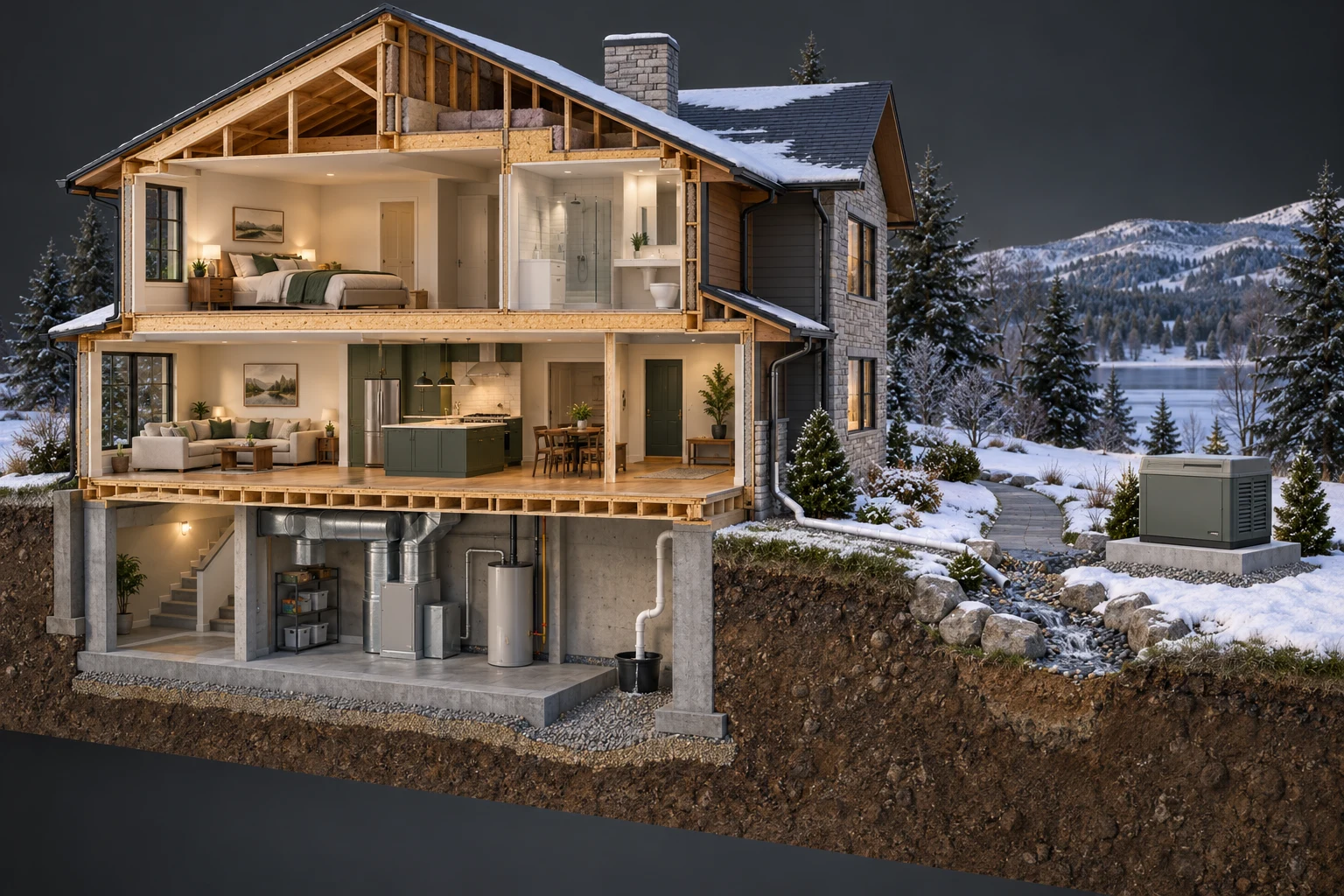
- Closed outdoor cabinet
The generator remains closed and unsheltered in the drawing. Ask the installer to reconcile the actual site and model with current guidance.
- Water routes
The downspout, pump pipe and ground channel locate possible water relationships; the picture cannot prove their receiving route.
- Seasonal setting
Snow and the walkway illustrate seasonal context. They do not guarantee safe access, startup or unchanged performance.
What does this illustration leave out?
The rocky channel and pipe ends do not establish a verified drainage direction or safe receiving location. Exhaust dispersion, setbacks, cold-weather accessories, capacity and actual snow conditions are unknown. This is not a compliant site plan or snow-clearing procedure. This illustration explains an idea. It is not an installation guide.
Which seasonal site conditions and responsibilities were actually assessed for this generator?
Explore this with HomeAI ↗Opens an editable question. Nothing is sent until you choose to send it.What starts the engine when utility power is missing?
The starting battery provides the electrical energy needed for engine starting and associated functions in the identified system. It is different from a home storage battery intended to supply household loads. A generator can therefore have a battery without being a battery-backup installation. Naming that small component’s job prevents a common misunderstanding during property handover.
A charger maintains the starting battery under the designed arrangement. The reviewed generator manual describes an integrated charging function and its support connection; the transfer manual distinguishes sensing, control and charging roles. Those functions need the matched equipment and installation. A buyer cannot establish battery condition, charger performance or wiring suitability from the presence of a battery-shaped component.
Controls also have a readiness state, history and model-specific messages. The purpose is to coordinate automatic operation and communicate relevant conditions. An exterior light or remote message should be interpreted through the applicable instructions. A green-looking illustration or a seller’s screenshot is not a professional finding about starting, transfer, supplied loads or every protective function.
Ask for the provider’s recorded battery and charging assessment, service date and outstanding recommendations. A replacement invoice identifies stated work, whereas a condition assessment describes a check and outcome. Keep both when available. If the controller’s displayed quantity is unfamiliar, have the provider explain it; hours associated with monitoring or readiness must not silently become engine-running hours.
Do not access the battery, disconnect cables, attach a charger, remove a fuse or clear an alarm as part of a showing. Automatic starting, electrical energy, moving parts and hot surfaces require controlled professional access. The handover should give the household a clear contact and response plan while leaving internal service and commissioning to the appropriately qualified people.
Does a scheduled engine run prove the house is backed up?
An exercise run is a scheduled equipment activity under the system’s configured instructions. It may run the engine without transferring the household loads. The reviewed generator manual explicitly distinguishes its exercise cycle from transfer during a utility failure. Hearing a weekly or other scheduled run therefore answers a narrower question than whether the intended household equipment receives generator power.
Ask what actually happened in the record. Did the engine run? Was transfer part of an authorized test? Which loads were involved? Which electrical or fuel observations were recorded, by whom and under what conditions? These questions connect a reassuring event with its real scope. They do not dismiss a useful service record merely because it leaves another task unanswered.
Commissioning is the professional process of checking the delivered installation against its intended functions and instructions. The reviewed transfer manual separates functional operation, load-related checks and end-user teaching. That separation is useful when purchasing a home: a receipt for routine engine care is not automatically a commissioning record for the transfer equipment and selected household loads.
A later professional verification can address the current arrangement if records are missing or equipment changed. Its scope should reflect the household needs and installation, with access and any interruption coordinated responsibly. Someone should identify exclusions and follow-up rather than promising that one demonstration predicts every future outage, fuel condition or severe-weather event.
Do not switch off the utility, operate transfer handles, create a load challenge or ask an unqualified person to conduct an outage test for a buyer. Preserve existing dated evidence and arrange the appropriate assessment through the seller and transaction team. The goal is a readable professional result, not an entertaining showing demonstration that introduces risk or disrupts other occupants.
What did the recorded event actually cover?
- Scheduled exerciseAn engine activity; transfer may be outside its scope.
- Routine serviceThe identified care tasks and dated findings.
- Professional transfer/load verificationThe stated equipment, conditions, loads and outcomes.
- Authority completion recordThe regulated work and process outcome identified by the issuer.
No test is prescribed or claimed performed at any actual home.
Further reading: Generac · 60 Hz Air-Cooled Generators owner manual, A0000973303 Rev. A; Generac · RXSW100A3CUL / RXSW200A3CUL transfer-switch owner manual, 10000022845 Rev. D; Electrical Safety Authority · Generator safety.
If it runs but the house loses power, what could be different?
Separate the observations before proposing a fault. An engine reportedly running, a light seen on the cabinet, a room without electricity and a remote message are different observations. Record their timing and source. Without that sequence, an exercise run can be confused with an outage run, or a deliberately excluded circuit can be mistaken for complete generator failure.
The first question is whether the affected equipment belongs to the confirmed backup schedule. An unserved appliance, a managed load waiting under its normal conditions and a connected load that should have been available raise different enquiries. The electrical provider should compare the actual route and design with the report, rather than diagnosing everything from one room name.
Other possibilities include a starting or protective-control condition, fuel-related performance, a transfer/control issue or a problem downstream in household equipment. The reviewed manuals distinguish these categories. They do not allow a buyer to identify the cause from the external symptom alone. A specific service scope should state which possibilities are being investigated and what evidence would separate them.
Use an ordinary event account and existing records, not a recreated fault. Preserve the safely available message exactly, including its date and the device or app that showed it. Do not repeatedly reset, change a mode, adjust fuel, remove a cover or cycle appliances to see whether the observation returns. A cleared message without an explained finding can erase useful context while leaving the cause unresolved.
For a purchase decision, ask what is known now, which essential function remains uncertain and what qualified follow-up is feasible. Your agent can coordinate access; technical specialists establish findings; legal advisers address the agreement. Keep those roles distinct. HomeAI can make the question coherent but cannot certify a failed part, authorize a repair or declare the property ready from a remote description.
Which installation and commissioning records should fit together?
Build the file around the actual equipment identities and location. Request the generator and transfer models, applicable manuals, installation date, fuel configuration and any separate load-control identities. Then match invoices, drawings and work descriptions to that list. If a model is missing or a replacement occurred, mark that specific mismatch for clarification rather than silently treating the original package as unchanged.
Ask for the applicable electrical and gas approval records and their completion status. Ontario ESA’s stated notification requirement is an Ontario example; the responsible authority at the property must explain its own records and process. A permit number, submitted application and completed approval are different stages. An authority’s record also has a defined work scope and date, not an unlimited present-day guarantee.
Request commissioning findings that explain the installed transfer arrangement, intended supplied and managed loads, relevant checks, outstanding items and household teaching. A useful record answers what was examined and what result was reached. A generic line saying generator tested may be genuine yet insufficient for the exact function you want to rely on.
Link the fuel assessment and electrical assessment rather than expecting one document to replace the other. If equipment relies on a tank contract, monitoring subscription or service agreement, keep those rights and responsibilities separately indexed. Drawings, technical findings and commercial agreements interact, but they answer different questions and may be supplied by different people.
Preserve original documents with their qualifications. A short index can identify a missing load schedule or unmatched manual without rewriting a professional report into a certificate. Ask the issuer or provider to explain ambiguous wording. Records gathered before a purchase should remain useful after possession, when the next service provider needs to understand the same installation and unresolved tasks.
Keep the chronology readable when equipment changed. An initial installation record, a later controller replacement and a subsequent service visit can all be accurate while describing different configurations. Ask which present components each document covers and whether the relevant verification followed the change. Do not assume that a newer invoice renews all older findings or that an old model list describes the current system. A clear timeline points to the specific confirmation needed and lets the appropriate provider explain the transition without inventing a missing test.
An exercise run, service and function check answer different questions
A scheduled engine run may leave household loads on the utility. A service invoice identifies the care and findings it names. Professional function checks concern their actual equipment, conditions and outcomes. An authority record concerns a defined regulated scope and status. Keep these documents together while retaining each boundary.
Numbers identify the parts explained below.
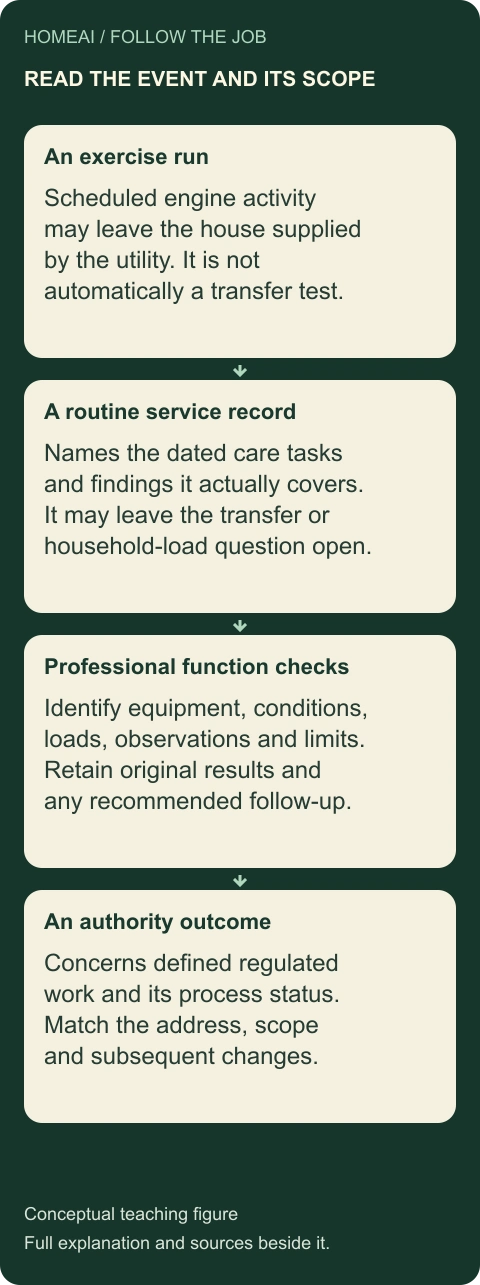
- An exercise run
Scheduled engine activity may leave the house supplied by the utility. It is not automatically a transfer test.
- A routine service record
Names the dated care tasks and findings it actually covers. It may leave the transfer or household-load question open.
- Professional function checks
Identify equipment, conditions, loads, observations and limits. Retain original results and any recommended follow-up.
- An authority outcome
Concerns defined regulated work and its process status. Match the address, scope and subsequent changes.
What does this illustration leave out?
No actual event, test, approval, finding or present equipment condition is supplied. Ontario examples do not establish the process elsewhere. This illustration explains an idea. It is not an installation guide.
Which specific question remains unanswered by the available engine, transfer, load and authority records?
Explore this with HomeAI ↗Opens an editable question. Nothing is sent until you choose to send it.Match the purchase question to the responsible evidence
- Will this function stay available?Actual backup-load schedule, dependencies and professional findings.
- Is the fuel/site arrangement suitable?Matched equipment instructions and local qualified assessment.
- What work completed?Original scope, invoices and authority outcome records.
- What transfers?Actual ownership, service and monitoring agreements with transaction advice.
A question framework, not legal advice or a representation about a property.
Further reading: Generac · 60 Hz Air-Cooled Generators owner manual, A0000973303 Rev. A; Generac · RXSW100A3CUL / RXSW200A3CUL transfer-switch owner manual, 10000022845 Rev. D; Electrical Safety Authority · Generator safety.
How should service history and present condition affect the decision?
An engine-driven system needs ongoing care for its identified components and operating history. The reviewed manual separates engine consumables, starting-battery checks, fuel-system attention, enclosure condition and other tasks. Those distinctions matter more than a single annual-service label. Have the provider explain which tasks apply to the actual model and how running hours and conditions affect the care plan.
A dated invoice supports the work described at that time. It does not automatically establish every current function or the condition of components outside its scope. Equally, an incomplete folder does not prove the equipment failed. Use the gap to define a current professional assessment, then keep its findings and recommendations linked to the exact equipment.
Describe visible concerns conservatively. Corrosion, damaged exterior material, changed landscaping or a nearby water route can justify questions without identifying an internal failure. An attractive enclosure may hide unknown age or service history; an older exterior may coexist with documented component work. Avoid assigning a repair, remaining life or resale value solely from appearance.
Ask the provider to distinguish necessary corrective work, routine care and optional changes for your proposed use. Obtain actual scoped proposals if cost matters. Generator equipment, gas work, electrical work, access and site changes can have different dependencies. A generic replacement price from another home is a poor substitute for an agreed scope and local quotation.
Carry unresolved essential functions into the transaction discussion and household contingency plan. Do not rely on future reimbursement, a warranty outcome or insurance acceptance until the relevant party confirms the actual terms. A technical assessment improves the evidence for a decision; your legal and transaction advisers determine how that evidence should be handled in the agreement.
What needs to transfer to the next household?
The household needs more than a key to the generator enclosure. It needs the equipment map, matched instructions, supplied-load schedule, service contact and an explained response when the system is unavailable. Internal access remains a professional matter. A handover that only demonstrates a phone app can leave the most important power, fuel and emergency questions unresolved.
Identify equipment ownership and ongoing agreements. Ask whether the generator, tank, monitoring accessory and service plan are included, financed, rented or otherwise subject to terms. The actual agreements and transaction advice decide those questions. Do not assume equipment attached to a house is free of obligations or that the seller’s manufacturer registration or service coverage transfers automatically.
Arrange monitoring-account changes through the provider’s authorized process. Give the receiving household only the access needed for the agreed purpose, with its permission. Do not pass along the seller’s personal password or unrelated account history. A monitoring connection indicates what the service reports; it does not replace the installed system’s actual checks and offline response information.
Prepare for a loss of both power and communications. Keep the provider’s number, actual emergency instructions and alternative household arrangements available offline. If an important medical or accessibility need depends on electricity, obtain the appropriate independent continuity advice. The reviewed generator and transfer documents explicitly exclude critical life-support use; a house sale cannot turn optional standby equipment into medical assurance.
Sellers should distinguish their own recollections from professional findings, keeping unresolved events visible. Buyers should confirm who can provide future local service and whether intended changes require review. The result is a practical responsibility handover: someone knows which equipment does each job, which records support it and which question remains open after possession.
How would a fictional buyer evaluate a reassuring generator claim?
Fictional buyers Mina and Alex consider an invented detached home advertised with whole-home backup. The seller reports hearing the generator exercise regularly and remembers one outage when the refrigerator worked. An installation invoice names the generator, but the supplied documents do not identify the transfer model or a backup-load schedule. These invented facts show useful history and specific gaps, not a failed installation.
Their intended use includes heating, the groundwater sump and a proposed future heat pump. They write those three functions separately. The sump guide helps them understand collection and discharge; the heating and backup-battery guides explain relevant dependencies. They do not assume that the kitchen experience establishes every basement function or that the proposed new load matches the original design.
Through the seller and agent, they request matched equipment identities, applicable completion records and the provider’s commissioning findings. The provider is asked to explain the present supplied and managed loads, current service needs and whether the intended heat-pump change warrants assessment. No buyer opens a cabinet, stages an outage or asks a neighbour to demonstrate manual transfer.
Suppose the first response confirms only that the engine received routine service. Mina and Alex retain that useful scope and keep transfer/load verification open. If another document later describes a professional functional check, they match its equipment, date and included loads. They do not merge the two documents into a broader finding that neither author made.
They discuss any unresolved function and actual proposals with their technical, transaction and legal advisers. An offline contingency remains necessary. This fictional example supplies no test result, equipment rating, repair price, approved upgrade or purchase recommendation. Its outcome is an enquiry that follows the whole mechanism and gives each professional a precise question to answer.
What should a clear generator purchase summary say?
Start with the identified system and intended household functions. Explain the fuel source, engine/alternator, transfer equipment and supplied or managed loads in a few connected sentences. A reader should be able to follow energy from fuel to the household function before seeing the document list. Keep confirmed information and the person who supplied it attached to the summary.
Next state the actual assessment and completion evidence: which provider, which equipment, what date, what scope and what outcome. Keep routine service, automatic operation, load-related verification and authority records separate where their purposes differ. Mark unresolved identities or conditions plainly. This preserves depth without requiring a future owner to decode an unexplained pile of attachments.
Include the site and seasonal responsibilities that matter to the installation. Current official guidance, the identified equipment’s instructions and the responsible authority govern the real address. A photograph, illustrated setback or national climate generalization must not substitute for that reconciliation. The Canadian and local limits belong beside the relevant siting and approval questions.
End with who will service the equipment, what access and account changes are arranged and what the household will do if backup is unavailable. Carry agreed future tasks into the home record without marking them completed prematurely. The system should complement emergency planning rather than become an excuse to assume every electrically dependent need is guaranteed.
The best evidence is understandable and bounded. You can value documented useful capability while retaining uncertainty about unobserved conditions. You can ask for a targeted assessment without diagnosing a fault yourself. That is the purpose of this guide: connect construction, equipment, site, records and household needs so the next decision rests on the actual installation rather than a reassuring cabinet or slogan.
Keep learning about the connected parts
- A power outage plan for heating, water and communications
- Home backup batteries: what stays on and for how long?
- Sump pumps and backwater valves: know each part’s job
- Can this home support your electrical plans?
- Electrical renovation records: what was actually checked?
- New-build commissioning: ask how the systems were verified
- Carbon monoxide and gas: what to do, and how prevention works
- Build a home-care record that the next person can understand
Canadian context and authorities · Visual atlas · Learning labs
Practice the distinction.
An exercise record and an unconfirmed sump supply
Fictional Mina and Alex have a generator invoice, reported exercise runs and one remembered refrigerator outcome, but no matched transfer identity or backup-load schedule.
Reported observations
- The seller reports a scheduled engine run.
- The installation invoice identifies only stated equipment.
- Heating and sump dependencies remain to be confirmed.
- A proposed heat pump is a new design question.
Compare the explanations
Expand each possibility to see the evidence needed to distinguish it. Similar symptoms can have different mechanisms.
The reported event had a narrower scope
An exercise or one supplied appliance may leave transfer and other loads outside the evidence.
Matched professional commissioning and supplied/managed-load records.
The intended household use differs from the original design
New equipment or priorities can change the assessment without proving a present defect.
An actual provider’s review of the intended loads and installation.
A useful next question
Request matched equipment, fuel/electrical completion scope and qualified function/load assessment through authorized access.
Fictional only; no failed component, successful test, approved upgrade, guaranteed runtime, repair price or purchase recommendation.
Know what the words mean.
- Alternator
- The generator component that converts engine-driven rotation into electrical output.
- Automatic transfer equipment
- The installed arrangement that selects the appropriate source for connected loads and prevents unwanted feedback between sources.
- Backup-load schedule
- A dated list of confirmed supplied, managed and excluded equipment and relevant dependencies.
- Load shedding
- Control that temporarily prevents specified loads from operating under defined system conditions.
- Starting battery
- The battery serving engine starting and associated generator functions, distinct from household energy storage.
- Exercise run
- A scheduled engine activity whose exact scope may exclude household transfer and load verification.
- Commissioning
- Professional verification and handover of the delivered installation against its intended functions and applicable instructions.
- Control connection
- A connection serving sensing or coordination, distinct from the power path supplying household loads.
Questions to bring
to the conversation.
- Which exact generator, transfer and load-management equipment is installed?
- Which household functions and dependencies are confirmed supplied, managed or excluded?
- What records cover fuel, electrical work, automatic transfer and actual verification scope?
- Who reconciles the actual site and model with current Canadian guidance and local requirements?
- Which service, ownership, account and contingency arrangements will transfer?
Separate a showing observation, an existing record and a new professional assessment. Unknown means a question remains; it does not automatically mean a defect.
Use the evidence planner ↗Go to the source.
Original HomeAI explanation informed by these public references. Sources support the underlying guidance; they have not reviewed or endorsed HomeAI. Diagrams are conceptual, and calculator outputs depend on your inputs.
Full current source bodies were read October 13, 2026. The generator manual is explicitly an October 2020 publication, while the matched CUL transfer document prints February 19, 2025 and was retrieved as manufacturer-authored material from a distributor host after the manufacturer URL redirected to a not-found shell. An unrelated commercial legacy PDF was held and supplies no household claim. No current installed model, Canadian approval, timer, output, weather rating, maintenance interval or owner switching/testing procedure is inferred. Ontario ESA’s process stays Ontario-specific; the actual authority, utility and qualified providers govern the property. All examples and pictures are conceptual and separate from actual findings.
Publication & source review
First published .
Sources reviewed .
- Generac · 60 Hz Air-Cooled Generators owner manual, A0000973303 Rev. A
Where this reference applies
Jurisdiction: Named 10–24 kW product family; includes Canadian CSA rating context, not a national installation rule
Edition: Printed October 9, 2020; fresh retrieval is not a 2026 revision.
Source reviewed: 2026-10-13 · America/Edmonton
Reading scope: All 44 pages extracted and read; original PDF and full text retained in property/research/generatorOwner.*. No source-PDF pixel inspection claimed.
Engine/alternator, outdoor enclosure, automatic start, starting battery/charger, transfer sequence, exercise versus supplied loads, protective controls, model-dependent fuel/weather/maintenance and authorized service. All numerical ratings, distances, settings and operating/service procedures withheld.
- Generac · RXSW100A3CUL / RXSW200A3CUL transfer-switch owner manual, 10000022845 Rev. D
Where this reference applies
Jurisdiction: Manufacturer-authored Canadian CUL-model document retrieved from a distributor host; named equipment only
Edition: Printed February 19, 2025. Manufacturer URL redirected to a not-found shell; that hold is retained.
Source reviewed: 2026-10-13 · America/Edmonton
Reading scope: Complete 28-page manufacturer PDF extracted and read, including Canadian Electrical Code reference and model identities. Distributor hosting does not authenticate an installed model or prove latest applicable revision.
Two-source transfer, load-management priorities, distinct power/control functions, qualified access, professional functional/load verification and end-user education. No wiring, switch operation, electrical measurements, timings or approval verdict.
- Health Canada · Carbon monoxide: Preventing exposure
Where this reference applies
Jurisdiction: Canada; federal consumer exposure prevention
Edition: Page details November 12, 2024.
Source reviewed: 2026-10-13 · America/Edmonton
Reading scope: Complete substantive current HTML body captured and read, including generator safety, alarm response, certification and maintenance sections.
Immediate fresh-air/emergency response; outdoor generator/exhaust hazard, CO alarms and professional care. Public six-metre advice is retained as an unresolved siting question alongside model instructions, not reduced or overridden.
- Electrical Safety Authority · Generator safety
Where this reference applies
Jurisdiction: Ontario electrical authority; Ontario notification and contractor pathway only
Edition: No substantive revision date established.
Source reviewed: 2026-10-13 · America/Edmonton
Reading scope: Complete current substantive HTML body captured and read; no linked video viewing or all linked standards reading claimed.
Permanently connected generation needs transfer equipment to prevent feedback; matching electricity requirements, certification identity and Ontario notification/contractor enquiry. Portable-cord, fuel and refuelling directions excluded.
Have a question about your home?
Start with the symptom, timing and what you have observed.
Ask HomeAI