- An oil-storage system includes delivery, venting, storage and onward supply; an appliance service invoice may cover a different part.
- Tank identity, present condition, past storage and environmental findings need different evidence. A replacement tank does not answer every historical question.
- Canadian rules depend on the actual location and tank category. Match the records and ask qualified providers and relevant authorities to explain consequential gaps.
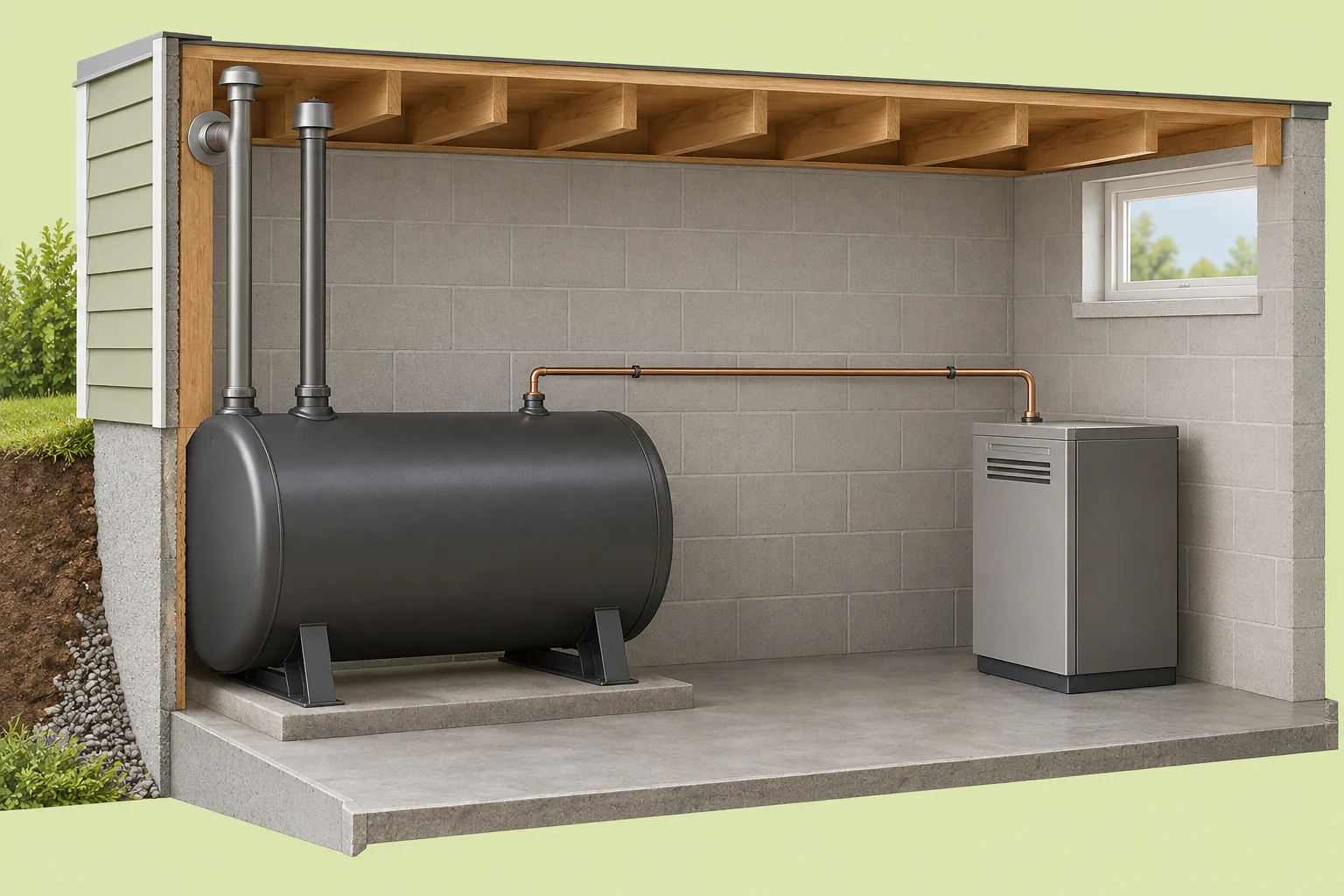
A closed horizontal grey vessel rests on illustrated supports at the left. Two capped vertical pipe forms rise from its top. A thinner copper-coloured line-like form is drawn between another top connection and the separate closed cabinet at the right. A short side fitting meets the partial wall near the left-hand pipe; two complete exterior endpoints are not shown.
About this illustration
The model identifies no actual fuel, manufacturer, tank construction, fuel level, fill/vent/alarm function, complete external route, product-line specification or flow, appliance purpose or condition, support adequacy, code compliance or approved installation. The capped top forms are landmarks; they do not demonstrate a working fill-and-vent arrangement. No caps, covers or fittings should be opened to reproduce this illustration. This is a conceptual teaching model, not an assessment of your home.
4 picture lessons appear beside the questions in this guide. Use them to understand the explanation, then consider what it means for your home.
What does the oil tank do—and what else belongs to the system?
The tank stores fuel. Delivery adds it through the filling arrangement; a vent provides the associated air route. A separate product line supplies the heating equipment. Gauges, delivery-warning arrangements, valves and filters can have their own jobs. Nova Scotia’s domestic-tank page explains these relationships. A picture helps you distinguish the landmarks, without establishing how any actual installation operates.
Start a property file with the storage location, the appliances it serves and the provider’s component map. A boiler, warm-air furnace or water-heating appliance should be identified separately. Keep unknown routes marked unknown. An invoice for burner service may be useful while saying nothing about a concealed fuel line or older storage. Ask which components the service covered instead of treating the words heating system as a complete tank assessment.
Storage, top-pipe landmarks and onward supply are separate questions
A closed horizontal grey vessel rests on illustrated supports at the left. Two capped vertical pipe forms rise from its top. A thinner copper-coloured line-like form is drawn between another top connection and the separate closed cabinet at the right. A short side fitting meets the partial wall near the left-hand pipe; two complete exterior endpoints are not shown.
Numbers identify the parts explained below.
- Top-pipe landmarks
Two capped vertical forms introduce separate delivery and venting record questions. The actual provider’s map must identify their functions and complete endpoints; this drawing does not show both exiting the wall.
- Closed storage specimen
The larger vessel locates the storage question. Its appearance supplies no material identification, remaining life, integrity, fuel level or support finding.
- Thin line and closed cabinet
A smaller line-like route meets a separate cabinet. Match the actual onward fuel route and appliance with provider records; this still contains no operation test or installed specification.
What does this illustration leave out?
The model identifies no actual fuel, manufacturer, tank construction, fuel level, fill/vent/alarm function, complete external route, product-line specification or flow, appliance purpose or condition, support adequacy, code compliance or approved installation. The capped top forms are landmarks; they do not demonstrate a working fill-and-vent arrangement. No caps, covers or fittings should be opened to reproduce this illustration. This illustration explains an idea. It is not an installation guide.
Which actual tank, complete fill/vent/product routes and appliances are covered by the provider’s component map and assessment?
Explore this with HomeAI ↗Opens an editable question. Nothing is sent until you choose to send it.Which identity details should match the property records?
Keep manufacturer/model information, serial identity and the available dates beside the actual equipment photographs. Manufacture, installation, relocation and service are different events. A readable label can establish labelled information; it cannot establish concealed condition or prove that later work followed the applicable requirements. Do not scrape, repaint or uncover a label to complete the file.
Request a closer photograph or interpretation from the qualified provider when ordinary access is insufficient. Match each invoice and report to the address and identified tank, not simply to the seller’s name. If a record names an indoor tank and the installation is reported outside, retain that discrepancy for the specialist: Ontario TSSA explicitly distinguishes indoor designation from outdoor suitability. A generic brochure or a neighbour’s tank is not the missing identity record.
Why are primary storage and secondary containment different?
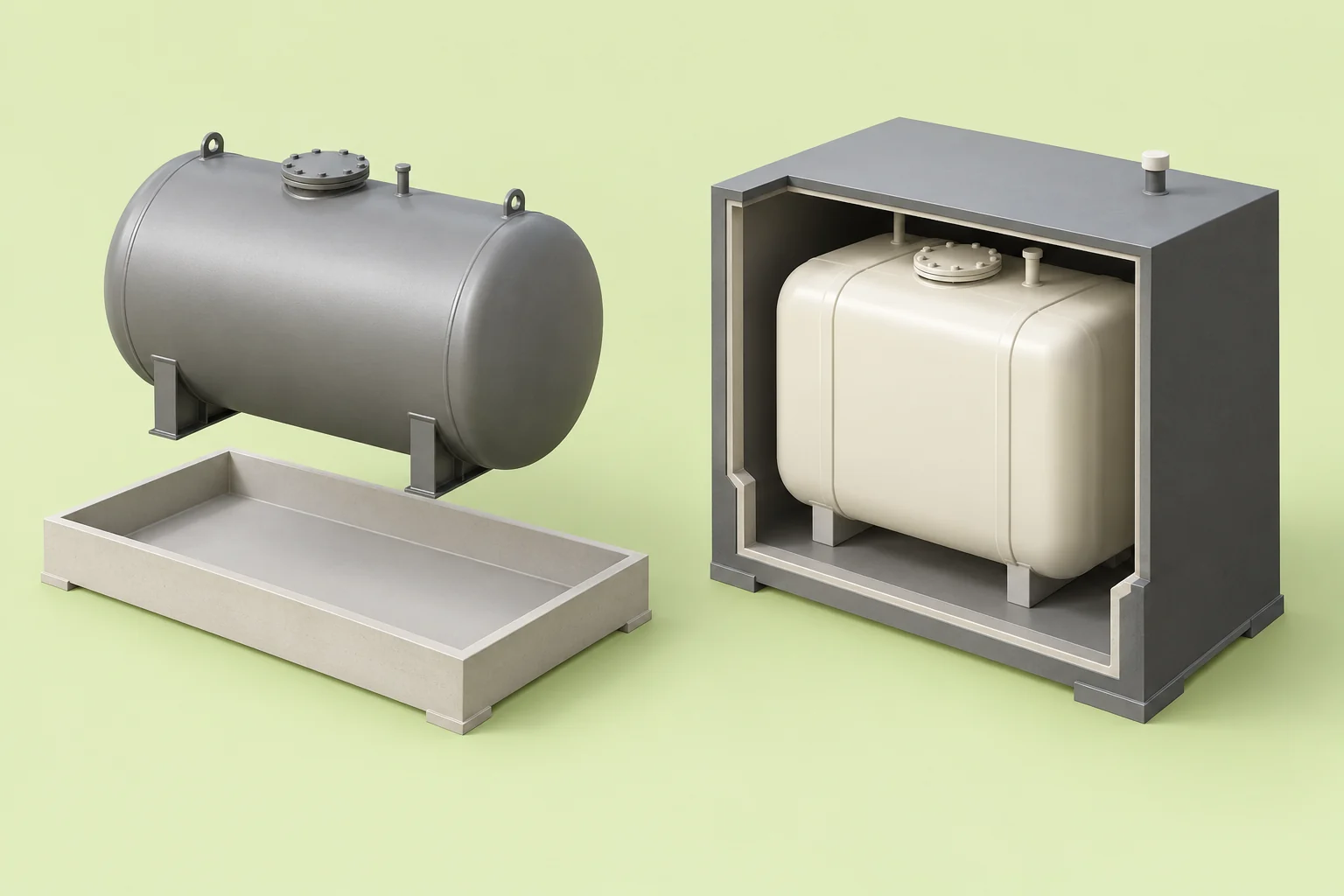
Primary storage holds the fuel during intended operation. An additional containment arrangement has a different role if fuel escapes that primary boundary. The relationship may involve a separate tray or another vessel surrounding the primary one. Roth’s named double-wall family illustrates an inner polyethylene vessel within an outer steel vessel; other products and arrangements need their own documentation.
Ask the provider to identify the actual construction, monitoring features and applicable maintenance information. A visible outer casing cannot reveal every inner layer. A tray’s presence cannot establish its capacity or whether fuel could escape elsewhere in the system. A double-wall description also does not clear delivery piping, onward piping or previous storage. The conceptual cutaway teaches the two roles; it supplies no containment sizing, leak test, product selection or installation detail.
Primary storage and an additional containment layer have different roles
At the left, a closed grey vessel and empty shallow pale tray are separated vertically for display. At the right, a smaller ivory vessel sits on small visible supports inside a grey outer shell with its front cut away. Space is visible beside and beneath portions of the inner vessel; no liquid, leak or operating indication is shown.
Numbers identify the parts explained below.
- Primary-vessel specimen
The closed vessel introduces the intended primary-storage boundary. The detached display supplies no actual integrity result or support/installation instructions.
- Separated tray specimen
The empty tray represents a different potential containment relationship. Its drawn dimensions establish no capacity, drainage permission or approved arrangement; the gap above it is a display separation.
- Inner and outer specimens
The front-cutaway outer shell surrounds a smaller vessel on small supports. Match an actual product’s layers and monitoring records; the anonymous model supplies no material identity, leak test or alarm status.
What does this illustration leave out?
This is an exploded and cutaway teaching composition, not a floating tank installation, identified commercial model or approved containment design. Actual vessel materials, capacity, continuity, integrity, monitoring function/state, local suitability and manufacturer instructions are unknown. No visible tray or outer casing proves sufficient containment capacity or covers other piping and historic storage. This illustration explains an idea. It is not an installation guide.
Which actual primary vessel, additional containment and monitoring features are identified by the manufacturer-matched and professional records?
Explore this with HomeAI ↗Opens an editable question. Nothing is sent until you choose to send it.Why can the exterior look sound while a condition question remains?
A photograph records an accessible surface at a stated time. It does not look through the wall of a tank or establish concealed line integrity. Nova Scotia’s August 2015 oil-tank education explains why internal corrosion and damp-looking or bubbled areas need professional attention rather than rubbing or probing. Those observations cannot be translated into remaining life from an online image.
Keep competing explanations visible in the enquiry. An external mark can have more than one cause; a dry later visit does not explain an earlier wet-looking area. Missing observations also remain missing. Ask the specialist what method supports the finding, which portions were accessible and whether a consequential unknown needs further authorised work. Neither new paint nor a successful fuel delivery is a whole-system condition certificate. Never touch a suspect patch or attempt to demonstrate a leak.
What can a buyer safely record at an ordinary visit?
From ordinary accessible ground or floor space, capture the whole tank, its surroundings and the visible routes. Date the views and identify recent work or a reported change. Include support and exposure context without climbing, entering beneath the tank or moving stored objects that could disturb lines. Record leaning-looking support, a pinched-looking line or a wet-looking mark descriptively rather than diagnosing it.
The broader context helps the professional consider ground movement, nearby traffic, roof runoff and weather exposure. It does not establish anchorage, proper clearances or hidden corrosion. If the scene appears unstable or there is a suspected active spill, end the evidence-gathering task and obtain appropriate urgent help. Do not open caps, operate valves, wipe fittings, dig, drain, transfer fuel or attempt to brace the tank. Completing photographs is less important than maintaining the safe boundary.
Use the whole accessible context without turning appearance into a condition finding
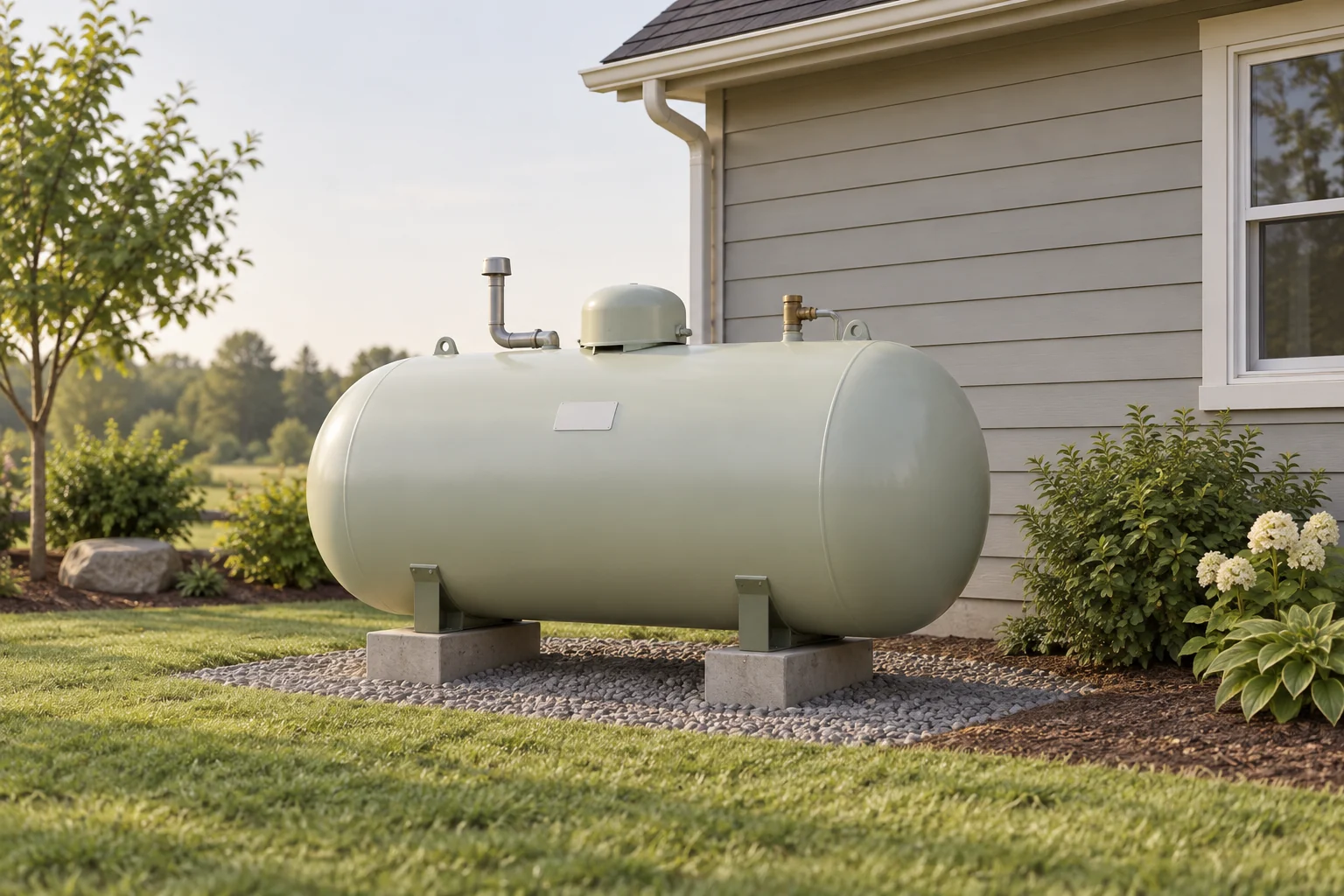
A pale closed horizontal vessel stands on illustrated supports and blocks beside a house wall. Gravel, lawn, planting, a roof edge and downspout context are visible. A small front plate is blank. Short top fittings and a domed top form are visible without identifying their functions.
Numbers identify the parts explained below.
- Blank identity landmark
The small plate has no readable text. Obtain the actual provider-matched identity and dates without scraping, repainting, uncovering or manipulating a label.
- Support and ground context
Support forms, blocks and ground are locations for a professional question, not evidence of adequate bearing, anchorage or compliant geometry. Observe only from ordinary safe access.
- Wall and roof-edge context
Surroundings help locate the exposure question. This still measures no roof runoff, falling-ice route, traffic protection, separation distance or clearances.
What does this illustration leave out?
The picture supplies no actual fuel, product/model identity, tank age, plate content, outdoor designation, internal corrosion, leak integrity, concealed route, support capacity, anchorage, measured clearance or weather-exposure finding. The tidy exterior is not an assessment, certification or remaining-life estimate. Top shapes are not identified as a fill, vent, gauge, alarm or approved component. This illustration explains an idea. It is not an installation guide.
Which safely observed identity, support, line and exposure questions should the qualified provider evaluate, and what remains inaccessible?
Explore this with HomeAI ↗Opens an editable question. Nothing is sent until you choose to send it.What should a tank and fuel-system assessment actually answer?
Request a written scope naming the tank, relevant piping, supports and protective components rather than a vague tank check. Ask how identification, accessible condition and applicable installation records will be assessed; the qualified provider determines the methods and permissions. Keep any exclusions, inaccessible parts and deferred work attached to the conclusion.
The heating appliance and storage may need related but separate findings. Ask whether the supplied report covers both, and whether a particular result concerns operation, installation or current condition. Ontario TSSA’s distributor FAQ distinguishes retained inspection reports and tank check sheets; that illustrates a useful document question within Ontario’s own context. A past report remains dated evidence. It cannot promise no future leak or supply an environmental finding that the inspector did not undertake.
Does a heat pump or a replacement tank resolve the earlier history?
Present heating equipment answers what is installed now. Ask separately whether oil storage formerly existed indoors, outdoors or underground, whether it was replaced or retired, and what documents establish that work. A heating-conversion invoice may omit the former tank, residual contents and associated piping. A seller’s account starts the enquiry without becoming a verified removal record.
Vancouver’s current underground-tank page separates a records search from a contractor’s property search. That named municipal example explains why absent records do not automatically establish absent storage. Search conclusions need their coverage and limitations. An illustrative buried-tank picture is a possibility lesson, never a discovery at a house or a prediction from neighbourhood age. Have the appropriate professionals define any further history or detection work with the owner’s permission. Do not probe the yard or open unexplained exterior pipes.
Present heating and earlier storage need separate records
A furnished timber house cutaway and closed outdoor fan-cabinet form occupy the left study. A separate translucent house-and-ground display on the right includes a grey cylindrical buried-vessel landmark. A detached grey vessel on small feet and two blank paper sheets sit in front. The visible vessel surfaces are grey.
Numbers identify the parts explained below.

- Present-equipment landmark
A closed outdoor fan form introduces a current-heating identity question. It does not establish previous fuel, storage history or completed conversion work.
- Separate history possibility
The right-hand diorama makes a possible historic storage location visible as a concept. It is not a tank search, actual buried discovery, neighbourhood prediction or evidence about the left study.
- Blank records and detached vessel
The paper sheets carry no findings. The separate vessel prop is not proof of removal, disposal or cleared soil; match actual history, search, retirement and environmental records with their stated scope.
What does this illustration leave out?
The studies are separate conceptual examples, not before-and-after evidence or a finding that the left house has buried storage. Actual current equipment identity/function, past oil use, tank presence/location, detection coverage, removal or disposal scope, retained piping/liquids, environmental condition and authority closure remain unknown. Neutral colouring cannot establish corrosion-free vessels, uncontaminated soil, completed removal or regulatory acceptance; blank sheets contain no reports, dates or results. This illustration explains an idea. It is not an installation guide.
What actual history, search, retirement and environmental records answer the earlier-storage question independently of the equipment installed today?
Explore this with HomeAI ↗Opens an editable question. Nothing is sent until you choose to send it.What does removed or decommissioned mean in the supplied file?
Read the actual scope behind the phrase. Was the tank removed, or was leaving it in place specifically accepted? What happened to associated piping and remaining liquids? Which receiver and final records identify the work? PEI’s June 2026 disposal page describes licensed handling and the identification tag’s return; it is a provincial record example, not an owner disposal procedure.
Vancouver’s removal/decommissioning form separately asks about the tank, piping, disposal, field findings and soil results. The distinctions matter: an invoice for lifting out a tank does not itself state the environmental conclusion or authority’s completed status. Request the relevant final report and attachments, then ask the provider/authority to explain unresolved entries. Local accepted abandonment, removal and completed reporting are distinct. Preserve the precise language rather than compressing everything into oil tank gone.
When does the question need environmental expertise?
A storage-system assessment and a site-contamination assessment examine different things. Where history or findings raise an environmental question, ask a qualified environmental professional to define the investigation. Nova Scotia’s August 2015 property booklet explains Phase 1 review as a combination of history, available records, interviews and site observations that identifies potential contamination concerns.
A record review is not the same as a sample result. A sample result is tied to its location, date, laboratory scope and the professional’s interpretation; it cannot represent an unexamined area simply because the page says soil analysis. Vancouver’s form makes plans and laboratory attachments part of its named reporting example. Ask which areas/materials the actual work examined and what remains unresolved. No home photograph, absence of odour or empty government search establishes that an entire property is uncontaminated.
Which document answers which oil-storage question?
Separate the job, the evidence and the question that remains.
- Tank identityMatched label/provider record · Concealed integrity and historic locations remain separate
- Current conditionScoped qualified assessment · Future performance and unexamined components remain separate
- Past storage/retirementHistory, search and removal/decommissioning records · Scope and accepted final status must be established
- Environmental findingQualified report with plan/method/results · Its conclusion applies to stated examined scope
- CoverageActual insurer policy/reliance confirmation · Manufacturer advertising is a different contract
Document categories address different questions. No storage layout, leak test, environmental clearance, current legal conclusion or insured outcome is established.
Nova Scotia · Domestic oil tanks; Nova Scotia · Buying and owning property: contaminated sites; City of Vancouver · UST removal/decommissioning report; Newfoundland and Labrador · Heating-oil tank registration confirmation. Reviewed October 5, 2026. Named equipment and Canadian jurisdiction limits remain in the full reference panel. Qualitative comparison; no measured quantity, test result or property approval.
How should Canadian location change the evidence request?
Begin with province, municipality and actual tank category. Ontario TSSA’s approved-aboveground age answer is conditional, while PEI’s defined home-heat programme uses provincial identification/expiry distinctions. Newfoundland and Labrador’s confirmation page links inspector-submitted information with matched tag and address details. These are different systems; none establishes a single Canadian replacement age or a universal tag.
Ask the relevant authority/provider to interpret the actual record rather than applying another province’s example. A registration confirmation can establish the reported registration relationship while leaving current condition separate. Nova Scotia’s historical property booklet also notes that its registry excludes a typical domestic tank: no entry cannot establish no tank. Current local requirements, accepted status and ownership/transaction consequences need their own qualified answer. The sources were accessed October 5, 2026; the two Nova Scotia brochures remain expressly dated August 2015.
How do insurance, costs and transaction timing fit together?
Give the insurer or broker the actual tank identity, location, history and available specialist findings. Ask what the written policy covers for your buildings, your land and other affected property, what limits/exclusions apply, and which documents are required. A manufacturer’s advertised protection is a separate contract whose eligibility and transfer terms must be established; it is not your household policy.
Compare proposals by scope instead of a headline tank-removal price. Detection, assessment, handling, disposal, restoration and environmental work may be different tasks, with exclusions and further findings affecting the brief. Ask your legal and transaction advisers how to address consequential missing evidence within the actual agreement and timing. The guide supplies no insured outcome, cleanup budget, obligation to buy or sell, or claim that a specialist is immediately available.
How would a fictional buyer read a mixed oil-tank file?
Explicitly fictional property: the seller supplies a recent heat-pump invoice, an older aboveground-tank photograph and a disposal invoice that names a tank but not its location or associated piping. An environmental search has no relevant entry. A short statement says the house no longer uses oil. These invented items do not prove a retained tank, spill, concealment or unsafe installation.
The buyer asks the providers to match tank identity/location and the disposal scope, and asks what search coverage the environmental result actually represents. Any environmental follow-up is scoped by a qualified professional; insurer and transaction advisers explain their own reliance requirements. If final records establish only the named tank’s removal, the file retains unanswered historic locations rather than claiming blanket clearance. The useful outcome is a connected evidence request with named limits—not an AI verdict on the purchase.
Practice the distinction.
New heating, an old photograph and a limited disposal invoice
Explicitly fictional buyer and documents. Current heat-pump equipment does not establish the earlier storage history.
Reported observations
- A new appliance invoice has no old-storage scope.
- The disposal invoice does not identify location or piping.
- The search result lacks a stated domestic-tank coverage explanation.
Compare the explanations
Expand each possibility to see the evidence needed to distinguish it. Similar symptoms can have different mechanisms.
The removal record needs to be matched
Useful documents may describe the same tank while omitting the relationship needed by the buyer.
Provider-confirmed tank/location identity, actual work scope and final documents.
Historic or environmental coverage remains limited
A search or removal statement may answer only a defined question.
Search coverage, specialist findings and authority status with their limits preserved.
A useful next question
Reconcile identity and scope; define any consequential condition/environmental enquiry with qualified providers and transaction advisers.
No real tank, leak, contamination, expiry, coverage, approval or purchase finding is represented.
Know what the words mean.
- Product line
- The documented onward fuel route from storage toward the oil-burning equipment, separate from filling and venting.
- Primary storage
- The vessel or boundary intended to retain fuel during normal storage.
- Secondary containment
- An additional identified arrangement intended to retain a release from primary storage; its capacity and condition need actual evidence.
- Registration confirmation
- A named authority’s record confirming a registration relationship; scope depends on the programme and actual tank identity.
- Decommissioning record
- A report describing how a named storage system was retired and which handling, removal, reporting and environmental tasks were included.
- Phase 1 environmental site assessment
- A qualified history/records/site review aimed at identifying potential environmental concerns; separate from targeted sample findings.
Questions to bring
to the conversation.
- Which tank, appliance and fill/vent/product routes are established by the provider’s record?
- Which manufacturer/model/serial and manufacture/installation dates can be matched without disturbing the equipment?
- Does the specialist report address tank, piping, support and protective components, with exclusions retained?
- What previous storage, replacement, spill or heating-conversion history is documented?
- If removal occurred, what piping, liquid, disposal and environmental work did the record actually include?
- Which local tag/registration, permit or closure status applies to this tank category?
- What does the actual insurance wording cover, exclude and limit, and what evidence does the insurer/lender require?
- Who will reconcile unanswered condition or environmental questions before a transaction decision?
Separate a showing observation, an existing record and a new professional assessment. Unknown means a question remains; it does not automatically mean a defect.
Use the evidence planner ↗Go to the source.
Original HomeAI explanation informed by these public references. Sources support the underlying guidance; they have not reviewed or endorsed HomeAI. Diagrams are conceptual, and calculator outputs depend on your inputs.
Publication & source review
First published .
Sources reviewed .
- Nova Scotia · Domestic oil tanks
Where this reference applies
Jurisdiction: Nova Scotia domestic oil-storage consumer education; older departmental names and technical references remain in the current page
Edition: No displayed publication/revision date established; current body accessed October 5, 2026.
Source reviewed: 2026-10-05 · America/Edmonton
Full substantive body read. Key component relationships, identification labels, visible damage/support concerns and disconnected fill-pipe history. No failure prevalence, universal interval, code edition, gauge specification, valve operation, additives, draining or installation procedure adopted.
- Nova Scotia · Living with an oil tank
Where this reference applies
Jurisdiction: Nova Scotia historical homeowner education; current local obligations require separate confirmation
Edition: August 2015 visibly printed on PDF page 5; five PDF pages.
Source reviewed: 2026-10-05 · America/Edmonton
Entire five-page PDF read. Exterior versus internal condition, cautious no-touch observation, exposure/support context and contamination-insurance questions. Historical installation, spill containment and tank replacement procedures are excluded. No numerical failure rate, life expectancy or cleanup cost adopted.
- Nova Scotia · Buying and owning property: contaminated sites
Where this reference applies
Jurisdiction: Nova Scotia historical property/environmental assessment education
Edition: August 2015 visibly printed on PDF page 5; five PDF pages.
Source reviewed: 2026-10-05 · America/Edmonton
Entire five-page PDF read. Phase 1 property-history/site-review purpose; registry excludes a typical domestic oil tank; questions about own/neighbouring land/building coverage and limits. No current legal liability conclusion, cleanup exemption, sampling procedure or cost estimate adopted.
- Roth North America · Double-wall heating oil tanks
Where this reference applies
Jurisdiction: Named North American manufacturer family with Canadian representative listings; not a national installation rule or installed-product finding
Edition: No displayed technical revision date established; current body accessed October 5, 2026.
Source reviewed: 2026-10-05 · America/Edmonton
Full product body read. Named-family polyethylene primary vessel, separate steel outer vessel and monitoring relationship support a conceptual containment comparison. No advertised leak-proof/ever-rust-free guarantee, warranty/insurance amount, capacity/dimensions, approval or product recommendation adopted.
- Ontario TSSA · Fuels FAQs
Where this reference applies
Jurisdiction: Ontario fuel-oil authority explanation; aboveground and underground categories are separate
Edition: No displayed page revision date established; current body accessed October 5, 2026.
Source reviewed: 2026-10-05 · America/Edmonton
Full substantive page read. Aboveground age answer is conditional on approval/non-leaking status; indoor designation is separate from outdoor use; underground detection/removal/variance and retained inspection-record questions. No historic CSA clause applied to a property, no diagnostic consumption threshold, spill telephone number or national replacement rule adopted.
- Prince Edward Island · Home Heat Tank Program
Where this reference applies
Jurisdiction: Prince Edward Island defined aboveground home-heat-tank programme only
Edition: Published April 11, 2025.
Source reviewed: 2026-10-05 · America/Edmonton
Full substantive body read through web provider; direct raw GET is a Radware challenge. Provincial ID/expiry and defined installation-class distinctions support asking the department/provider to interpret the actual tank. No universal calendar, used-tank permission, national approved construction or expiration verdict adopted.
- Prince Edward Island · Oil tank disposal
Where this reference applies
Jurisdiction: Prince Edward Island retired home-heat-tank handling and record context
Edition: Published June 5, 2026.
Source reviewed: 2026-10-05 · America/Edmonton
Full substantive body read through web provider; direct raw GET is a Radware challenge. Licensed handling, piping/system removal and returned identification tag are explained as records to request, not owner work instructions.
- City of Vancouver · Underground storage tank removal or abandonment
Where this reference applies
Jurisdiction: City of Vancouver, British Columbia; named municipal underground-storage process only
Edition: No displayed page revision date established; current body accessed October 5, 2026.
Source reviewed: 2026-10-05 · America/Edmonton
Full substantive body read through web provider; direct raw GET is403. File search, contractor search, distinct removal/accepted abandonment and environmental/report closure relationships. No local deadline/fee, excavation sequence or national legal obligation adopted.
- City of Vancouver · UST removal/decommissioning report
Where this reference applies
Jurisdiction: City of Vancouver reporting example; property-specific environmental interpretation stays with qualified professionals
Edition: Form includes UST Removal – Final Completion/Closure Report Version 1.4; exact publication/revision date not established.
Source reviewed: 2026-10-05 · America/Edmonton
Entire two-page form read through web provider; direct raw GET is403. Plan, tank/piping, receivers, field findings, confirmatory results, conclusion and attachments demonstrate why a removal invoice and an environmental conclusion are different. No sampling count, locations prescription, test method or environmental clearance inferred.
- Newfoundland and Labrador · Heating-oil tank registration confirmation
Where this reference applies
Jurisdiction: Newfoundland and Labrador heating-oil-storage registration confirmation; actual category/status require departmental interpretation
Edition: No displayed publication/revision date established; current body accessed October 5, 2026.
Source reviewed: 2026-10-05 · America/Edmonton
All 33 web text lines read. Confirmation uses inspector-submitted information and matched tank/tag/address information; the example tag is excluded as an actual expiry finding and its pixels were not inspected. No national registration rule, processing guarantee or present-condition/soil clearance adopted.
Have a question about your home?
Start with the symptom, timing and what you have observed.
Ask HomeAI