Jump to a question in this guide
- What does a shared route actually provide?
- How do physical access and legal access differ?
- Who owns, uses and manages the road?
- What does a maintenance agreement need to explain?
- What should winter access questions cover?
- Why do ditches and culverts need their own enquiry?
- What does Ontario's mutual-agreement-drain example teach?
- How can other services share the corridor?
- How do routine bills differ from a major repair?
- What happens when the arrangement changes?
- How does a driveway differ from an approach to a public road?
- What can a culvert assessment establish beyond a visible opening?
- What does a fictional shared-lane purchase show?
- What should a new owner's shared-services file contain?
- A route you can drive today is physical access; the continuing right to use it needs the actual instruments, plans and legal advice.
- Road ownership, use, management and maintenance can belong to different parties; reconcile the tasks and cost allocation with current practice.
- Treat culverts, drainage outlets, public-road approaches and shared utility services as their own technical and responsibility enquiries.
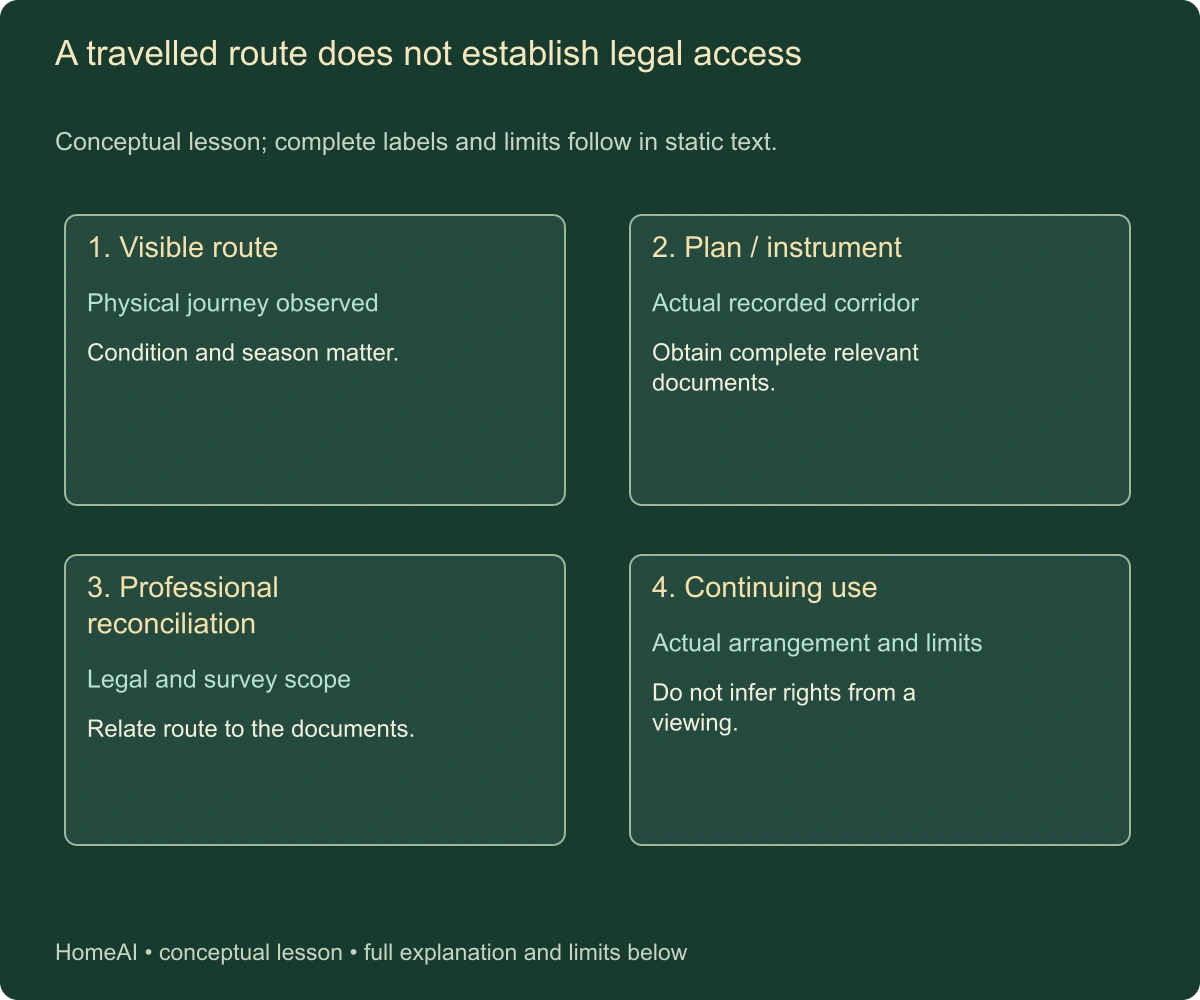
Physical route and legal records require reconciliation; neither alone answers all access, condition and maintenance questions.
About this illustration
No actual entitlement or boundary finding. This is a conceptual teaching model, not an assessment of your home.
7 picture lessons appear beside the questions in this guide. Use them to understand the explanation, then consider what it means for your home.
What does a shared route actually provide?
A road gives vehicles a physical route. A driveway connects a property to a route. A culvert carries water across a route, while a ditch manages water alongside it. Pipes, cables or other services may share a corridor without sharing the same owner or legal arrangement. Seeing all these features together does not establish who can use them, who maintains them or how costs are allocated.
Begin with a simple plan identifying the property, route to the public road, shared components and neighbouring land crossed. Ask which parts are publicly maintained, privately maintained or still unconfirmed. A map application, street sign, plowed surface or long history of use cannot resolve the complete ownership and responsibility enquiry.
This guide connects physical access, title and agreements, service arrangements, maintenance and handover evidence. The title-and-survey guide explains the wider record reconciliation. Here the emphasis is on what the household depends on each day and what documents support those dependencies. It does not determine access rights, interpret a dispute or prescribe road or drainage construction.
Canadian arrangements differ by province, municipality, ownership type and agreement. Alberta's current title-information page and Ontario's current private-drainage and mutual-agreement-drain pages provide named examples of records and shared infrastructure. Ontario's Road Access Act body was not successfully read and is held unadopted. No province-wide road-access legal rule is inferred from a search snippet or the held response.
A corridor can support more than one dependency. The route used for a moving vehicle, the drainage outlet and an underground service may each cross different land or depend on different permissions. Draw them as separate enquiries rather than one assumed bundle. The actual plans and agreements determine which components are shared and which remain outside the arrangement.
Which off-lot route does access depend on
Several homes beside gravel lane joining paved road; no legal boundaries or rights shown.
Numbers identify the parts explained below.

What does this illustration leave out?
Conceptual generated context. No actual property, installed design, topology, measured performance, approval, ownership or responsibility established. This illustration explains an idea. It is not an installation guide.
Which off-lot route does access depend on?
Explore this with HomeAI ↗Opens an editable question. Nothing is sent until you choose to send it.Which off-lot route does access depend on
Several homes beside gravel lane joining paved road; no legal boundaries or rights shown.
What remains unknown: Conceptual generated context. No actual property, installed design, topology, measured performance, approval, ownership or responsibility established.
A useful question: Which off-lot route does access depend on?
How do physical access and legal access differ?
A vehicle reaching the home demonstrates a physical journey at that moment. It does not establish the continuing legal right to use every part of the route, the permitted users or the purposes covered. A route may cross another parcel, a separately owned road parcel or a corridor subject to particular instruments. The legal professional must identify the actual arrangement.
Ask for the current title, relevant registered instruments, plans and agreements that describe the route. Alberta's official page explains that titles identify registered interests, and that copies of documents and survey plans are distinct records. This supports obtaining the instrument itself rather than treating a brief title entry as the full terms of access.
The legal description and plan need to connect with the actual route. A visible track may not align with a corridor shown on a document, and a generic neighbourhood map cannot settle that discrepancy. Ask the survey and legal professionals what information is needed to reconcile them. Do not move markers, fences or gates to make the site fit a reading of a plan.
Keep uncertainties explicit. Legal access not yet confirmed, route location not yet reconciled and present road condition not yet assessed are different holds. A title enquiry does not establish pavement condition, while an engineer's road assessment does not create a right to cross someone else's land. Each professional scope should remain visible.
Ask which parcels benefit from the documented route and which parcels contain it. The legal professional must reconcile the actual instrument, not simply the street address printed on a maintenance invoice. A route can look continuous while its documents describe several segments. The household needs the relevant chain of access and its limits, with any unresolved connection clearly identified.
A travelled route does not establish legal access
Physical route and legal records require reconciliation; neither alone answers all access, condition and maintenance questions.
Numbers identify the parts explained below.
What does this illustration leave out?
No actual entitlement or boundary finding. This illustration explains an idea. It is not an installation guide.
Which actual records and qualified advice answer this distinction?
Explore this with HomeAI ↗Opens an editable question. Nothing is sent until you choose to send it.A travelled route does not establish legal access
Conceptual lesson; complete labels and limits follow in static text.
- Visible route
- Physical journey observed. Condition and season matter.
- Plan / instrument
- Actual recorded corridor. Obtain complete relevant documents.
- Professional reconciliation
- Legal and survey scope. Relate route to the documents.
- Continuing use
- Actual arrangement and limits. Do not infer rights from a viewing.
Physical route and legal records require reconciliation; neither alone answers all access, condition and maintenance questions.
What remains unknown: No actual entitlement or boundary finding.
A useful question: Which actual records and qualified advice answer this distinction?
Who owns, uses and manages the road?
Ownership identifies an interest in the land or asset. A right to use the route can belong to others under the actual arrangement. Management concerns decisions and operations. Maintenance concerns the tasks needed to support the route's intended service. These roles can sit with different parties, so one name on an invoice may not answer all four questions.
Ask who owns each relevant segment, which properties may use it and who currently coordinates upkeep. Where an association, corporation or group of owners is involved, obtain its actual governing and financial records through the appropriate authorized process. A neighbour volunteering to arrange grading does not, by itself, establish a durable governance arrangement or authority to charge a new owner.
Read the documents for the purposes relevant to the household. Does the professional's interpretation address ordinary residential use, visitors, deliveries and proposed construction activity? Ask separately about changes of use or additional dwellings. This guide establishes no legal entitlement from those examples; they are questions for the actual instrument and current local advice.
Also ask how decisions are documented and communicated. A useful record identifies who approves routine work, who can commission larger work, how owners receive notice and how disagreements are handled under the actual arrangement. Informal cooperation can be valuable while still leaving the buyer with unresolved continuity and enforcement questions.
Present practice can depend heavily on one person who has coordinated work for years. Ask what happens when that person moves or is unavailable and which actual documents establish the continuing process. The buyer should understand the arrangement without assuming that informal cooperation is either legally sufficient or inherently unreliable. Current advice and records determine the answer.
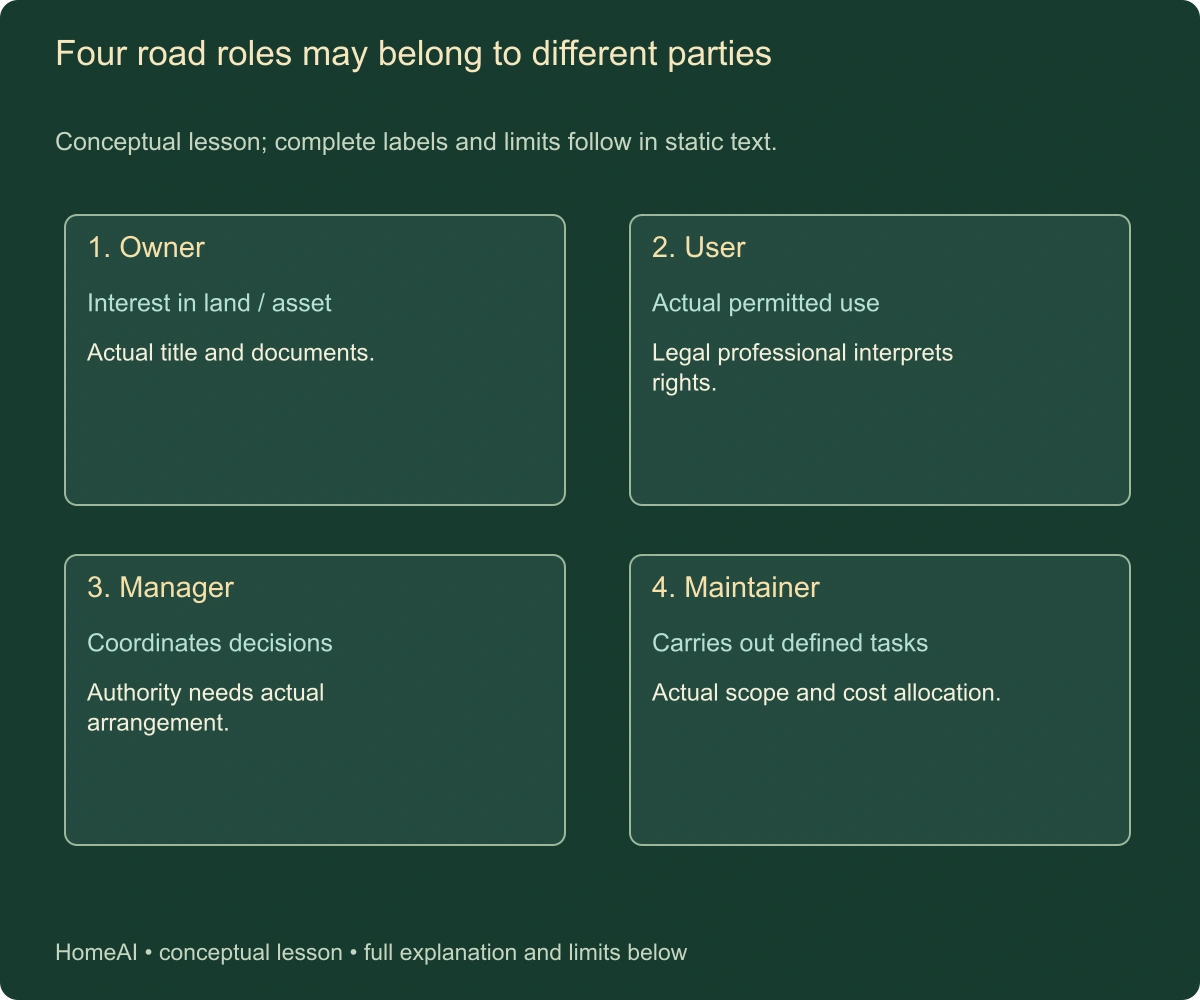
Four road roles may belong to different parties
Four neutral boxes show why a contractor invoice or helpful neighbour cannot identify every legal and operating role.
Numbers identify the parts explained below.
What does this illustration leave out?
No universal private-road duty or cost share. This illustration explains an idea. It is not an installation guide.
Which actual records and qualified advice answer this distinction?
Explore this with HomeAI ↗Opens an editable question. Nothing is sent until you choose to send it.Four road roles may belong to different parties
Conceptual lesson; complete labels and limits follow in static text.
- Owner
- Interest in land / asset. Actual title and documents.
- User
- Actual permitted use. Legal professional interprets rights.
- Manager
- Coordinates decisions. Authority needs actual arrangement.
- Maintainer
- Carries out defined tasks. Actual scope and cost allocation.
Four neutral boxes show why a contractor invoice or helpful neighbour cannot identify every legal and operating role.
What remains unknown: No universal private-road duty or cost share.
A useful question: Which actual records and qualified advice answer this distinction?
What does a maintenance agreement need to explain?
Ask the legal professional to explain the actual agreement's parties, affected land, tasks, cost allocation, access for work, decision process and treatment on a change of ownership. Do not assume an old document covers every current parcel or later subdivision. A signed page without its plans, schedules or amendments can leave the practical arrangement incomplete.
Maintenance should be described by function rather than a vague promise to keep the road good. Ask which party handles surface work, drainage components, vegetation, winter operations and any other identified asset. The answer depends on the actual system and documents. The guide supplies no universal maintenance duty or guaranteed standard of service.
Cost responsibility needs a separate explanation. Equal shares, use-based allocation and another method can produce different obligations; none should be assumed without the actual agreement and advice. Ask how quotations, approvals, invoices, reserves or arrears are handled if those features apply. A seller's current annual payment does not necessarily establish every future obligation.
Keep present practice beside the written arrangement. If the parties have been using a different allocation or contractor, ask how that difference is authorized and whether it has been formally recorded. The buyer needs to understand both the agreement and unresolved discrepancies rather than inherit an unexplained claim that everyone has always done it that way.
An agreement may refer to a plan or schedule that contains essential component and allocation information. Obtain the complete document rather than reading the signature page alone. Ask the legal professional about amendments and changes in participating properties. The practical task is to connect the parties, land, work and costs under the actual current arrangement.
What should winter access questions cover?
Winter operations concern the route the household actually depends on. Ask the responsible party for the current service arrangement, affected segments and communication process. A road cleared before a viewing provides an observation, not a promise about every future storm, response time or type of vehicle.
Identify household needs and obtain answers from the appropriate local service providers. Emergency access, deliveries, school transport, waste collection and moving vehicles may have different requirements or service boundaries. A neighbour's successful delivery does not establish that a particular provider serves every address throughout the year. Request confirmation suited to the actual property and planned use.
Ask about any gates, shared controls or restricted segments that affect authorized access. Keep operational information appropriately limited to the people who need it. A buyer should not test another owner's gate, copy an access device or enter a restricted route merely to resolve a question. The responsible parties can arrange an authorized explanation.
If a route is impassable or unsafe, follow current local instructions and obtain appropriate assistance. This guide does not prescribe towing, plowing, traction devices or improvised road work. The useful transaction record explains the actual winter arrangement and remaining uncertainties before a household relies on it for daily access.
Clarify which segment the winter contractor serves. The shared lane, individual driveway and public-road connection can be different tasks. A provider’s vehicle may also have requirements beyond ordinary household access. Ask that provider directly for the actual service boundary and retain its answer; a neighbour’s recollection should not become a guarantee for a new household.
What changes between ordinary access and seasonal maintenance planning
Winter gravel lane beside open wooden gate, snowbanks and homes; no service-level or legal-access proof.
Numbers identify the parts explained below.

What does this illustration leave out?
Conceptual generated context. No actual property, installed design, topology, measured performance, approval, ownership or responsibility established. This illustration explains an idea. It is not an installation guide.
What changes between ordinary access and seasonal maintenance planning?
Explore this with HomeAI ↗Opens an editable question. Nothing is sent until you choose to send it.What changes between ordinary access and seasonal maintenance planning
Winter gravel lane beside open wooden gate, snowbanks and homes; no service-level or legal-access proof.
What remains unknown: Conceptual generated context. No actual property, installed design, topology, measured performance, approval, ownership or responsibility established.
A useful question: What changes between ordinary access and seasonal maintenance planning?
Why do ditches and culverts need their own enquiry?
The road surface and its drainage components have different jobs. A route can appear smooth while a ditch, inlet or culvert still needs investigation. Conversely, water beside a road does not by itself establish a blockage or defective design. The relevant professional must identify the actual drainage system, outlet and condition.
Ontario's current private-drainage page distinguishes a roadside ditch built to drain a road from a municipal drain, even where the latter lies beside a road. It warns against assuming that an adjoining property's water can simply be directed into a roadside ditch. This named Ontario guidance supports identifying the actual drainage type and permissions, not applying Ontario's legal answer throughout Canada.
Ask which drainage components belong to the road arrangement and where water is intended to go. A ditch crossing a boundary may involve another owner's land, a municipal system or a natural watercourse. The physical route and the authorized outlet are related but distinct questions. A visible downstream connection does not prove permission, capacity or continuing maintenance access.
Do not clear, deepen, redirect or pipe a ditch, disturb a culvert or enter another parcel to investigate. Ontario's guidance explicitly directs owners toward legal and authorized drainage processes, and notes that environmental requirements can apply. The responsible professionals and authorities must establish the permissible scope for the actual site.
A drainage concern can affect both access and neighbouring land without belonging entirely to either road maintenance or the household’s landscaping. Ask who assesses the actual crossing and outlet and which permissions apply. This is especially useful when a proposal describes only clearing a ditch while the professional enquiry concerns a wider system.
What does Ontario's mutual-agreement-drain example teach?
Ontario's current mutual-agreement-drain page describes private drainage arrangements between two or more property owners and distinguishes them from municipal drains. The page is updated May 4, 2026 and contains an October 2022 fact-sheet edition statement. Its role here is a named example of how shared infrastructure needs defined location, users, responsibilities and records.
The guidance identifies design, route, parties using the system, construction and future maintenance cost shares, access, approvals and plans as matters the agreement addresses. It also distinguishes a registered arrangement from an unregistered agreement in its Ontario context. A lawyer must determine the effect of the actual document at a reader's property; this guide does not decide validity or enforceability.
The example is useful because technical and legal tasks meet at the same asset. A suitably designed drain still needs the applicable permissions and agreements. An agreement does not demonstrate the installed drain's condition or capacity. A record of construction does not explain every future access and maintenance obligation. Keep those answers connected without substituting one for another.
The Ontario source also explains that agreed responsibilities and access can become disputed and that obtaining necessary approvals remains important. The guide does not provide litigation instructions or advise a reader to convert a drain to another legal form. Its practical lesson is to obtain the complete actual arrangement and current specialist advice before relying on a shared outlet or commissioning changes.
The Ontario example must remain attached to its geography and actual legal arrangement. A similar-looking ditch elsewhere does not automatically have the same registration or enforcement treatment. The useful comparison is the set of questions about route, outlet, users, costs, access and approvals. The reader’s lawyer and technical advisers determine the local answer.
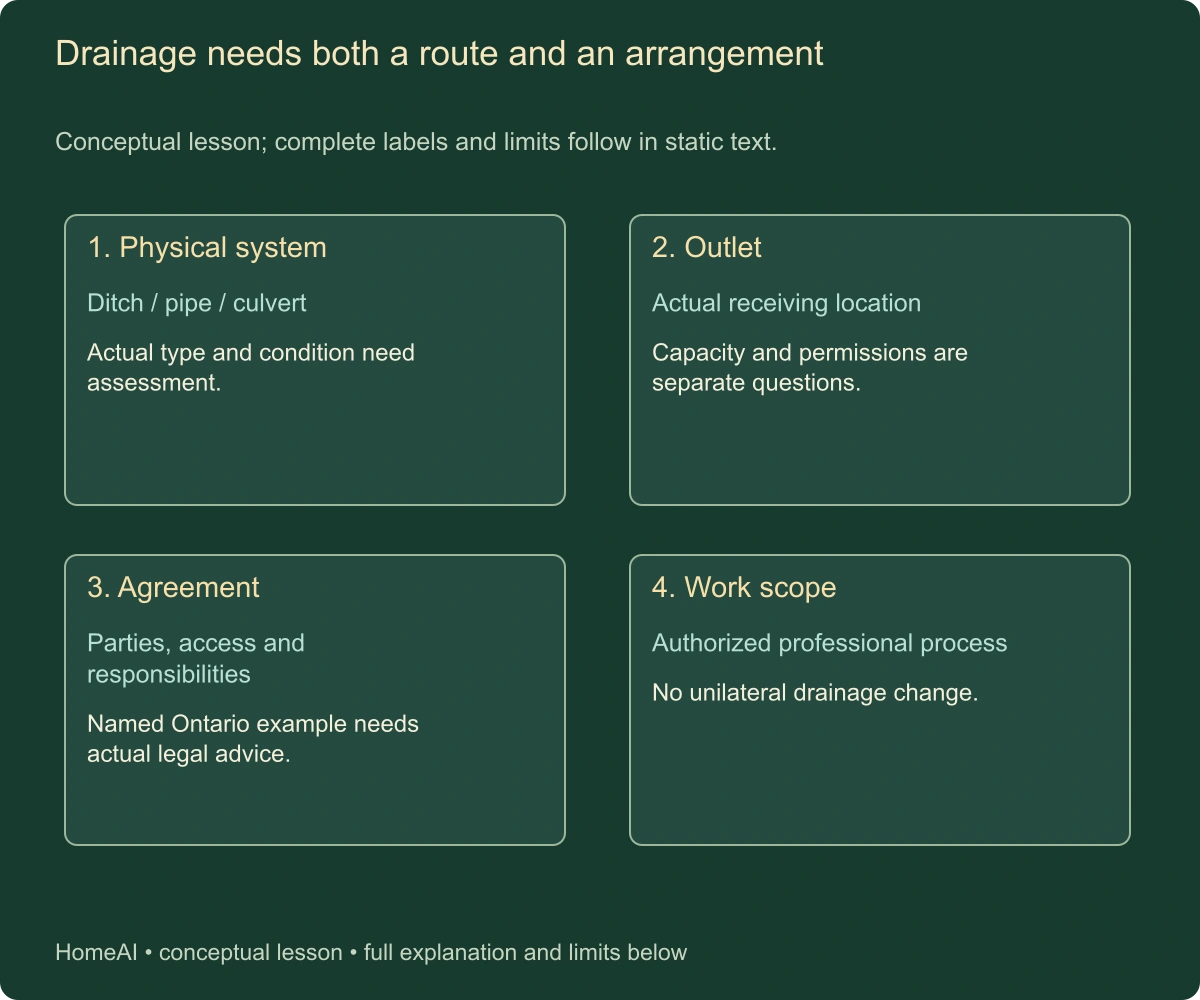
Drainage needs both a route and an arrangement
A physical outlet, agreement and assessed work scope answer different questions. The diagram supplies no pipe design or legal authorization.
Numbers identify the parts explained below.
What does this illustration leave out?
No drainage entitlement, sizing, capacity, construction instructions or nationwide rule. This illustration explains an idea. It is not an installation guide.
Which actual records and qualified advice answer this distinction?
Explore this with HomeAI ↗Opens an editable question. Nothing is sent until you choose to send it.Drainage needs both a route and an arrangement
Conceptual lesson; complete labels and limits follow in static text.
- Physical system
- Ditch / pipe / culvert. Actual type and condition need assessment.
- Outlet
- Actual receiving location. Capacity and permissions are separate questions.
- Agreement
- Parties, access and responsibilities. Named Ontario example needs actual legal advice.
- Work scope
- Authorized professional process. No unilateral drainage change.
A physical outlet, agreement and assessed work scope answer different questions. The diagram supplies no pipe design or legal authorization.
What remains unknown: No drainage entitlement, sizing, capacity, construction instructions or nationwide rule.
A useful question: Which actual records and qualified advice answer this distinction?
How can other services share the corridor?
A road corridor can contain or adjoin pipes, cables and related equipment. Each service can have its own provider, ownership boundary and access rights. A road-maintenance agreement should not be assumed to govern a water line or electrical installation merely because the assets lie near one another.
Ask the seller and relevant providers to identify the actual services used by the home and the responsible account and maintenance contacts. Request appropriate plans and agreements through authorized channels. A pipe visible near a ditch does not establish its contents, route or ownership. Keep covers closed and do not trace hidden services by excavation or improvised tests.
For each shared component, distinguish physical connection, authority to use it, service availability, condition and payment. A current bill can establish an account relationship without showing the condition of a buried line. A plan can show intended routing without establishing installed depth or later changes. A provider confirmation should state its own scope and date.
Ask how road work coordinates with affected services. A proposal to resurface or change drainage may require additional professional and provider involvement. The actual project team must identify relevant assets and safe work requirements. This guide supplies no digging procedure or universal clearance; the household's task is to obtain an authorized, complete scope.
Provider records and road records can use different maps and identifiers. Ask the appropriate parties to reconcile them where the proposed work depends on both. A drawn service line is not permission to excavate, and an access agreement is not a utility-location record. Keep authorized safe-work identification and the legal right to enter as separate requirements for the actual project.
Which shared equipment and access areas need identification
shared-lane context with houses and closed outbuilding, no anatomy or concealed services.
Numbers identify the parts explained below.

What does this illustration leave out?
Conceptual generated context. No actual property, installed design, topology, measured performance, approval, ownership or responsibility established. This illustration explains an idea. It is not an installation guide.
Which shared equipment and access areas need identification?
Explore this with HomeAI ↗Opens an editable question. Nothing is sent until you choose to send it.Which shared equipment and access areas need identification
shared-lane context with houses and closed outbuilding, no anatomy or concealed services.
What remains unknown: Conceptual generated context. No actual property, installed design, topology, measured performance, approval, ownership or responsibility established.
A useful question: Which shared equipment and access areas need identification?
How do routine bills differ from a major repair?
Routine invoices describe work already commissioned or a recurring arrangement. A major rehabilitation proposal concerns a larger scope and may have a separate approval and funding process. Ask which category the seller's payment represents. A modest current fee cannot establish that all foreseeable road, drainage or shared-service work has been funded.
Obtain dated scope and financial records for known proposed work. Ask what the estimate covers, which component is affected, whether assessment or design is complete, and what remains provisional. Keep proposed cost, approved commitment, collected funds and completed work distinct. A meeting discussion is not a contractor's quotation or proof that every owner has paid.
Compare alternatives on the same basis. Surface repair, drainage correction and wider reconstruction can address different needs. A qualified assessment should explain why an option is proposed and what it leaves unresolved. The guide supplies no cost per metre, remaining-life estimate or preferred material for a particular route.
If costs are shared, ask the legal professional how the actual allocation and collection arrangement applies to the transaction. A seller's statement that no assessment is expected is not the same as current records and advice. Record any unresolved scope, funding or responsibility question without turning uncertainty into an invented future charge.
Ask how a proposed major repair affects ordinary access while work occurs. A budget can provide money without establishing the traffic or resident-access plan. The actual contractor and responsible coordinator should explain the affected scope and communication. Retain that practical arrangement separately from the funding and professional completion evidence.
What happens when the arrangement changes?
A new parcel, building, service connection or use can change the questions surrounding a shared route. Ask whether the relevant agreements, plans and approvals address the actual present arrangement. An older list of participating properties should be reconciled with current legal descriptions and instruments by the appropriate professionals.
The buyer should also ask about proposed changes already known through authorized records. A contractor's concept, an owner discussion and an approved project are different stages. Keep dates and status visible. This guide does not determine whether another owner may intensify use, alter a route or extend a service under the actual legal arrangement.
For work affecting shared assets, ask who can authorize entry and alterations and which parties must be involved. An individual household should not assume that paying a share permits unilateral changes. The responsible legal, technical and provider advice needs to establish the process and scope before work proceeds.
After a completed change, request the updated documentation relevant to the asset: plans, agreement amendments, provider records and professional completion information where applicable. A new surface or pipe does not explain the revised rights and obligations. The handover record needs to connect what changed physically with the documents establishing the current arrangement.
Changes may also expose a difference between current use and the older document’s description. Record the discrepancy and obtain the appropriate legal or technical answer. Do not amend an agreement informally or assume that visible use settles the question. A buyer needs the actual status and advice before relying on a proposed new arrangement.
How does a driveway differ from an approach to a public road?
A home's driveway and the connection through a public-road corridor can have different boundaries. The driveway may lie on the private parcel, while the approach connects that parcel with the travelled road. The exact terms and responsibilities vary by location. Ask the municipality or road authority to identify the boundary for the actual entrance rather than assume that one contractor or landowner controls the whole route.
Rocky View County's current Driveways and Approaches page provides a named Alberta example. It distinguishes private-property driveways from approaches and identifies permission and inspection requirements for new or altered approaches. This guide uses the boundary distinction and need to consult the actual authority. It adopts no universal permit exemption, inspection-response period or cross-Canada requirement.
A shared lane can make the enquiry more complex because several parcels may rely on one public-road connection. Ask which agreement covers the common portion, which party handles the approach and how proposed changes are coordinated. A maintenance invoice for the lane does not necessarily include the culvert or entrance at the road authority's boundary.
For a proposed widening or alteration, request the actual scope and authority answer before work is commissioned. Surface changes, drainage and nearby utilities may require more than a household preference. The guide supplies no standard width, sightline, culvert size or construction detail. Those questions belong to the relevant designers, providers and local authority.
A buyer should also ask for records of known alterations and any unresolved approval or completion question. An entrance that is being used can still require documentary reconciliation. The professional enquiry must establish the actual status; the guide does not declare an existing approach unauthorized simply because a record is absent from the seller's first folder.
The useful outcome is a component-specific note: this section is the shared lane, this section is the driveway, and this connection is governed by the identified road-authority arrangement. Attach the actual plan or confirmation and keep uncertainties visible. That turns a vague question about who looks after the road into requests the responsible parties can answer.
What can a culvert assessment establish beyond a visible opening?
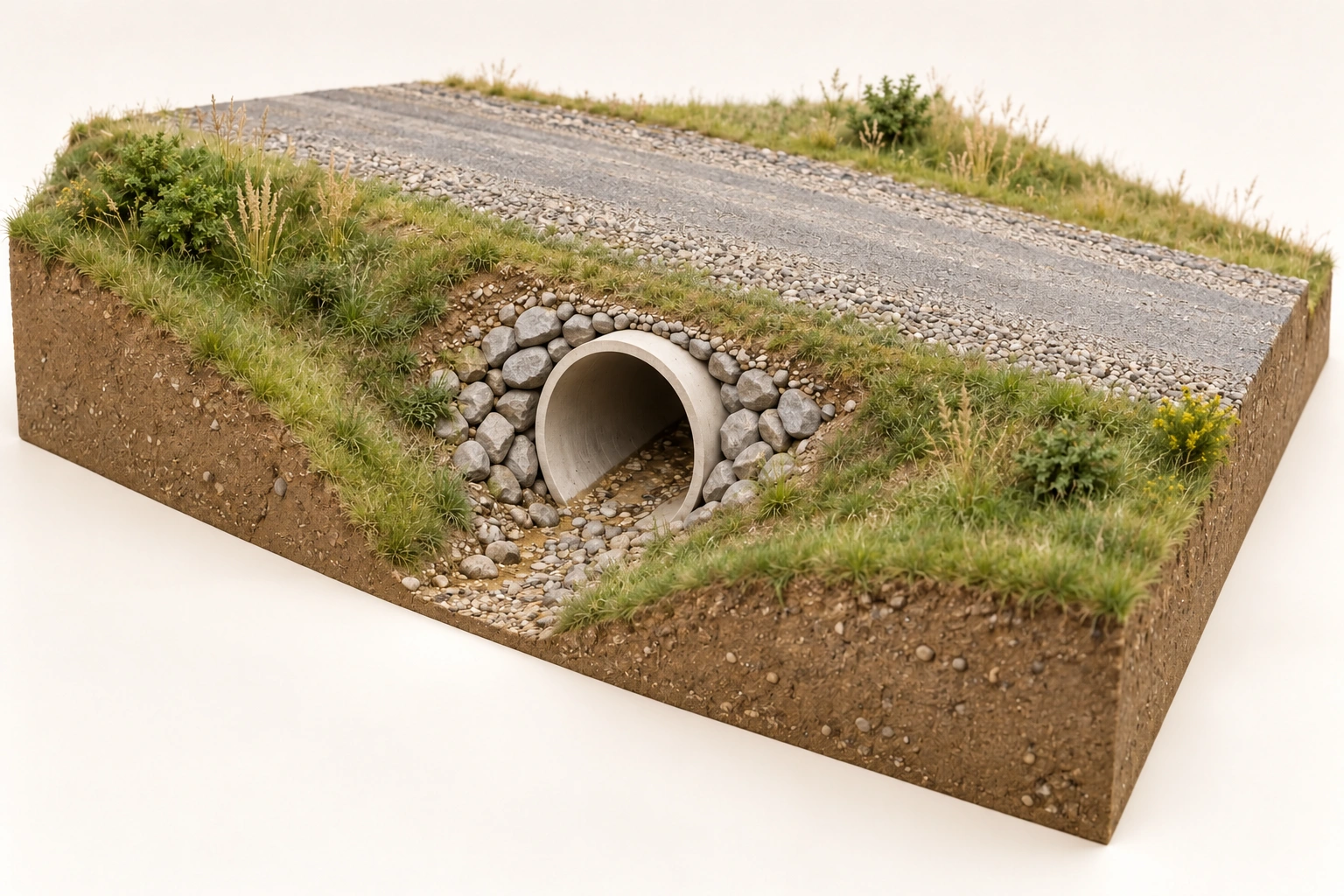
A culvert provides a passage for water beneath a road, approach or other crossing. Its opening is only the visible part of a wider drainage relationship. The route, outlet, surrounding conditions and actual structural state all matter to the relevant professional assessment. The single-mouth context illustration shows no hidden continuation, design capacity or permissible drainage change.
Rocky View County's complete current road-maintenance page explains the water-conveyance role of culverts and identifies blockage, deterioration and recurring flooding as reasons for inspection or further evaluation within its road program. That named local account supports reporting concerns to the responsible party. It is not proof that the County owns or maintains a private culvert at a reader's property.
Ask the assessor what area and circumstances the report covers. A visible opening can be clear while another portion remains unexamined. An observation made in dry weather may not settle the reported wet-weather concern. The report should distinguish visible facts, investigated condition, hydraulic or other specialist scope, limitations and recommended next work.
Ownership and condition remain separate. A well-maintained culvert does not establish a right to discharge water across another property. An agreement naming a drainage route does not establish that the installed crossing has the necessary condition or capacity. Obtain both the actual arrangement and the technical evidence appropriate to the question.
Where a repair or replacement is proposed, ask which associated work is included: authorized access, affected road surface, downstream or upstream interfaces, utility coordination, required approvals and reinstatement where relevant. These are scope questions, not a construction checklist for the household. A quote for a pipe alone may describe a different task from a complete crossing project.
Do not enter a culvert, probe an opening, remove debris, divert water or drive through a restricted crossing to test it. The responsible professionals determine access and safe investigation. A household can accurately report the observed location, time and concern from permitted safe space, then retain the actual findings and completion evidence once authorized work occurs.
Why can a road crossing and a drainage route need separate records
single culvert mouth beneath road; continuation hidden, no outlet/size/capacity or installed design.
Numbers identify the parts explained below.
What does this illustration leave out?
Conceptual generated context. No actual property, installed design, topology, measured performance, approval, ownership or responsibility established. This illustration explains an idea. It is not an installation guide.
Why can a road crossing and a drainage route need separate records?
Explore this with HomeAI ↗Opens an editable question. Nothing is sent until you choose to send it.Why can a road crossing and a drainage route need separate records
single culvert mouth beneath road; continuation hidden, no outlet/size/capacity or installed design.
What remains unknown: Conceptual generated context. No actual property, installed design, topology, measured performance, approval, ownership or responsibility established.
A useful question: Why can a road crossing and a drainage route need separate records?
What does a fictional shared-lane purchase show?
In this fictional rural purchase, Avery reaches the house along a lane used by several homes. The seller supplies a recent snow-clearing invoice and says the neighbours take care of everything. No actual parcel, association, agreement or road condition is represented. Avery separates the present route from the legal, maintenance and service questions.
The legal professional obtains the relevant title instruments and plans. The seller requests the current maintenance arrangement and known-work records from the authorized coordinator. A qualified professional addresses a reported culvert concern under a defined scope. Avery does not interpret an invoice as proof of access rights or a title entry as a culvert assessment.
Suppose the fictional file establishes the current routine contractor but leaves a major repair proposal unpriced. Avery records the unknown scope and funding separately from the confirmed routine invoice. The example supplies no repair amount or winning option. The household's decision depends on actual advice and records, not an invented universal annual road fee.
If the lane's legal corridor is not reconciled with the visible route, that remains a legal and survey hold. If a service provider has not confirmed year-round delivery, that is a service hold. If the contractor's report recommends further assessment, that is a technical hold. Distinct questions keep the next requests useful without assuming every missing item establishes a defect.
Avery asks which part of the recent invoice describes the shared lane and whether the entrance culvert appears in its scope. The fictional question does not invent a defect or unpaid bill. It clarifies that a useful routine maintenance record can still leave a separate component unresolved. The next request is tied to that specific gap.
What should a new owner's shared-services file contain?
Keep a clear map reference, current title and relevant instruments, complete agreements with plans and amendments, identified responsible parties, current service contacts and the authorized maintenance and financial records. Restrict personal account and access-control details appropriately. Ask the legal professional which documents should be retained for the actual ownership arrangement.
For known work, keep the investigation, approved scope, funding record, contractor documents and relevant completion evidence together. Identify what was performed and what remains outside the scope. A receipt can support payment without establishing the technical result or legal responsibility for future work. The record needs to answer those different questions explicitly.
A practical handover note can state that this route serves these properties under these identified documents, this party coordinates these tasks, these providers serve the home and these questions remain unresolved. Include dates and supporting references. Avoid a broad phrase such as private road included that hides the boundaries a household needs to understand.
Review the file when ownership, the route, a service or the maintenance arrangement changes. Preserve the earlier version beside the dated update rather than silently replacing the history. The useful outcome is continuing access and shared-service understanding supported by the actual documents and qualified advice, with the limits of each record left clear.
Preserve complete plans and location references beside the relevant reports. A future owner may otherwise know that work occurred without knowing which crossing or segment it concerned. A dated, traceable file helps the responsible parties find the right evidence when a new question arises. It still does not replace current advice where use, condition or the legal arrangement changes.
Keep learning about the connected parts
- Title, survey and physical property: reconcile the actual site
- Before you make an offer: what to check, who to ask
- Cash required for closing: deposit, advance, adjustments and deadlines
- Buying a home on leased land: identify the home, site and continuing rights
- Buying beside a lake, river or coast: connect the shore, parcel and whole property
- Buying a property with a detached workshop or outbuilding
Canadian context and authorities · Visual atlas · Learning labs
Practice the distinction.
What does a fictional shared-lane purchase show?
In this fictional rural purchase, Avery reaches the house along a lane used by several homes. The seller supplies a recent snow-clearing invoice and says the neighbours take care of everything. No actual parcel, association, agreement or road condition is represented. Avery separates the present route from the legal, maintenance and service questions.
Reported observations
- The legal professional obtains the relevant title instruments and plans. The seller requests the current maintenance arrangement and known-work records from the authorized coordinator. A qualified professional addresses a reported culvert concern under a defined scope. Avery does not interpret an invoice as proof of access rights or a title entry as a culvert assessment.
- Suppose the fictional file establishes the current routine contractor but leaves a major repair proposal unpriced. Avery records the unknown scope and funding separately from the confirmed routine invoice. The example supplies no repair amount or winning option. The household's decision depends on actual advice and records, not an invented universal annual road fee.
A useful next question
Avery asks which part of the recent invoice describes the shared lane and whether the entrance culvert appears in its scope. The fictional question does not invent a defect or unpaid bill. It clarifies that a useful routine maintenance record can still leave a separate component unresolved. The next request is tied to that specific gap.
Know what the words mean.
- Physical access
- A route that can actually be travelled at the observed time.
- Legal access
- The property-specific rights determined through actual documents and legal advice.
- Maintenance arrangement
- The actual tasks, authority and costs assigned to responsible parties.
- Roadside ditch
- A drainage feature serving the road; its legal type needs identification.
- Sufficient outlet
- The safe/legal drainage outlet described by the named Ontario guidance.
- Shared service
- Infrastructure or service used by more than one property under its own arrangement.
- Completion evidence
- Records connecting authorized scope with the actual performed work.
Questions to bring
to the conversation.
- Do the complete title instruments and plans connect this parcel to every segment of the route actually used?
- Who authorizes routine and major work, which assets and winter tasks are included, and how are costs and changes handled?
- What separate rights, condition assessments and provider arrangements support the culvert, drainage outlet, approach and shared services?
Separate a showing observation, an existing record and a new professional assessment. Unknown means a question remains; it does not automatically mean a defect.
Use the evidence planner ↗Go to the source.
Original HomeAI explanation informed by these public references. Sources support the underlying guidance; they have not reviewed or endorsed HomeAI. Diagrams are conceptual, and calculator outputs depend on your inputs.
Primary Canadian bodies read with the recorded editions and jurisdiction limits. Generic illustrations and fictional cases establish no actual result. Actual documents, provider terms and qualified advice control.
Publication & source review
First published .
Sources reviewed .
Have a question about your home?
Start with the symptom, timing and what you have observed.
Ask HomeAI