- Cold glass and indoor moisture work together to create condensation.
- Room-side droplets, fog between panes and rain-linked wetting need different questions.
- Use the dew-point calculator with the actual location and uncertainty of your observations.
- Recurring wet materials need attention to the source, even when one calculation looks reassuring.
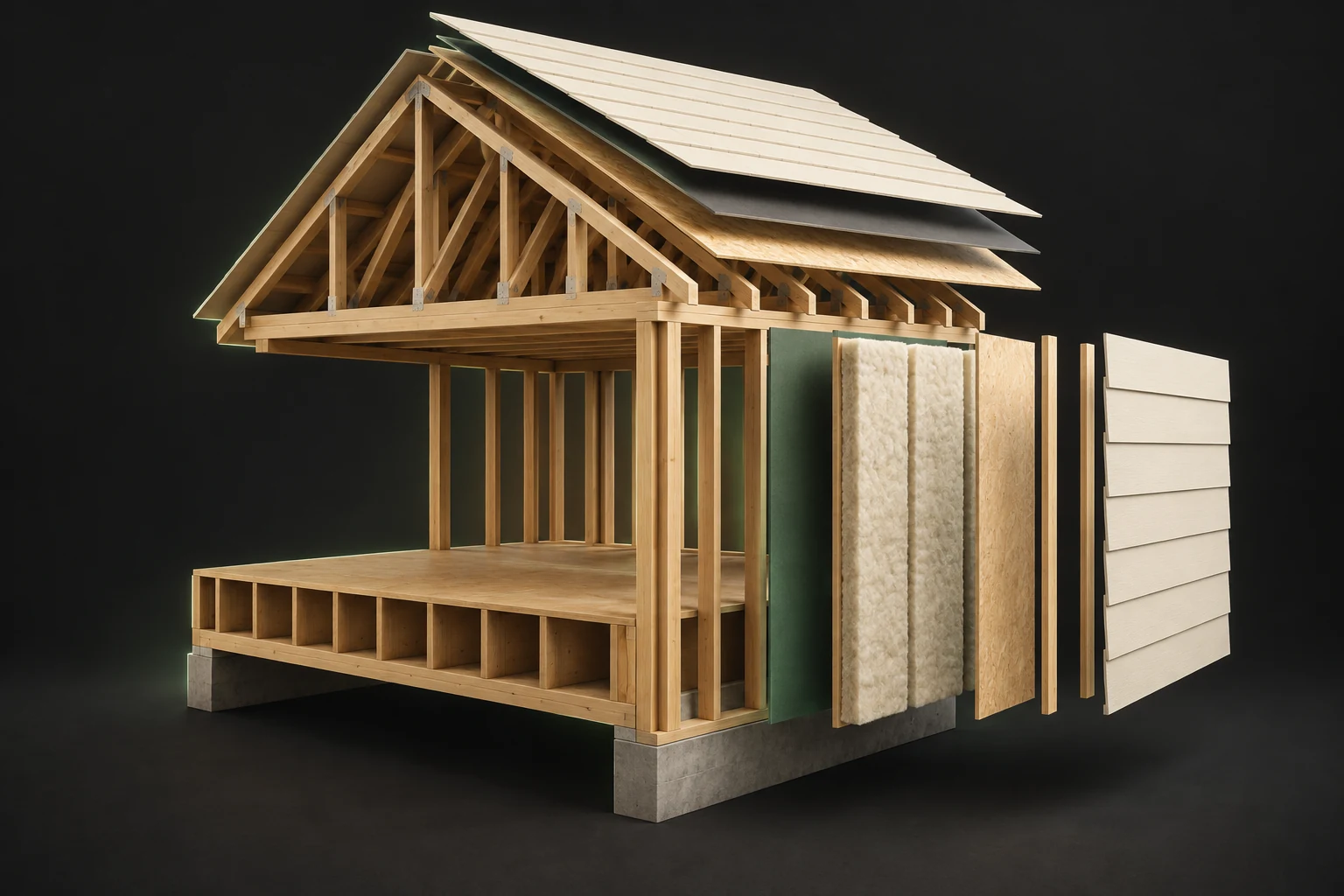
Conceptual architecture. Layout, sizes and routes are illustrative; the picture does not describe your home’s condition.
Explore this in the visual atlas ↗4 picture lessons appear beside the questions in this guide. Use them to understand the explanation, then consider what it means for your home.
Why does water collect on a cold window?
The water usually starts as invisible water vapour in the room. Cooking, showers, people and other moisture sources add vapour to indoor air. When that air meets cold glass, it cools. If the glass is cold enough, some of the vapour becomes liquid droplets on its surface. This is condensation: the same process that wets the outside of a cold drinking glass.
The dew point is the temperature at which the entered air conditions reach saturation. A window surface below that temperature can collect condensation. Relative humidity, or RH, tells you how close the air is to saturation at its current temperature. It is not a direct reading of how cold the window is. Two rooms with the same RH can therefore have different window problems.
Glass, frame edges and corners often get colder than the insulated wall beside them. The room may feel warm while one part of the window is cold enough to become wet. That gives you two useful questions: how much moisture is in the room air, and how cold is the affected surface? A wet window does not answer either question on its own.
Why warm rooms can have wet windows
The room is furnished and the garden is snowy. Drops sit on the room-facing glass: a useful way to picture indoor moisture meeting a colder surface.
Numbers identify the parts explained below.
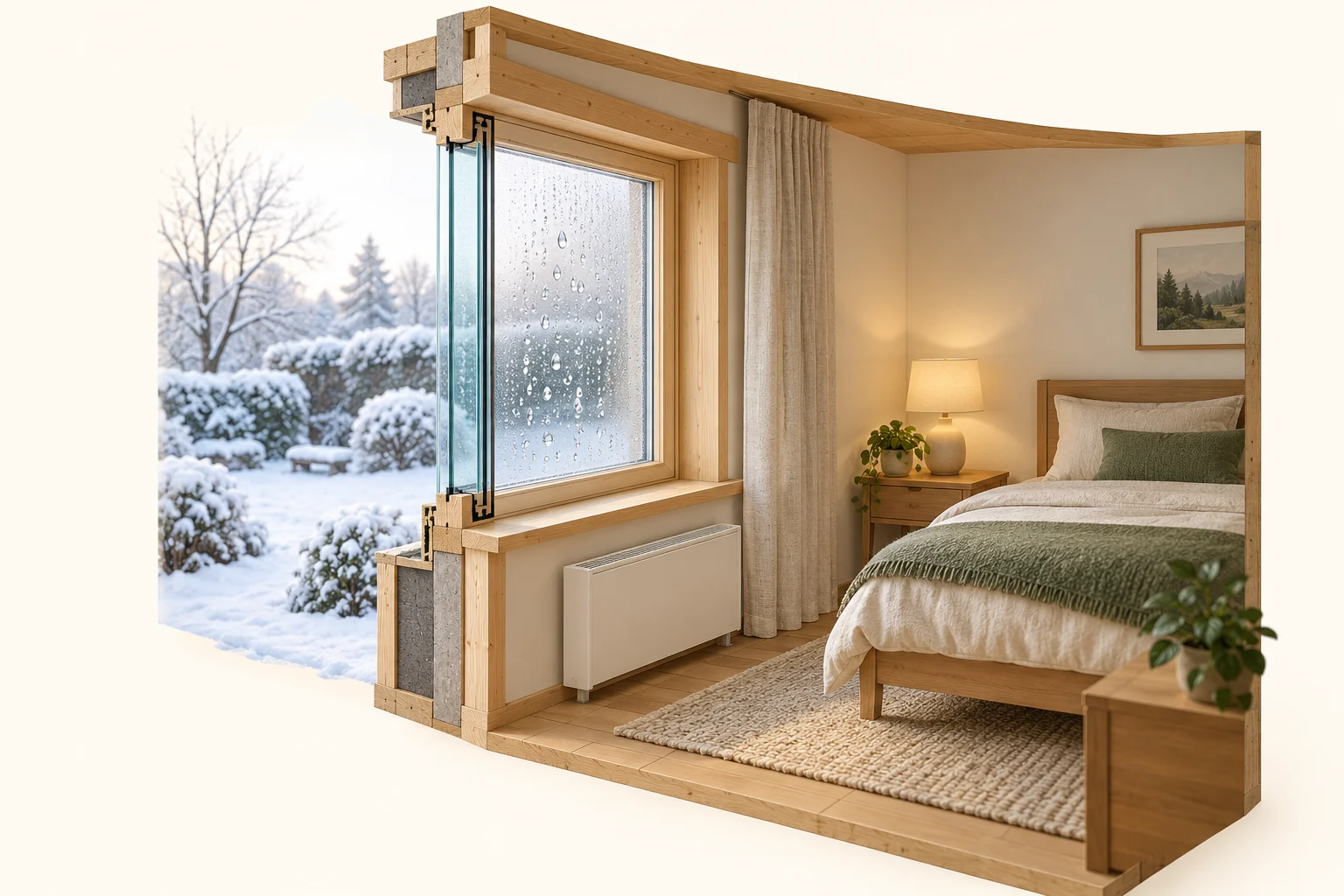
- Room-side glass
Water vapour can become droplets when the surface is below the dew point of the air beside it.
- Warm room, colder surface
Room comfort and glass temperature are different questions. A warm room can still have a cold glass edge.
- Winter context
Weather helps explain the pattern. This snowy illustration supplies no measured temperature or humidity.
What does this illustration leave out?
This invented room shows a mechanism, not a measured dew point, identified window fault or explanation of water inside a real wall. Use safe accessible observations; the cutaway is not a construction or test procedure.
Why is the room side of my window wet, and what should I note before replacing it?
Explore this with HomeAI ↗Opens an editable question. Nothing is sent until you choose to send it.Which side of the window is wet?
Start by locating the water from normal safe access. Droplets you can see on the room-facing glass point toward a relationship between indoor moisture and a cold surface. Fog trapped inside a sealed glazing unit raises a different question about that unit. Water at the frame or nearby wall after rain raises a water-entry question. These patterns can occur together, so keep their locations separate.
Glazing means the transparent part of a window, usually glass. A sealed double- or triple-glazed unit contains spaces between its panes. That is different from a separate storm window installed beside another window. NRCan explains that condensation inside a sealed unit and condensation between non-sealed or storm windows can have different causes. Identify the arrangement before calling every misted pane a failed seal.
A useful note might say: “Room-side drops at the lower glass edge on a cold morning; no rain overnight; the sill is wet.” A different note might say: “Stain beside the frame grew after wind-driven rain.” Neither diagnoses the hidden wall. The precise location, timing and weather help the right specialist decide what to investigate.
First ask where the water is
These three views separate room-facing glass, the glazing unit and the outside of a window. Water in different places can lead to different assessment questions.
Numbers identify the parts explained below.
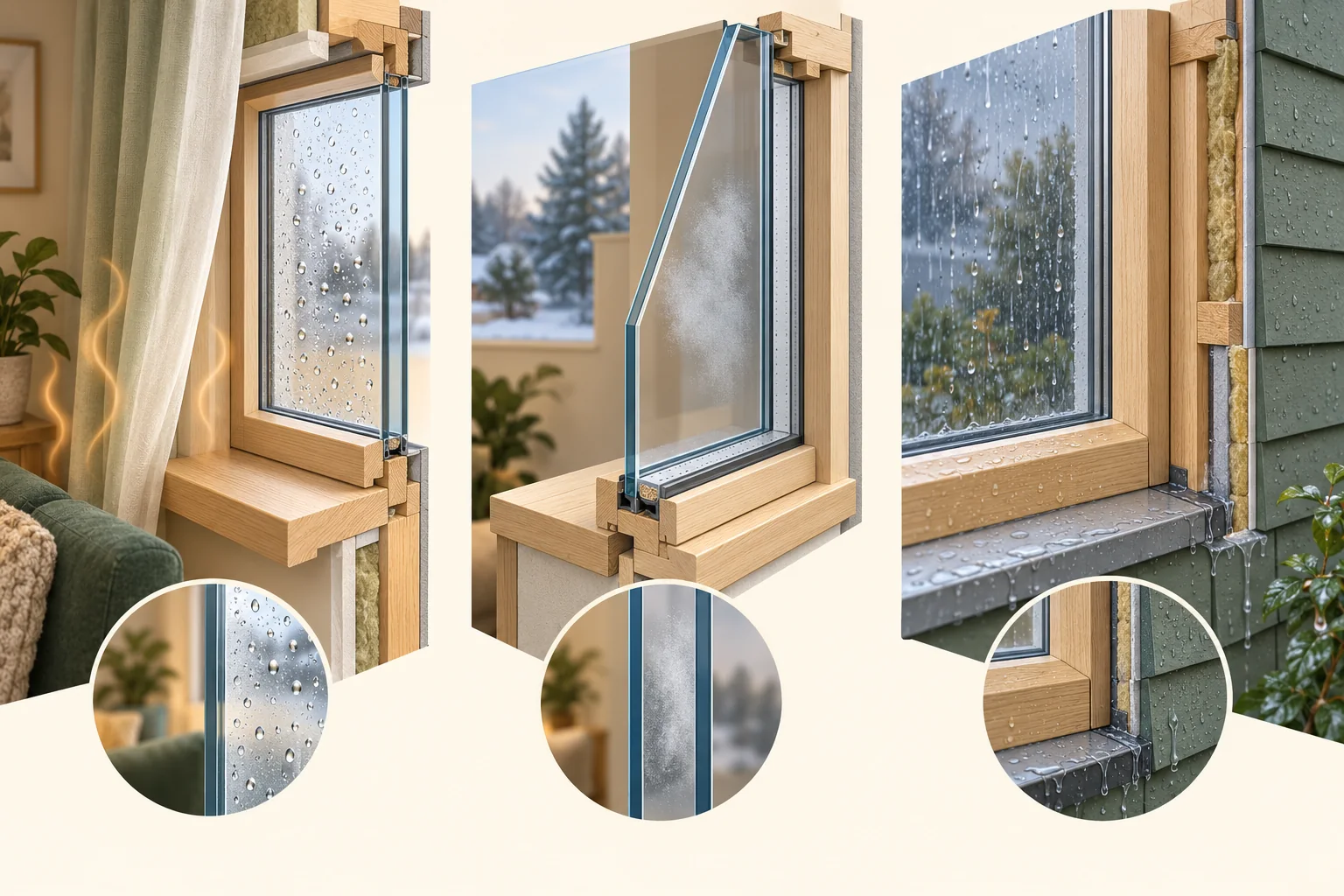
- Room-facing glass
Record where accessible drops appear and the conditions when they recur.
- Glazing spaces
Ask whether the actual window is a sealed unit or a separate storm-window arrangement before interpreting fog between panes.
- Frame and outside
Record water at the frame or nearby finishes and whether its timing follows rain. Exterior wetness alone does not identify its cause.
What does this illustration leave out?
The separated pane is a teaching display, not an opening instruction. The picture cannot distinguish condensation, rain or hidden damage in your home. Leave glazing and concealed layers intact; a qualified provider should investigate uncertain routes.
How do I tell room-side condensation from fog between panes or water around the frame?
Explore this with HomeAI ↗Opens an editable question. Nothing is sent until you choose to send it.Locate the water before choosing the explanation
- Room-facing glassConsider indoor moisture and the temperature of the affected surface.
- Inside a sealed glazing unitAsk a window specialist about the identified glazing unit; distinguish it from a storm-window arrangement.
- Frame or wall after rainAsk about water entry and affected materials rather than assuming indoor condensation.
Why is one window wetter than another?
The centre of the glass, its perimeter and the frame do not necessarily have the same temperature. Heat can leave through these parts at different rates. NRCan describes how the spacer between panes can contribute to edge heat loss. That helps explain why droplets may start along an edge even when the middle looks clear; it does not identify the spacer in your window.
Room layout matters too. Tightly closed blinds or heavy curtains can limit warm room air reaching the glass, leaving the space behind them colder. A blocked heating outlet or furniture arrangement can also affect air circulation nearby. Note the covering position and surrounding layout rather than assuming that the wettest window must be the worst product.
Air leakage at a joint, heat flow through the assembly and changing sun, wind or heating conditions can affect the pattern. A sensation of cold air is not enough to distinguish a leak from air cooling and moving beside the glass. If the pattern persists, ask for a window or building-envelope assessment that considers the actual assembly and room conditions.
Coverings change how room air reaches the glass
The open curtain leaves the window exposed to the room. The closed curtain separates the glass from much of that room-air movement.
Numbers identify the parts explained below.
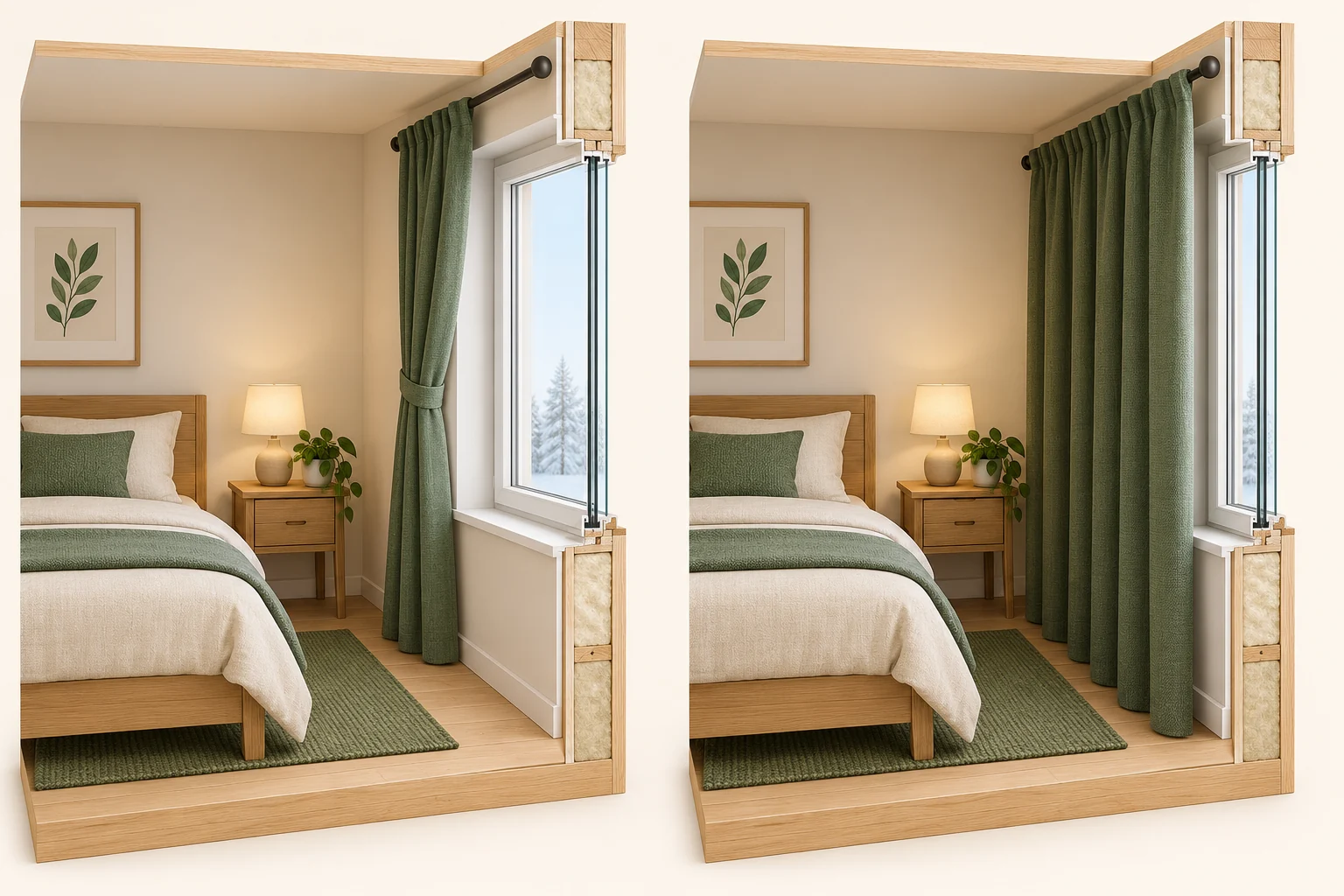
- Open covering
The room has a more open path to the glass. Keep surrounding heating outlets appropriately clear.
- Closed covering
The space behind a heavy covering can stay colder. Record covering position alongside a recurring moisture pattern.
What does this illustration leave out?
Neither room has measured airflow, temperature or humidity. This comparison does not guarantee that opening a curtain will solve recurring moisture or rule out a leak. Follow equipment instructions and seek an assessment for persistent wet materials.
Can closed blinds affect window condensation, and what else should I consider?
Explore this with HomeAI ↗Opens an editable question. Nothing is sent until you choose to send it.What can I change before replacing the window?
Begin with the moisture sources and existing ventilation. Use the bathroom exhaust during bathing and the vented kitchen hood during cooking as appropriate to their instructions. A qualified person can confirm an uncertain exhaust route; a fan noise alone does not prove that air goes outdoors. Note indoor clothes drying, leaks and humidifier use when discussing recurring moisture.
Allow warm room air to reach the window by keeping coverings and nearby heating outlets appropriately clear. Dry accessible wet glass, frames and sills so the water does not keep soaking adjacent finishes. These are ways to manage the visible moisture while its cause is understood. Recurring dampness, spreading stains or a persistent musty smell need prompt attention to the source, rather than repeated wiping alone.
There is no single humidity number that guarantees dry windows in every Canadian home. Outdoor cold, window performance and room conditions change the useful target. General moisture guidance and a cold-window assessment answer different questions. Ask a qualified professional about a suitable approach for the home, particularly before major air sealing, insulation or ventilation changes. Tighter replacement windows can change the moisture balance by reducing uncontrolled air leakage.
How do I use the dew-point calculator?
Enter room temperature in degrees Celsius and relative humidity in percent. The calculator uses the retained NOAA vapour-pressure formulation to estimate the dew point. Then enter a measured or assumed surface temperature. The surface margin is the surface temperature minus the dew point: a simple comparison between how cold the surface is and the temperature at which the entered air can condense.
For an illustrative room at 21°C and 45% RH, the calculated dew point is about 8.6°C. A surface entered at 7°C has a margin of about −1.6°C, so those simplified conditions support condensation. A surface entered at 12°C is above that dew point. These are model examples, not measurements of your glass, a replacement recommendation or proof that there is no simultaneous leak.
The graph changes humidity while holding room temperature constant. Use it to see the relationship: more moisture at the same room temperature raises the dew point; a colder entered surface leaves less margin. Keep the units and assumptions with any saved result. The graph does not predict every corner of a real window or establish what is wet inside the wall.
What the calculator result means
- Surface margin below zeroThe entered surface is below the calculated dew point, supporting condensation under those simplified conditions.
- Surface margin close to zeroMeasurement uncertainty and the exact glass location matter.
- Surface margin above zeroThe entered point is above dew point; other points or moisture routes remain separate questions.
How reliable are my temperature readings?
A hygrometer measures relative humidity; many also show room temperature. Its reading describes the air near that device. A surface measurement describes a particular point on the glass or frame. Record both locations and take related observations at roughly the same time. Comparing yesterday’s room reading with today’s edge temperature can create a convincing-looking calculation from mismatched conditions.
Infrared thermometer readings depend on the target surface and the device. For example, Fluke’s named 59 MAX / 59 MAX+ manual warns about inaccurate readings on reflective objects and lists material-dependent emissivity, the property describing how a surface emits infrared energy. That does not give every window a universal setting. Follow your actual instrument instructions and ask a qualified person to choose an appropriate method when a decision depends on the result. Do not invent a correction or treat the decimal display as proof of accuracy.
A reading near the calculated dew point deserves particular care. A small difference can fall within uncertainty in the observations, and the measured centre may be warmer than a wet edge. A short dated log of location, room readings, weather and covering position is useful context. Do not wait to finish a log if materials are staying wet or damage is spreading.
Room readings and glass readings describe different places
The room meter is away from the window. The marked glass locations are separate from that room-air reading, and the instrument displays are blank.
Numbers identify the parts explained below.
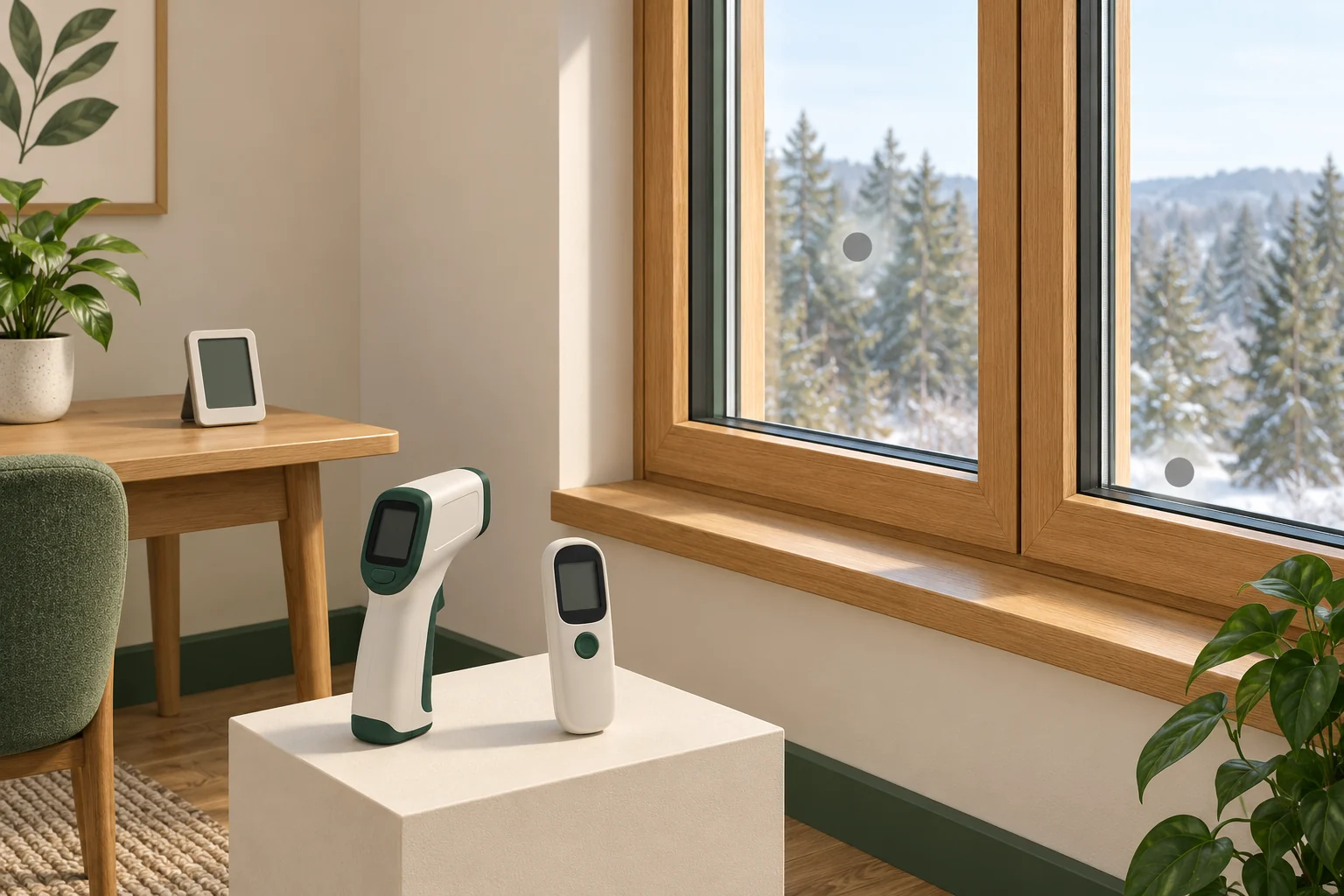
- Room-air reading
Note the sensor location, temperature, relative humidity and time. The reading describes nearby air.
- One glass point
A surface reading belongs to its measured location. It cannot describe every edge or corner.
- Another glass location
Use a method suited to the surface and actual instrument. Reflective glass can make infrared readings misleading.
What does this illustration leave out?
The props identify no instrument model or measurement result. The dots give no test method, numeric uncertainty allowance or universal glass setting. The instruments are unused illustrations; follow the actual manual and obtain qualified help when the decision depends on accuracy.
How should I compare room humidity with glass temperature when condensation readings are close?
Explore this with HomeAI ↗Opens an editable question. Nothing is sent until you choose to send it.What should a window or moisture assessment answer?
Tell the professional where the water appears, when it recurs and whether nearby finishes change. Ask which explanations the assessment will consider: room-side condensation, a sealed-glazing problem, rain entry or another moisture source. A window specialist may address glazing or hardware; a building-envelope or moisture professional may be needed for persistent wet materials and uncertain concealed paths.
Before accepting a proposal, ask what condition was identified and why the proposed work fits it. Replacing a glazing unit, improving air sealing, correcting water-entry details and managing indoor moisture are different scopes. The written findings should connect the observation to the work recommended, state areas that were not assessed and describe useful follow-up. A product brochure or clean photograph does not supply that connection.
Health Canada’s January 2023 moisture and mould guidance emphasizes solving the moisture source and seeking professional help where the source or required action is unclear, mould returns or hidden contamination is suspected. A photograph cannot establish mould species or personal health effects. Discuss health concerns with a healthcare professional. For a purchase or sale, retain the findings, work scope and dated completion records so the history is understandable.
What does a fictional borderline reading teach?
In this invented example, Priya sees drops along the lower edge of a bedroom window. The room sensor reads 21°C and 45% RH. She has one uncertain glass reading near 9°C, giving a calculated margin of roughly 0.4°C above the guide’s 8.6°C dew point. The small positive result describes that entered point; it cannot establish the temperature at the wet edge.
Priya records the location, timing, device and closed-blind position. She asks a qualified professional how to improve the observations and investigate the recurring wet sill. She does not decide that the entire window is defective, that every window needs replacing or that the positive number rules out water entry. The assessment should explain which moisture routes were actually considered.
Suppose the professional later recommends work with a stated reason and follow-up. Priya retains those findings alongside the original observations, and records later conditions without pretending the weather stayed identical. The improved file explains the decision and its limits. This fictional case includes no real inspection result, product diagnosis or promise that condensation can never return.
Keep learning about the connected parts
Condensation lab
Change room conditions. Watch the temperature margin change.
Surface margin = surface temperature − dew point
NOAA vapour-pressure formulation. Approximate scenario; reflective surfaces and instrument uncertainty matter.
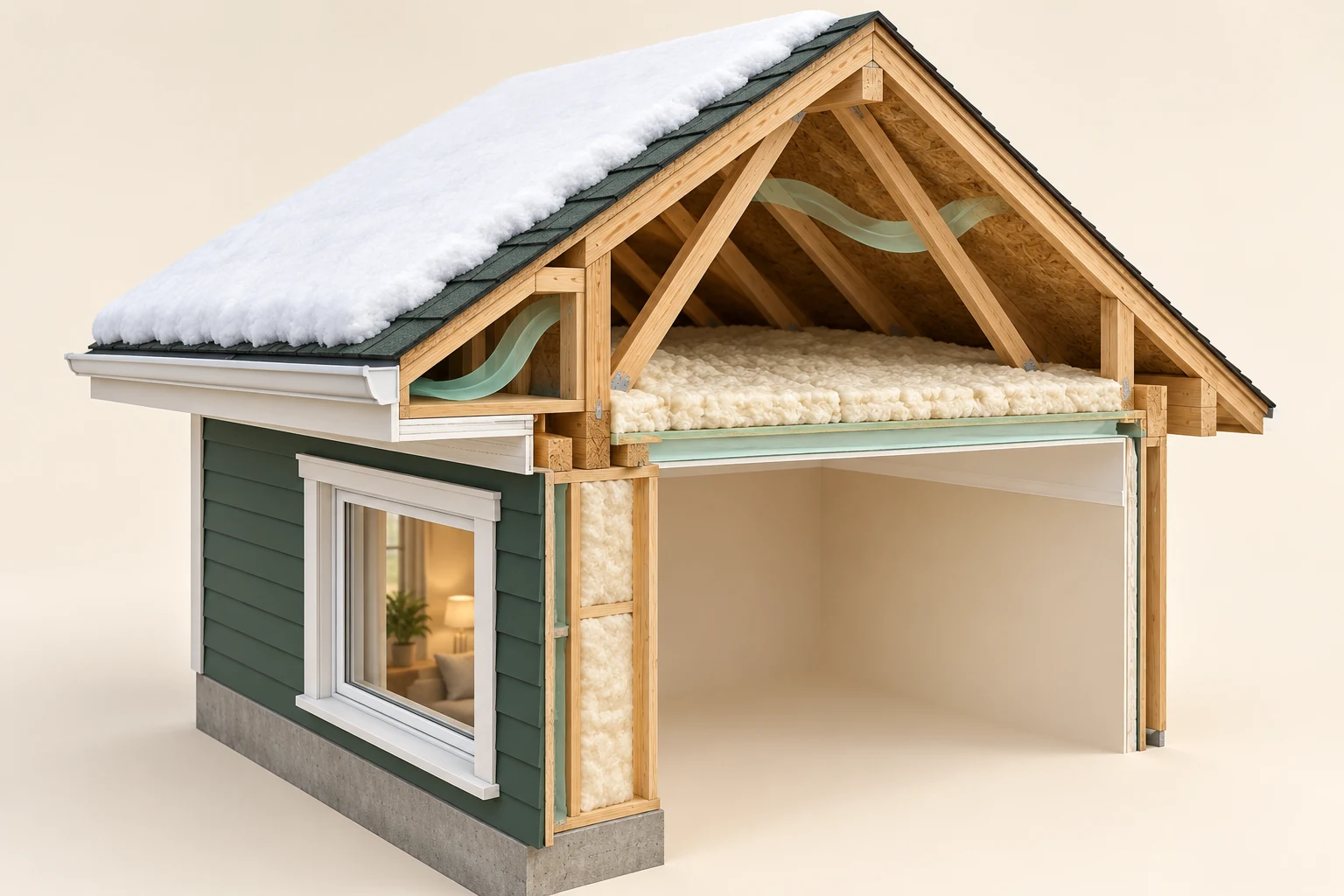
Roof, attic and window answer different questions.
Snow over one retained roof surface, with exposed timber framing and an attic volume below. A ceiling-level insulation layer, a thin mint layer and conceptual mint air ribbons. A window and a small wall-layer section below the attic.
The evidence the illustration cannot supply
Snow weight, structural loading, roof capacity and the cause of any real ice or water problem. Actual air leakage, ventilation, insulation continuity and condensation conditions. The suitability of this illustrative layer arrangement for a particular building. This is a separate conceptual teaching house, not another view of a surveyed property.
Practice the distinction.
Priya’s wet edge and almost-positive reading
Fictional learning scenario: Priya sees room-side drops at a lower glass edge while one uncertain glass reading is near the calculated dew point.
Reported observations
- The room sensor reads 21°C and 45% RH; its location and timing are recorded.
- One glass point reads roughly 9°C, while the wet edge has not been reliably measured.
- The blind was closed; the recurring wet sill still needs attention.
Compare the explanations
Expand each possibility to see the evidence needed to distinguish it. Similar symptoms can have different mechanisms.
The wet edge is colder than the measured point
The centre or another point may not describe the surface where the drops appear.
An appropriate surface assessment with room conditions and locations recorded.
Another moisture route also needs investigation
The small calculated margin does not rule out a leak or explain persistent damp finishes.
A scoped assessment of the moisture source and affected materials.
A useful next question
Ask a qualified professional to improve the observations and explain which assessment will address the recurring wet sill.
This invented example includes no actual inspection result. The calculator describes entered conditions at a point, not the entire window or concealed wall.
Know what the words mean.
- Surface margin
- The entered surface temperature minus the calculated dew point. It helps compare a particular surface with conditions that can support condensation.
- Input uncertainty
- How much confidence you can place in the observations entered, including the device, location, timing and measurement method.
Questions to bring
to the conversation.
- Which side of the glass or frame is wet?
- What were the weather, room conditions and covering position?
- Where and when were the air and surface readings taken?
- What identified condition does the proposed work address?
- Which areas or moisture routes were left unassessed?
Separate a showing observation, an existing record and a new professional assessment. Unknown means a question remains; it does not automatically mean a defect.
Use the evidence planner ↗Go to the source.
Original HomeAI explanation informed by these public references. Sources support the underlying guidance; they have not reviewed or endorsed HomeAI. Diagrams are conceptual, and calculator outputs depend on your inputs.
References read for this guide on October 5, 2026. The NOAA formulation supports the entered calculator scenario. The named Fluke manual is an instrument example, not a universal glass-measurement setting or a window-assessment standard.
Publication & source review
First published .
Sources reviewed .
- Natural Resources Canada · How your house works
- NOAA · Dew point from relative humidity
- CMHC · Mould in housing
- Natural Resources Canada · Windows and exterior doors
- Health Canada · Addressing indoor moisture and mould
- Fluke · 59 MAX / 59 MAX+ infrared thermometer user manual
Where this reference applies
Jurisdiction: Manufacturer instrument example; international manual with Canadian support contact, not a window-assessment standard
Edition: Visible PN 4311999, March 2013. Current official PDF observed October 5, 2026; HTTP Last-Modified June 23, 2021 is server metadata.
Reading scope: Complete English extraction across all 22 PDF pages personally read. Source figure pixels have not been inspected.
Surface infrared measurement, reflective-target warning, nominal material-dependent emissivity and separate accuracy/display resolution. No window-specific emissivity setting, taped-target workaround, laser-use procedure, inferred instrument identity or numeric accuracy allowance is adopted.
Have a question about your home?
Start with the symptom, timing and what you have observed.
Ask HomeAI